
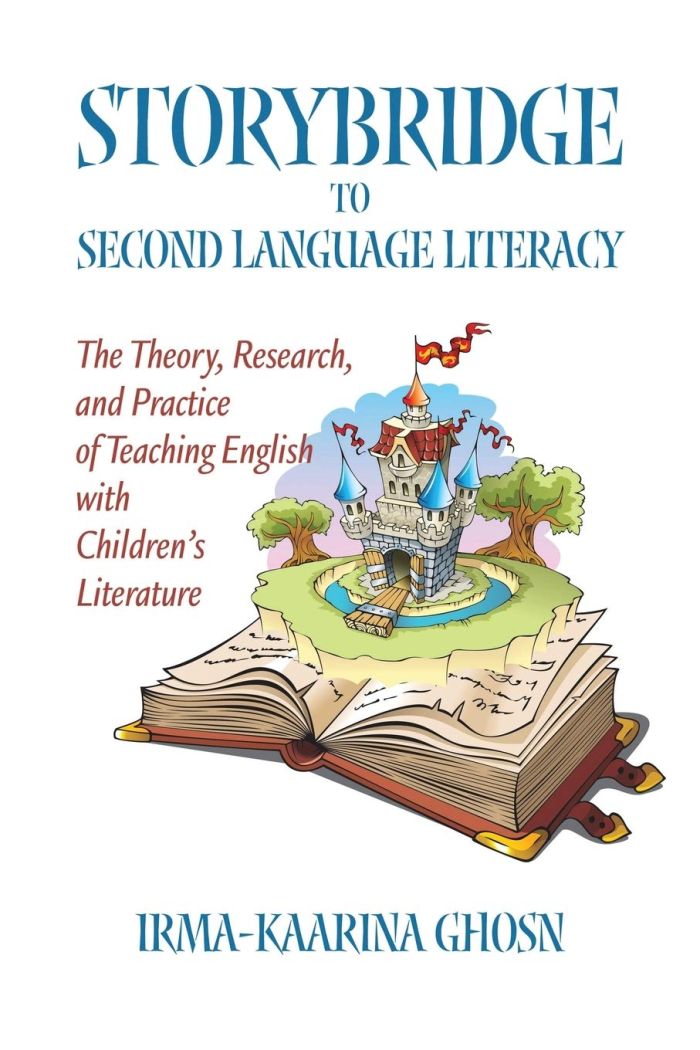
Storybridge to Second Language Literacy
The Theory, Research and Practice of Teaching English with Children's Literature

This book can be opened with

Note on our eBooks and Audiobooks: you can read our eBooks (ePUB or PDF) and listen to audiobooks on the free Emerald Books app on iOS, Android, and desktop. Or read and listen on Emerald's online reader (ePUB eBooks and audiobooks only). To purchase a digital book you will need to create an account if you don’t already have one. After purchasing you will receive instructions on how to get started.
- Description
- Contents
Storybridge to Second Language Literacy makes a case for using authentic children’s literature—alternately also referred to as ‘stories’ or ‘real books’—as the medium of instruction in teaching English to young learners, particularly in contexts where children must access general curriculum subjects in English. The author first proposes theoretical foundations for the argument that illustrated children’s books are superior to traditional language teaching courses in the primary school. She builds the case around the motivational power of stories, the language and content of quality children’s literature, and the potential of literature to contribute to development of second language academic literacy. She then reviews research of the past thirty years that clearly supports her claim. Finally, she uses transcripts from real classrooms to illustrate how teachers in diverse contexts make use of stories. Through the classroom vignettes, a practical model of literature-based instruction emerges that is adaptable to a wide range of primary school teaching contexts, including English as a second language contexts in core-English countries.
Storybridge to Second Language Literacy compiles in one volume solid theoretical foundations for story-based instruction, research evidence of the past thirty years supporting the approach (not currently available in a single source), and extensive classroom vignettes illustrating diverse practical applications (not lesson plans).This makes the book valuable for anyone in the field of young learner ELT.
MA students in TESOL will find the book useful and will develop an understanding of why and how literature-based instruction works and develop insight to guide their practice. Members of TESOL Elementary Education, EFL, and Bilingual Education SIGs, and IATEFL Young Learner SIG will be interested in the volume. Instructors of teacher development courses should also find the proposed volume a valuable addition to assigned readings. Each chapter is followed by ‘Think about it’ questions and ‘Try it out’ suggestions.
Acknowledgments
- Preface
- Introduction
- Part I. The Case: Theoretical Foundations for Literature-Based Instruction
- Chapter 1. Significance of Literature for Children
- Chapter 2. Coursebook Language versus Language of Stories
- Chapter 3. Literature as Appropriate Content and Context
- Chapter 4. Literature Link to School Subjects
- Chapter 5. Interest, Memory, and Language Learning: Exploring the Connections
- Part II. Expert Testimony: Research in Support of Literature-Based Instruction
- Chapter 6. Talking like Texts or Talking about Texts?
- Chapter 7. Literature and Second Language Reading Development
- Chapter 8. Vocabulary from Stories
- Chapter 9. Learning Grammar from Stories
- Chapter 10. Waiting from Reading
- Chapter 11. Literature and School Subjects: Emerging Evidence
- Part III. Eyewitness Accounts: One Story, Different Paths
- Chapter 12. Preparing for the Story Journey
- Chapter 13. The Story Experience
- Chapter 14. Revisiting the Story World
- Chapter 15. Linking the Story to Subject Matter
- Part IV. Closing Summations
- Chapter 16. Summary in Defense of Authentic Children's Literature in Primary School ELT
- Chapter 17. Selecting Books for Language Teaching
- References