
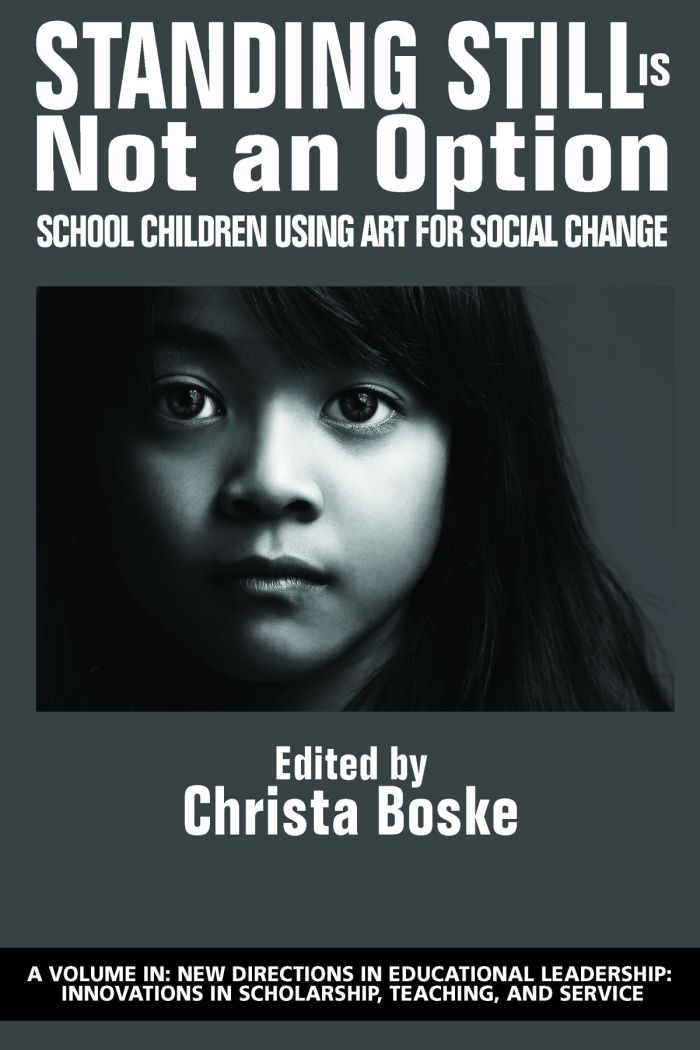
Standing Still Is Not an Option
School Children Using Art for Social Change

This book can be opened with

Note on our eBooks and Audiobooks: you can read our eBooks (ePUB or PDF) and listen to audiobooks on the free Emerald Books app on iOS, Android, and desktop. Or read and listen on Emerald's online reader (ePUB eBooks and audiobooks only). To purchase a digital book you will need to create an account if you don’t already have one. After purchasing you will receive instructions on how to get started.
- Description
- Contents
This book captures the experiences of children in U.S. public schools and how they utilize artmaking to disrupt injustices they face. These first-time authors, who represent school children, parents, teachers, and community leaders, focus on artmaking for social change. Their first-tellings provide thought-provoking insights regarding the impact of artmaking on their capacity to promote social justice-oriented work in K-12 school communities.
As the U.S. continues to experience significant demographic shifts, including increases of homeless children, children identified with learning differences, thousands of refugees and immigrants, children living in poverty, children in foster care, and increasing numbers of Children of Color, those who work in schools will need to know how to address disparities facing these underserved communities. These U.S. demographic shifts and issues facing underserved populations provide opportunities for children, teachers, families, and school leaders to deepen their understanding regarding their experiences within their communities and K-12 schools as well as ways to interrupt oppressive practices and policies they face every day through art as social action.
Authors call upon decision-makers who serve children from disenfranchised populations to utilize artmaking to create equal access for children to explore social justice, equity, reflective practices, and promote authentic social action and change through artmaking. Authors reflect on this artmaking process as a catalyst for increasing consciousness, creating imaginative possibilities, and facilitating meaningful change in schools. Authors urge readers to create equal access art spaces to build bridges among schools, families, and communities. Together, they contend that artmaking promotes courageous conversations and encourages the exploration of what it means to live this significant work.
Dedication.
- Endorsements.
- Chapter 1. Artmaking for Social Justice: Unforeseen Passion for Possibilities; Christa Boske.
- Section I. Youth Voices.
- Chapter 2. Be Free; Leonard Joshua Jackson.
- Chapter 3. I Embody My Art; Angely Boske.
- Chapter 4. Capital B; Hunter Zachariah Smith.
- Chapter 5. Es El Mundo (The World Is Mine); Shannon Vickers.
- Chapter 6. Black and Bold; Josiah Tate.
- Chapter 7. WomanUp; Abigail Hornacek.
- Chapter 8. De-Evolution of Humanity: Stop and Think Before You Speak; Jihad I. Ruffin.
- Chapter 9. Two Birds, One Cage; Bryianna Davis.
- Chapter 10. Telekinesis; A.
- Chapter 11. My Art is My History of My Life; L.
- Section II. Adult Responses.
- Chapter 12. A Father's Perspective; Leonard Jackson.
- Chapter 13. He Is My Stone; Charles Rainey.
- Chapter 14. Leadership Is Not a Title, It's an Action: Using Artmaking to Lead for Social Justice with Young Black Men in K-12 Schools; Leshun Collins.
- Chapter 15. As a Father, My Heart Aches; Shannon Vickers, S.R.
- Chapter 16. Artmaking for Social Change: Concluding Thoughts; Christa Boske.
- Biographies.