
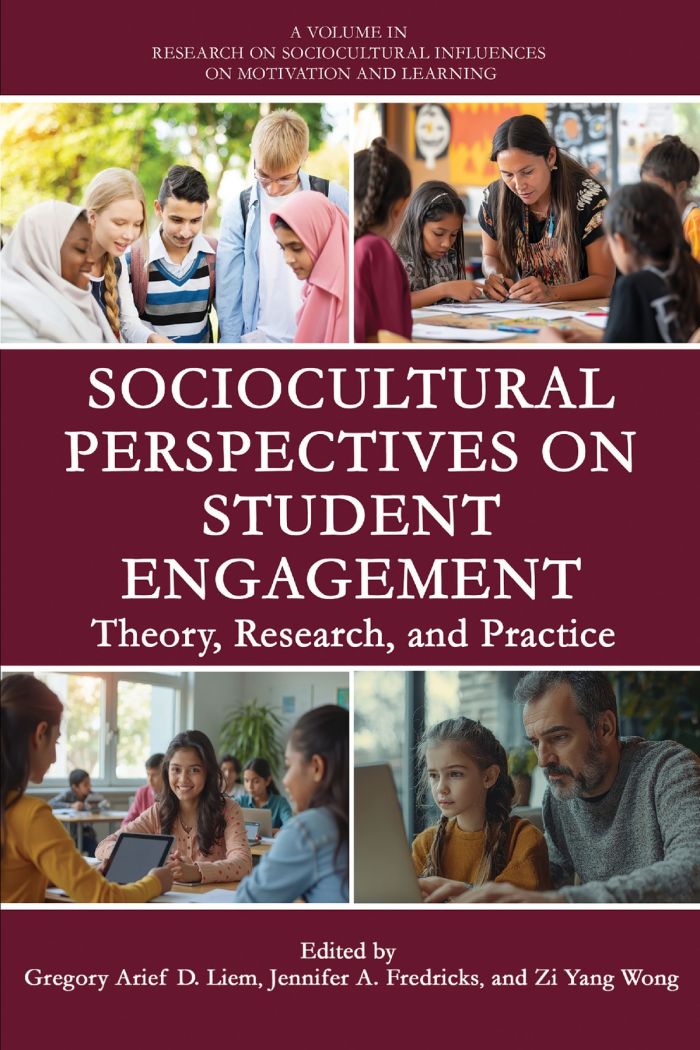

Sociocultural Perspectives on Student Engagement
Theory, Research, and Practice

This book can be opened with

Note on our eBooks and Audiobooks: you can read our eBooks (ePUB or PDF) and listen to audiobooks on the free Emerald Books app on iOS, Android, and desktop. Or read and listen on Emerald's online reader (ePUB eBooks and audiobooks only). To purchase a digital book you will need to create an account if you don’t already have one. After purchasing you will receive instructions on how to get started.
- Description
- Contents
- About
The concepts of student motivation and student engagement have emerged from related but distinct fields of study. Contemporary scholars suggest that student engagement is shaped by various sociocultural, contextual, and personal factors (including motivation), and that it serves as a pathway to various positive student outcomes (e.g., academic achievement, well-being). Given its significance, there is growing global interest among researchers, policymakers, and practitioners (teachers, interventionists, parents) in understanding how engagement can be promoted in schools, at home, or in other settings. That said, much of the research on student engagement has been conducted in WEIRD (Western, Educated, Industrialized, Rich and Democratic) contexts, leaving us with limited knowledge about generalizability of extant student engagement models on students from non-WEIRD backgrounds.
To address this gap, we invited experts in various areas of student engagement to critically examine their theoretical and empirical works through a sociocultural lens and consider the implications for future research and practice. Contributors of this volume have offered novel models for understanding how sociocultural contexts and backgrounds (e.g., ethnicity, socioeconomic status, immigrant status, relationships) and socioculturally learned attributes (e.g., cultural beliefs, values, and practices) shape student engagement in different settings (e.g., online, classroom, out-of-school time programs). Additionally, they provided insights on practical and methodological issues that both researchers and practitioners should be mindful of. This volume highlights the need to critically consider both the cultural specificity and universality of student engagement processes and discusses ways to promote engagement across diverse sociocultural contexts and student populations.
Chapter 1. Sociocultural Perspectives on Student Engagement: Recent Advances and New Insights; Gregory Arief D. Liem, Jennifer A. Fredricks, and, Zi Yang Wong
- Chapter 2. How Do Macrosystem Forces Shape the Development of Student Motivation and Engagement? Stratified Niches, Proximal Processes, and Exosystem Entry Points; Ellen A. Skinner and Thomas A. Kindermann
- Chapter 3. From Research to Practice: Applying the Development-in- Sociocultural-Context Model of Student Engagement; Ming-Te Wang, Christina L. Scanlon, and James P. Huguley
- Chapter 4. School Dropout Process From a Sociocultural Lens: A Life-Course Engagement-Resilience Model for Immigrant- Background Students; Isabelle Archambault, Véronique Dupéré, Sophie Pascal, Kristel Tardif-Grenier, and Michel Janosz
- Chapter 5. The Academic and Cultural Demands-Resources (ACD-R) Framework: A Lens for Understanding and Supporting Immigrant Students’ Academic Development; Andrew J. Martin, Rebecca J. Collie, and Jeremy Pan
- Chapter 6. The Study Demands-Resources Model of Student Engagement and Burnout: The Role of Personal and Contextual Factors; Katja Upadyaya and Katariina Salmela-Aro
- Chapter 7. Cracking the Engagement Enigma: Decoding the Multifaceted Sociocultural Influences on Student Engagement in Digital Learning; Nina Bergdahl, Melissa Bond, and Alice Brown
- Chapter 8. Sociocultural Influences on Flow in Schools; David J. Shernoff and Janine Bempechat
- Chapter 9. Sociocultural Forces That Encourage and Restrict Students’ Agentic Engagement; Hyungshim Jang and Johnmarshall Reeve
- Chapter 10. Mapping Belonging: A Sociocultural and Socioecological Approach Within Educational Contexts; Kelly-Ann Allen, Margaret L. Kern, Geetanjali Basarkod, Ebony Melzak, Rhea Jain, and Christopher Boyle
- Chapter 11. Student Momentary Engagement in the Life Course: A Sociocultural Developmental Perspective; Jennifer E. Symonds, Benjamin M. Torsney, Ioannis Katsantonis, Natassa Kyriakopoulou, and Jonathan Smith
- Chapter 12. Parent Socialization of Student Engagement: The Role of Culture, Ethnicity, and Socioeconomic Status; Jennifer A. Fredricks
- Chapter 13. Teacher Influences on Student Engagement: Integrating the Classic, the Current, and the Cultural; Gregory Arief D. Liem
- Chapter 14. Types of Peers and Sociocultural Contexts Matter: The Influence of Peers on Student Engagement in Learning Activities; Zi Yang Wong
- Chapter 15. Critical Racial Third Spaces: Attending to Racialized Realities to Honor Student Engagement; Crystal J. Charity, Rolonda L. Payne, Rossina Zamora Liu, and Claudia L. Galindo
- Chapter 16. A Stridently Situative Approach to Inclusive Engagement and Assessment; Daniel T. Hickey, Charmian Lam, and Qianxu (Morgan) Luo
- Chapter 17. Moving Beyond the School Day: Sociocultural Considerations for Out-of-School Engagement; Ashlee L. Sjogren and Nancy L. Deutsch
- Chapter 18. Cross-Cultural Measurement of Student Engagement: The Psychometric Properties of the Student Engagement Instrument (SEI); Amy L. Reschly and James J. Appleton
- Chapter 19. What Have We Learned About Culture and Engagement and Where Do We Go From Here? A Commentary; Jennifer A. Fredricks, Gregory Arief D. Liem, and Zi Yang Wong
Gregory Arief D. Liem is an Associate Professor in the Department of Psychology and Child and Human Development, at the National Institute of Education, Nanyang Technological University, Singapore.
Jennifer A. Fredricks is a professor of Psychology at Union College, USA, where she previously served as the Dean of Academic Departments and Programs.
Zi Yang Wong is a Research Fellow from the Psychology and Child and Human Development Department, National Institute of Education, Nanyang Technological University, Singapore.