
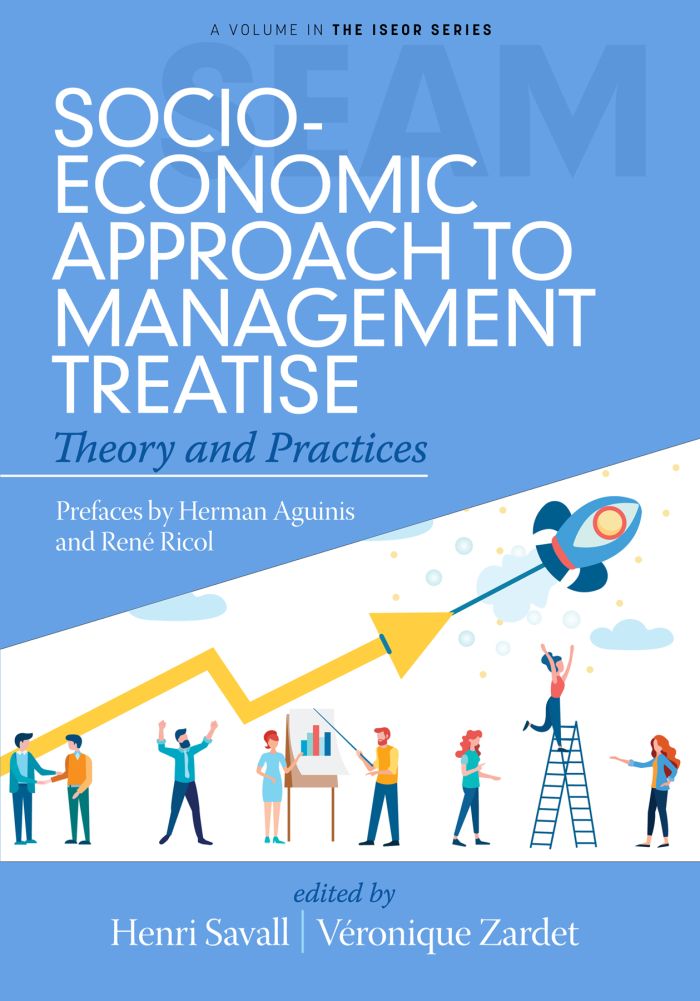
Socio-Economic Approach to Management Treatise
Theory and Practices

This book can be opened with

Note on our eBooks and Audiobooks: you can read our eBooks (ePUB or PDF) and listen to audiobooks on the free Emerald Books app on iOS, Android, and desktop. Or read and listen on Emerald's online reader (ePUB eBooks and audiobooks only). To purchase a digital book you will need to create an account if you don’t already have one. After purchasing you will receive instructions on how to get started.
- Description
- Contents
The result of half a century of research and experimentation in economics and management, this Treatise is intended for management practitioners. Socio-economic management (SEAM) makes the demands of humanism in professional life and sustainable economic prosperity compatible. It is illustrated with numerous cases from 2,150 companies and organizations from a wide variety of sectors and presents observed and measured results. Most of these chapters are written jointly by managers or executives of companies and organizations, and scholars or consultants involved in the pilot actions.
This book is the work of 193 authors, from 16 countries and 4 continents, practitioners or academics in management sciences and management. This reflects the diversity of national and sectoral contexts of SEAM applications. Some chapters situate this concept in relation to the major currents of current thought. Each chapter is preceded by abstracts in French, English and Spanish. The prefaces, signed by Herman Aguinis and Rene Ricol, show the scope of socio-economic theory and management beyond the borders of the company. The book illustrates the international influence (48 countries) of the innovative and robust methods created and developed by the ISEOR team.
Socio-economic theory constitutes a "breakthrough innovation", both in terms of its conceptual contribution and the practical methods and tools of its applications. This holistic approach touches on the different functions of the company and its multiple problems. It provides a structured change management method, focused on stimulating Human Potential and on self-financing the development of the company or organization, through the periodic recycling of hidden costs.
Prefaces; Herman Aguinis and René Ricol.
- Acknowledgments.
- Foreword to the English Edition.
- Part I: Socio-Economic Management: Purpose And Applications.
- Chapter 1. Updated Synthesis of the Socio-Economic Theory and of the Socio-Economic Approach to Management (SEAM); Henri Savall and Véronique Zardet.
- Part II: The Organization Of The Iseor Research Center, Pivot Of An International Network (Capitalization, Validation, And Diffusion Of Scientific And Practical Knowledge In Management).
- Chapter 2. Junior Intervener-Researchers at the ISEOR Research Center: Discovery and Integration Process; Pierrick Govart and Suzon Roche.
- Chapter 3. A Tamed Digitalization Process to Support the Development of the Socio-Economic Approach to Management; Nouria Harbi, Henri Savall, Véronique Zardet, and Ridha Ziani.
- Chapter 4. Executive Education Seminars: A Scientific and Pedagogical System Complementary to Intervention-Research; Véronique Zardet and Karile Morel.
- Chapter 5. Consolidating Intervention-Research Through Communication and Dissemination Mechanisms: Annual Conferences and the Journal Recherches en Sciences de Gestion—Management Sciences—Ciencias de Gestión; Véronique Zardet and Michelle Bonnard.
- Chapter 6. The Socio-Economic Approach to Management (SEAM): A Fruitful Theory and Method—Contributions to the Collective Work and Specificities of Doctoral Theses; Alexis Roche.
- Chapter 7. The Henri Savall-Iseor Foundation; Michel Grivel and René Charmasson.
- Chapter 8. School of Thought in the Humanities and Social Sciences and More Specifically in Economics and Management: Application to the ISEOR Research Center; Roland Pérez.
- Part III: Stimulating The Development Of SMES, Very Small- And Medium-sized Enterprises (Business Creation, Family Business, Cultural ...).
- Chapter 9. The Restaurant That Didn't Exist Yet; Barbara Filippazzo.
- Chapter 10. The Creation of Sustainable Enterprises: Contributions of the Socio-Economic Approach to Management (SEAM); Christophe Combaudon and Helga Fouré-Joopen.
- Chapter 11. Internal Stucturing and External Development: The Challenges of the Second Generation of a Family; François Filippazzo.
- Chapter 12. Learning to Be a Leader; Julien Vinay, Muriel Legendre, Laura Bondin, and Olivier Voyant.
- Chapter 13. Survival-Development of Very Small Enterprises (VSE): Support for VSE Managers; Gérard Desmaison and Thomas Rouveure.
- Chapter 14. Organizational Decoding in the 21st Century; María Elizabeth Canllo de Montoto and Juan Matías Montoto Canllo.
- Chapter 15. Earning More by Working Better is Feasible; Laurent Paysac, Bertrand Paysac, and Mélissa Sanchez.
- Chapter 16. How to Professionalize Managerial Practices in Family Businesses;Éric Pernoud, Gilles Pernoud, and Françoise Goter.
- Chapter 17. From a Small Traditional Company to an International Group: Structuring the Growth of the Aganova Group; María Ángeles Rastrollo Horrillo, Marisa Rastrollo Horrillo, and Agustín Ramírez García.
- Chapter 18. SEAM in Cross-Cultural Context; Omaya Kuran, Dolly Bassil, and Lara Khabbaz.
- Chapter 19. From the Artist-Director to the Director-Artist: The Case of Very Small Performing Art Organizations in France; Isabelle Horvath and Caroline Adoumbou.
- Chapter 20. Development of Managerial Skills and Sustainable Performance of Small Businesses in the Liberal Professions; Renaud Petit and Véronique Zardet.
- Chapter 21. Management and Training of French Notaires: Results of 20 Years of Transformation of a Profession; Xavier Daudé and Laurent Cappelletti.
- Part IV: Supporting The Development Of Mid-sized And Large Companies.
- Chapter 22. Nearly 40 Years of Socio-Economic Approach to Management: Lessons Learned Regarding the Notion of Dynamic Equilibrium; Pascal Pasquier and Amandine Savall.
- Chapter 23. Professionalization of a Family Business Trhough Human Support in Order to Sustain Value Creation; Victor Frontera and Victor Caumeil.
- Chapter 24. Independent Leadership and Shared Governance; Jean Claude Pénicaud-Tesson, Mireille Tesson-Pénicaud, and Yann Goudy.
- Chapter 25. Mastering Growth While Sustaining Both Profitability and Human Potential: The Successful Challenge of an Agro-Industrial SME in Mexico; Isaac Sanchez, Arturo Guerrero Lizardi, and Véronique Zardet.
- Chapter 26. How to Succeed a Post-Downsizing Large-Scale Economic Recovery; Françoise Goter.
- Chapter 27. An Original and Evaluated Experiment to Stimulate the Sustainable Development of Socio-Economic Productivity; Philippe Lacroix, Frantz Datry, and Rodolphe Bachaud.
- Chapter 28. Learning From the Implementation of the Socio-Economic Approach to Management at La Poste; Joseph Gauchard.
- Chapter 29. Developing Organization Agility; Thomas G. Cummings, Christopher G. Worley, and Rickie Moore.
- Chapter 30. Contextualizing SEAM in the Broad Milieu of Consulting Methodologies; Eric J. Sanders and Tonya L. Henderson.
- Part V: Leading Public And Para-public Service Organizations: Health, Education, Local Authorities, Etc.
- Chapter 31. Socially Responsible Policies Do Exist; Pierre-Alain Raphan.
- Chapter 32. The Socio-Economic Approach to Management and Hospital Organizations; Anne Thiébaut-Bertrand and Denis Fière.
- Chapter 33. Complexity, Magical Thinking, and SEAM; John Conbere, Alla Heorhiadi, and Dave Dobosenski.
- Chapter 34. Improving Managerial Skills Through the Implementation of the Socio-Economic Approach to Management: An Approach for the Survival and Development of the Hospital; Patrick Tabchoury, Donabelle Zakkour, and Rocks Mazraani.
- Chapter 35. Interaction Between Regulation and Organization: The Case of the Hospital System; Frédéric Kletz and Jean-Claude Moisdon.
- Chapter 36. The Socio-Economic Improvement Project: A Source of Quality and Performance in Hospitals; Chantal Thouverez.
- Chapter 37. Ramping Up Public Policies: The Case of the General Labor Inspectorate in Angola; Kianvu Tamo.
- Chapter 38. How to Involve Employees to Write the History of the Company; Norbert Deville and Olivier Voyant.
- Chapter 39. Necessary Communication-Coordination-Cooperation to Fight Against the Blockages of Locked Organizations: Cases of Hospitals; Isabelle Barth and Marc Frachette.
- Chapter 40. Listening and Mediation as a Lever for Transforming a Conflictual State Into a Cooperative State; Laurent Bertrand and Renaud Petit.
- Chapter 41. Modernizing the Associative Model in the Medico-Social Sector in France; Frédéric Gloro and Denis Hamayon.
- Chapter 42. The Socio-Economic Drive to Transformation From Non-Governmental Organization Into Social Enterprise; Pierre El Haddad and Rana Barazi.
- Chapter 43. SEAM in America: Cultural Compatibility for Teaching and Diffusion; Yue Cai Hillon, Debra Salsi, and Mark E. Hillon.
- Chapter 44. Long-Term Organizational Change Processes in Mexico; Martha M. Fernández Ruvalcaba and Graciela Carrillo González.
- Chapter 45. Evolution of Business School's Business Model; Gilles Guyot and Marc Bonnet.
- Chapter 46. Changes in the Environment of Universities Impact in Their Strategy: Towards a Paradigm Shift? Claude Jameux.
- Chapter 47. Knowing and Being Able to Build One's Path in an Increasingly Complex and Uncertain World: The Challenge of Knowing How to Become; Paul Rousset and Michel Grivel.
- Chapter 48. Enhancing the Managerial Impact of Management Research Towards Doctoral Training in Management Associating Academics and Practitioners; Michel Kalika, Jérôme Chabanne-Rive, and Marc Bonnet.
- Chapter 49. Socio-Economic Theory at the Heart of Student Entrepreneurship Support; Sylvie Mira-Bonnardel and Isabelle Géniaux.
- Chapter 50. The Role of Management Schools in Accompanying the Transformation of a Profession and Society; Marc Bonnet and Réda Gourine.
- Chapter 51. Contribution of the Socio-Economic Approach to Management to Steering Action Plans in a Changing World; Samia Khenniche and Sébastien Podevyn-Menant.
- Chapter 52. Local Authorities and Monitoring; Philippe Sauvannet and Marie-Christine Chalus-Sauvannet.
- Chapter 53. An Original Experiment in Evaluating the Impacts of Networking Through Socio-Economic Analysis: Case of the Lyon Health and City Workshops; Pascal Brenot and Michaël Baska.
- Chapter 54. Strategic Planning and Change Management in Public Organizations: Integration of Socio-Economic Tools in Belgian Local Governments; Henri Talaszka and Xavier Pierre.
- Chapter 55. Strategic Development and Implementation: Managing Rythms and Relationships With Time—Case of a Congregation; François Du Penhoat and Maïté Rateau.
- Part VI: Socio-economic Strategies: Organizational Development, Corporate Social Responsibility, Tetranormalization, Business Transfers, Mergers And Acquisitions ...
- Chapter 56. SEAM as an Organization Development Intervention: Fifty Years of Common Ground; Peter F. Sorensen and Therese F. Yaeger.
- Chapter 57. A Powerful Organization Development Resource That Remains Overlooked; Joanne C. Preston.
- Chapter 58. Organizational Theory Early Developments: Locating the Seeds of Socio-Economic Approach to Management (SEAM); Richard Baker and Bruno Cohanier.
- Chapter 59. Negotiated Commitment: A Key to Continous Improvement in the Chinese Companies That Have Adopted LEAN Management; Jean Ruffier and Ziyuan Tang.
- Chapter 60. The Impact of Socio-Economic Intervention on the Development of Ambition and Strategic Implementation in a Medium Size and in a Small Company; Jérémy Salmeron and Carole Bousquet.
- Chapter 61. The Technord Group: An Industrial Adventure and Advanced Social Responsibility; Michel Foucart.
- Chapter 62. Corporate Citizenship: A Common Good and the Search for Sustainable Performance; Christophe Fargier and Frantz Datry.
- Chapter 63. Pro-Actively Reacting to the Tetranormalized Business Environment: Cases of a Lebanese Bank and a Small Family Insurance Brokerage Firm; Jocelyne B. Eid and George N. EL-Rahbani.
- Chapter 64. Rigor and Relevance of Responsible Strategic Management: Contributions of the Socio-Economic Theory; Alexandre Asselineau.
- Chapter 65. Impact of the Socio-Economic Model: On Corporate Social Responsibility; Eva Conraud Koellner and Martha Ríos Manríquez.
- Chapter 66. Towards a General Model of Hidden Costs Integrating Ecological Issues; Stéphane Trébucq and Jocelyn Husser.
- Chapter 67. From the Territory as a Territory of Standards to ISO Standards Without Territories; Yvon Pesqueux and Benoît Pigé.
- Chapter 68. The Management of Normative Inflation by Control and Management Functions: Case of the French Financial Sector; Nicolas Dufour and Imen Abdou.
- Chapter 69. Digital Transformation: The Human-Digital Competitiveness (HDC) - Framework From Technological Determinism to a Socio-Economic Perspective; Emmanuel Monod.
- Chapter 70. Managerial Engineering at the Service of Vision-Robotics; Amandine Savall, Hervé Henry, and Nylème Chettih.
- Chapter 71. SEAM's Role in Merger and Acquisition Integration; Anthony F. Buono.
- Chapter 72. Considerations on the Socio-Economic Approach to Management in the Context of a Merger Between Two Competitors; Jean Caghassi.
- Chapter 73. International Communication in an Intercultural Environment—Illustrations; Jeannette Rencoret and Georges Peillon.
- Part VII: Socio-economic Management Of Human Resources And Human Potential.
- Chapter 74. The Socio-Economic Approach to Management: A Metaphor From the Panarchy; Pedro Constantino Solís Pérez and Juan Castaingts Teillery.
- Chapter 75. Crossed Reflections on Transdisciplinarity in Maritime Expeditions: Entrepreneurship and Crew Spirit; Serge Péron.
- Chapter 76. Giving Meaning to Work and Reducing Psychosocial Risks; Nathalie Ombelets and Sandra Fattorutto.
- Chapter 77. How to Contribute to the Development of Managerial Skills in SMEs; Sébastien Payre and Aline Scouarnec.
- Chapter 78. Recycling Hidden Costs: Importance of the Serial Learner; Jean-Marie Peretti and Soufyane Frimousse.
- Chapter 79. Contribution of the Socio-Economic Approach to Management (Seam) to the Renewal of the Territorial Human Resource Management Model (HRM); Anne Loubès and Florence Noguera.
- Chapter 80. Exploration of Convergence and Normative Articulation in the Field of Professional Training; Arnaud Muret.
- Part VIII: Socio-economic Management Control.
- Chapter 81. Overcoming the Poverty of Conventional Management Control Philosophy Through SEAM; R. Murray Lindsay and Henri Savall.
- Chapter 82. Management Control as a Paradoxical Speciality; Yves Dupuy, Gérald Naro, and Denis Travaillé.
- Chapter 83. The Socio-Economic Approach to Management as a Conceptual Framework for Strategic Cost Management; Miguel Juan Bacic.
- Chapter 84. Entrepreneurial Risk as a Hidden Cost; Daniel Farré and Susana T. Máspero.
- Chapter 85. Socio-Economic Management Control, a Lever for Changing Organizational Standards: The Case of Operating Norms and Occupational Health; Thierry Nobre and Laurent Cappelletti.
- Chapter 86. Hourly Contribution to Value-Added on Variable Costs (HCVAVC) as a Concept and Tool to Manage the Creation of Value-Added; Cécile Ennajem and Mohammed Ennajem.
- Chapter 87. Analysis of the Socio-Economic Risks of Organizations: A Current Vision; Francisco Javier Quesada Sánchez and María Ángela Jiménez Montañés.
- Chapter 88. Cost Calculation, Management Indicators, Business Intelligenceand Business Analytics for Urban and Metropolitan Transport Services, Daniel Carrasco and Daniel Sánchez Toledano.
- Chapter 89. The Chartered Accountant and the Decision Support of Managers; André Rostan and Marc Rostan.
- Part IX: Economics And Management: Articulation And Continuum.
- Chapter 90. Towards a Participative Management of Companies and the Economy; Gilbert Blardone.
- Chapter 91. For a Europe of Organized Exchange Zones: A Socio-Economic Approach to Decentralization; Jean-Simon Tabournel.
- Chapter 92. The Socio-Economic Approach to Management: A Lever for Action in Organizations of the Southern Countries; Geneviève Causse and Pierre Hidalgo.
- Chapter 93. Hidden Risk: Socio-Economic Theory and Crises; Robert Gephart.
- Chapter 94. Hidden Costs Stemming From Situations of Uncertainty: The Case of Cyberattacks; Philippe Laurier.
- Chapter 95. Successful SDG Transformation Through Socio-Economic Co-Creation; Raymond Saner and Lichia You.
- Chapter 96. Saving Companies, Entrepreneurs, and Jobs; Robert-Louis Meynet.
- Chapter 97. Contractual Efficiency: Socio-Economic Approach to Management.
- Chapter 98. Versus Agency Theory: The Case of an IT Services Company in Morocco; Tariq Zidi.
- Chapter 99. The Global Heritage Value Chain: Technological and Social Innovation; Claudia Rocío González Pérez and Pedro Constantino Solís Pérez.
- Chapter 100. The Importance of the Role of Intermediaries in the Creation and Maintenance of Collaborative Networks; Laura P. Peñalva Rosales and Silvia Pomar Fernández.
- Chapter 101. Is Today's Management Science Up to the Task? Guy Devillebichot.
- Part X: Epistemology And Research Methodology.
- Chapter 102. The Socio-Economic Approach to Management (SEAM) Uses Ensemble Storytelling, Abduction-Induction-Deduction, and Self-Correcting Methods for Highly Rigorous, Effective, and Ethical Organizational Interventions; Grace Ann Rosile and David M. Boje.
- Chapter 103. The Socio-Economic Theory of Firms and Organizations: Heterodoxy in Management Science; Laurent Cappelletti.
- Chapter 104. An Aristotelian Archeology: CSR and the Socio-Management Paradigm; Jean-Jacques Rosé.
- Chapter 105. Three Elements for Positioning Intervention-Research in the Epistemological Debate of Plato and Aristotle; Manuel Garcia and Emmanuel Beck.
- Chapter 106. Transforming the Mental Structures of Organizations: A Clinical Approach to Socio-Economic Intervention; Daniel Bonnet and Emmanuel Beck.
- Chapter 107. The Mirror-Effect: A Self-Image for Change; Éric Davoine.
- Chapter 108. Lifting the Veil of a Managerial Illusion Through the Contribution of the Humanly Integrated Operational and Functional Information System: Saying What We Do and Doing What We Say; Miguel Delattre and Rodolphe Ocler.
- Chapter 109. Intervention in Socio-Economic Management: Epistemci and Methodological Elements and Principles of Action; Jean-Michel Plane and Florence Noguera.
- Chapter 110. Intervention- Research and Team Management: Epistemological Reflections and Proposal of a Heuristic and Transformative Methodological Device; Antoine Masingue.
- Part XI: Connections: Philosophical, Sociological, Geographical.
- Chapter 111. Socio-Economic Management of Urban Spaces: From Urban Planning to Urbanology; Jacques Bonnet and Nathäel Torrès.
- Chapter 112. From the Socio-Economic Model to Organizational Ability: A Human-Centered Path; Consuelo García de La Torre, Osmar Arandia Pérez, and Luis Portales Derbez.
- Chapter 113. The Golden Triangle of the Socio-Economic Approach to Management (SEAM); Philippe Trouvé.
- Chapter 114. Socially Responsible Capitalism: A Relevant Setting for the Socio-Economic Approach to Management (SEAM); Henri Savall, Michel Péron, Véronique Zardet, and Marc Bonnet.
- Postface; R. Murray Lindsay.
- APPENDICIES.
- Main General References on the Socio-Economic Approach to Management (SEAM) Theory.
- List of Doctoral Dissertations Prepared at the ISEOR Institute, Under the Direction of the Institute's Research Directors, Since 1976.
- About the Contributors.
- Index.