
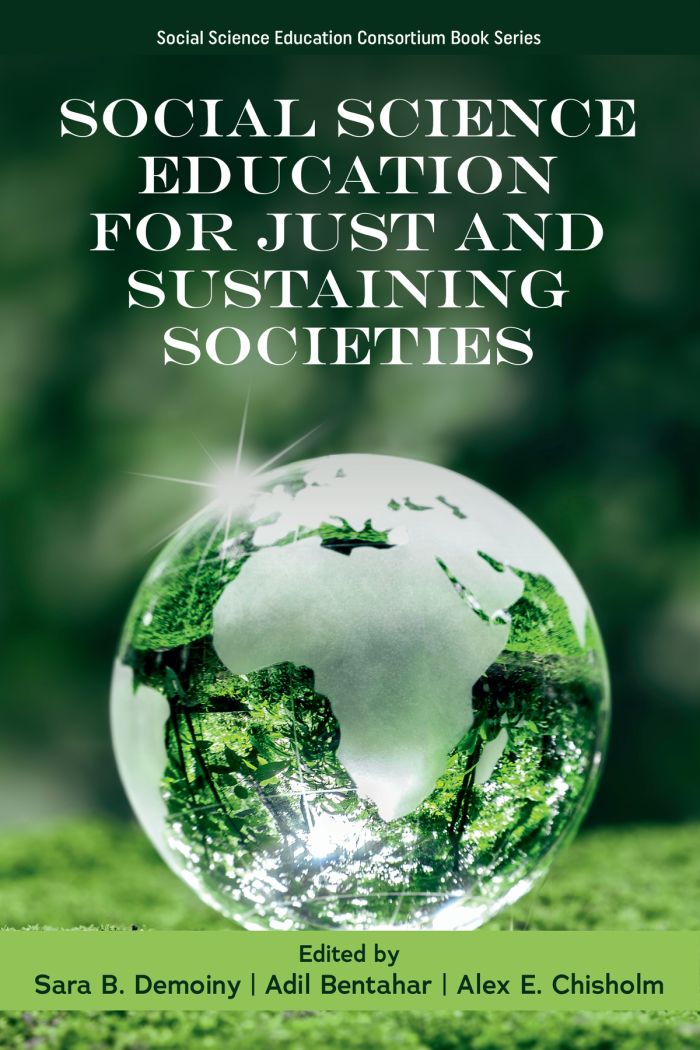
Social Science Education for Just and Sustaining Societies

This book can be opened with

Note on our eBooks and Audiobooks: you can read our eBooks (ePUB or PDF) and listen to audiobooks on the free Emerald Books app on iOS, Android, and desktop. Or read and listen on Emerald's online reader (ePUB eBooks and audiobooks only). To purchase a digital book you will need to create an account if you don’t already have one. After purchasing you will receive instructions on how to get started.
- Description
- Contents
- About
People around the world face grave crises of wars, climate change, genocides, rising sea levels, human rights violations, and inequitable distribution of natural resources. These problems are transcontinental, interconnected, and create immense human suffering, which require collective efforts toward just and sustainable global solutions. The United Nations resolved to address these concerns in adopting the Sustainable Development Goals in 2015. These goals form a “plan of action for people, planet, and prosperity,” which “seeks to strengthen universal peace in greater freedom” (United Nations, 2015, para. 1).
The social sciences are uniquely positioned to address the Sustainable Development Goals (SDGs) by offering content and tools to pursue just and sustainable societies. The knowledge, skills, and values of social science education can empower global citizens to seek truth, to deliberate on the current problems, and to shape a just and equitable future for people and for our planet. In this volume, authors from around the world a) propose critical philosophical questions, b) describe current education problems, and c) explore educational possibilities for a just and sustainable world.
Part 1. Philosophical Critical Questioning
- Chapter 1. What is Lost When Efficiency is Gained?: Examining the Tension Between Efficiency-Driven Logics and Just, Sustainable Futures; Joseph McAnulty and Elaine Alvey
- Part 2. Describing Current Educational Problems
- Chapter 2. Challenges to Improving Human and Planetary Conditions: Analyzing Selective Cases of South Korean Social Studies Teacher Experiences; EunJung Kim and SeungHee Shim
- Chapter 3. Privatization of Primary and Secondary Education in Morocco; Rim Roubi
- Chapter 4. Student Support as the Weakest Link: School Dropout in Morocco; Ali Ait Si Mhamed, Rita Kasa, Rim Roubi, and Wiame Imrharn
- Part 3. Exploring Educational Possibilities for a Just and Sustainable World
- Chapter 5. Exploring Civic Education for Social Justice Among Middle and High School Students in Morocco: A Qualitative Study Adil Bentahar; Mohammed Elmeski and Elarbi Imad
- Chapter 6. Climate Change Education in China: Exploring the Effect of Chinese Traditional Ecological Knowledge (TEK) on Students’ Perceived Efficacy Towards Combating Climate Change; Daniel Yonto and Bin Feng
- Chapter 7. Promoting International Student Civic Engagement in English Language Programs; Cheryl A. Ernst
- Chapter 8. How to Confront Climate Crisis: Pointed Interventions in the Social Studies Classroom; Anne Marie Kavanagh
- Chapter 9. Using Youth Participatory Action Research (YPAR) to Engage Youth in Working Towards the UN SDGs and Lasting Change in their Communities; Sabrina L. Caldwell
- Chapter 10. “But now I see that there’s so much more to it”: Journaling, Primary Contradictions and Expanding Conceptions of Democracy and Citizenship; Dean P. Vesperman
- Chapter 11. The Potential of Project-based Learning for Preparing Students to Advance the UN’s Sustainable Development Goals; Saviour Kitcher and Anne-Lise Halvorsen
- Chapter 12. Unlearning to Relearn: A Self-study of Indigenous Sustainability Education; Kate Van Haren
- Chapter 13. Teaching Sustainability Through Democratic Pedagogy in a Virtual Reality School; John L. Pecore and Chara Haeussler Bohan
- Chapter 14. Deliberative Simulations and Global Citizenship: Exploring High School Students’ Engagement with Climate Change and Human Rights Through Model United Nations Summer Camp; Matthew F. Summerlin, Jesús A. Tirado, and Megan E. Andrews
Sara B. Demoiny is an associate professor of elementary education at Auburn University.
Adil Bentahar is an associate professor at the University of Delaware’s English Language Institute and School of Education.
Alex E. Chisholm is an assistant professor of secondary social studies education at Clemson University.