
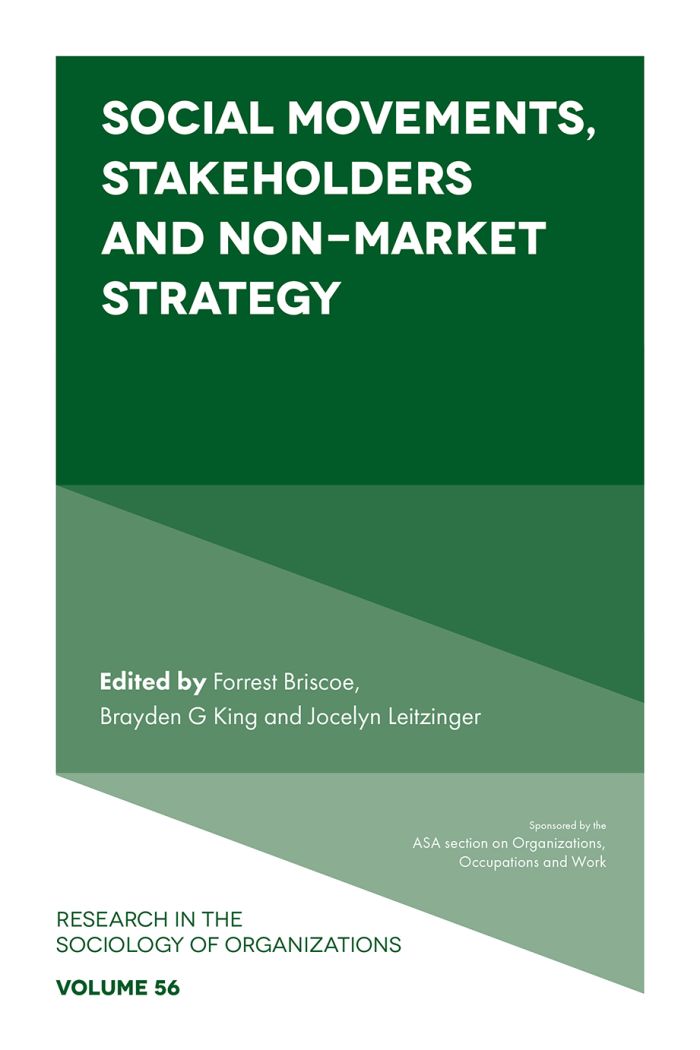

Social Movements, Stakeholders and Non-Market Strategy

This book can be opened with

Note on our eBooks and Audiobooks: you can read our eBooks (ePUB or PDF) and listen to audiobooks on the free Emerald Books app on iOS, Android, and desktop. Or read and listen on Emerald's online reader (ePUB eBooks and audiobooks only). To purchase a digital book you will need to create an account if you don’t already have one. After purchasing you will receive instructions on how to get started.
- Description
- Contents
- Reviews
- About
Introduction: Integrating Research Perspectives on Business and Society; Jocelyn Leitzinger, Brayden King, and Forrest Briscoe 1. Plug Power: Social Movements and Electric Vehicle Charging Stations in California, 1995-2012; Sunasir Dutta, Hayagreeva Rao and Ion Bogdan Vasi 2. Negotiating Moral Boundaries: Social Movements and the Strategic (Re)definition of the Medical in Cannabis Markets; Cyrus Dioun 3. Movement-Led Institutional Change: Uncertainty, Networks, and the Diffusion of Contentious Practices in Organizational Fields; Forrest Briscoe and Sean Safford 4. Social Movement Theory’s Contribution to Understanding Activism Around Corporations and Markets; Sarah A. Soule 5. The Negative Relationship Between Event-Specific Corporate Social Responsibility and Shareholder Value; Susan A. Kayser 6. Bridging Social Movement and Industrial Relations Theory: An Analysis of Worker Organizing Campaigns in the U.S. and China; Maite Tapia, Manfred Elfström and Denisse Roca-Servat 7. Not a Drop to Drink? Drinking Water Quality, System Ownership, and Stakeholder Attention; A. Wren Montgomery, Thomas P. Lyon, and Dan Zhao 8. Influence Stakeholders, Influence the World; Michael L. Barnett 9. On Two Sides of the Smoke Screen: How Activist Organizations and Corporations use Protests, Campaign Contributions, and Lobbyists to Influence Institutional Change; Ana M. Aranda and Tal Simons 10. Failure or Success? Defensive Strategies and Piecemeal Change Among Racial Inequalities in the Brazilian Banking Sector; Mario Aquino Alves and Marcus Vinícius Peinado Gomes 11. Non-market Strategy and Social Movements Research: What Are the Gains from Trade?; Thomas P. Lyon Afterword. Broadening Business and Society Research: A Postscript on the Limits of Strategic Action; Michael Lounsbury
Researchers from North America, Europe, and South America present 12 chapters on the relationship between social movement theory, stakeholder theory, and non-market strategy. They consider social movements and organizational theory, including the role of social movements in the development of the electric car industry in California, how social movement organizations impacted the medical marijuana industry, how the impact of a social movement changes over time, and social movement theory’s contribution to understanding activism around corporations and markets; social movements and stakeholders, with discussion of the conditions under which a firm's corporate social responsibility initiatives may lead to a decrease in shareholder value after a negative event, worker organizing campaigns in the US and China, the impact of stakeholder attention and pressure on service quality outcomes of water systems in the US, and the power and influence of stakeholders; and social movements and non-market strategy, including the role of activist and firm organizing in institutional change, the role of different strategies in influencing field-level change, and research on non-market strategy and social movements.