
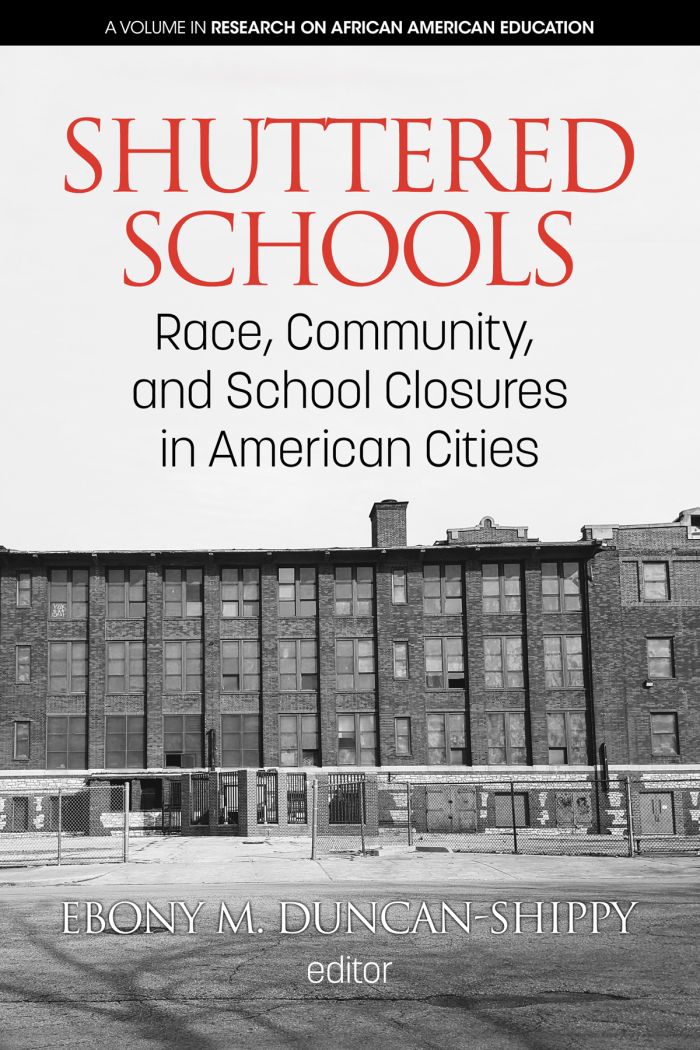
Shuttered Schools
Race, Community, and School Closures in American Cities

This book can be opened with

Note on our eBooks and Audiobooks: you can read our eBooks (ePUB or PDF) and listen to audiobooks on the free Emerald Books app on iOS, Android, and desktop. Or read and listen on Emerald's online reader (ePUB eBooks and audiobooks only). To purchase a digital book you will need to create an account if you don’t already have one. After purchasing you will receive instructions on how to get started.
- Description
- Contents
Since the late 1990s, mass school closures have reshaped urban education across the United States. Popular media coverage and research reports link this resurgence of school closures in major cities like Chicago and Philadelphia to charter school expansion, municipal budget deficits, and racial segregation. However, this phenomenon is largely overlooked in contemporary education scholarship. Shuttered Schools: Race, Community, and School Closures in American Cities (Information Age Publishing) is an interdisciplinary volume that integrates multiple perspectives to study the complex practice of school closure—an issue that transcends education. Academics, practitioners, activists, and policymakers will recognize the far-reaching implications of these decisions for school communities.
Shuttered Schools features rigorous new studies of school closures in cities across the United States. This research contextualizes contemporary school closures and accounts for their disproportionate impact on African American students. With topics ranging from gentrification and redevelopment to student experiences with school loss, research presented in this text incorporates various methods (e.g., case studies, interviews, regression techniques, and textual analysis) to evaluate the intended and unintended consequences of closure for students, families, and communities. This work demonstrates that shifts in the social, economic, and political contexts of education inform closure practice in meaningful ways. The impacts of shuttering schools are neither colorblind nor class-neutral, but indeed interact with social contexts in ways that reify existing social inequalities in education.
Chapter 1. The Rise of School Closures in the 21st Century; Ebony M. Duncan-Shippy.
- Section I. Patterns And Processes.
- Chapter 2. School Closure in Strained Cities: Implications for Racial Equity in U.S. Education; Ebony M. Duncan-Shippy.
- Chapter 3. School Closings ... Atlanta Style: The Convergence of Poverty, Segregation, and Achievement; Tomeka Davis, Deirdre Oakley, and Shanae Stover.
- Chapter 4. The Costs and Consequences of School Governance Change in Detroit: From Proposal A to the Education Achievement Authority; Leanne Kang and Kelly E. Slay.
- Chapter 5. An Open and Shut Case: Gentrification and School Closure Decisions in Washington, DC; Esa Syeed.
- Chapter 6. Complicating Sector Agnosticism: Relational and Spatial Displacement and Dispossession Through School Closure in Cleveland; Anne Galletta.
- Chapter 7. The Implications of Colorblind Decision-Making About the Closure, Renovation or Rebuild of (Almost) Every School in North Little Rock, Arkansas; Kendra Lowery.
- Section II. Implications.
- Chapter 8. The Effects of Public Elementary Schools Closures on Neighborhood Housing Values in U.S. Metropolitan Areas, 2000-2010; Noli Brazil.
- Chapter 9. A Spoke in a Wheel: School Closures and the Continued Violation of Public Trust; Sally A. Nuamah.
- Chapter 10. School Closures and the Political Education of U.S. Teachers; Lauren Ware Stark and Rhiannon M. Maton.
- Chapter 11. Closing Costs: Examining the Impact of School Closures on African-American Students' Educational Outcomes; Richard O. Welsh and Shafiqua Little.
- Conclusion: Education Reform in the Racial State: The Costs of School Closures for Marginalized Communities; Ebony M. Duncan-Shippy.
- About the Editor.
- About the Contributors.