
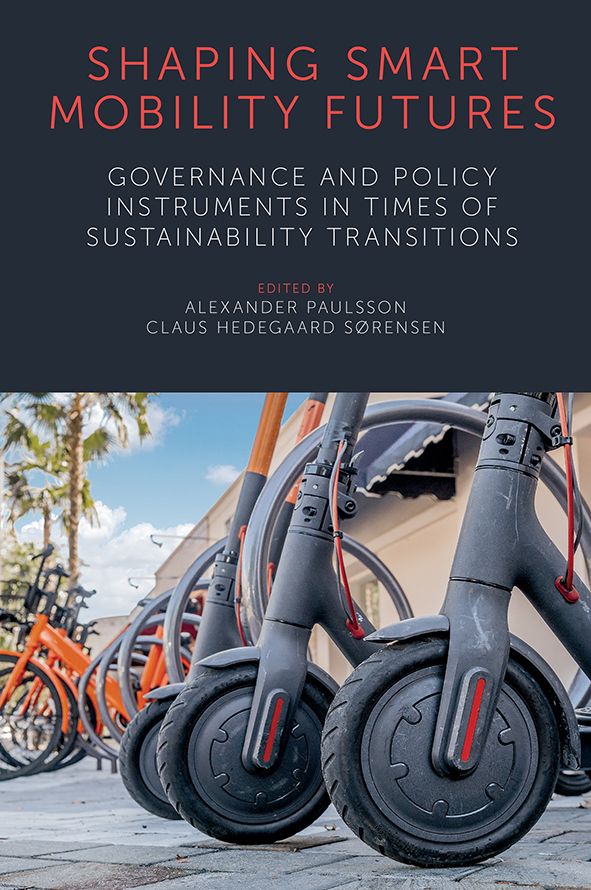
Shaping Smart Mobility Futures

Governance and Policy Instruments in times of Sustainability Transitions

Alexander Paulsson|Claus Hedegaard Sørensen
Emerald
Emerald

This book can be opened with

Glassboxx eBooks and audiobooks can be opened on phones, tablets, iOS and Android devices

Hardback
9781839826511
13 August 2020
£77.99
eBook (PDF)
9781839826504
13 August 2020
£77.99
eBook (ePub)
9781839826528
13 August 2020
£77.99

Note on our eBooks and Audiobooks: you can read our eBooks (ePUB or PDF) and listen to audiobooks on the free Emerald Books app on iOS, Android, and desktop. Or read and listen on Emerald's online reader (ePUB eBooks and audiobooks only). To purchase a digital book you will need to create an account if you don’t already have one. After purchasing you will receive instructions on how to get started.

  • Description
  • Contents
  • About
Smart mobility includes automation, shared mobility services and other new forms of mobility made possible by digital technologies. This book argues that smart mobility will only be developed in a desired direction and fulfil global sustainability goals if it is steered in that direction. There is a vast body of literature on public policy and policy instruments, and there are many different conceptualisations and categorisations. Applying an open and broad approach, whereby a variety of policy instruments that are used to govern smart mobility are introduced and discussed, this book is ideal for both professionals and researchers. The book is organised into three parts: the first part explores why there is a need for policy instruments in relation to smart mobility, the second part examines how policy instruments are chosen and developed, and the third part explores what policy instruments are doing and what smart mobility is doing to them. Of the policy instruments used today, many focus on producing knowledge for governments and thereby making smart mobility governable. Because of the difficulties with implementing policy instruments that make the transport sector more sustainable, the book concludes by discussing in which ways citizen deliberation can breathe new life into the debate.

Chapter 1. Smart mobility and policy instruments: broadened definitions and critical understandings; Alexander Paulsson and Claus Hedegaard Sørensen Chapter 2. Steering smart mobility services: Governance and accountability challenges for English local authorities; Ioanna Moscholidou Chapter 3. The impacts of automated vehicles on the transport system and how to create policies that target sustainable development goals; Anna Pernestål, Albin Engholm, Ida Kristoffersson and Johanna Jussila Hammes Chapter 4. Crafting effective policy instruments for 'Smart Mobility': can Multi-level Governance deliver?; Iain Docherty Chapter 5. Planning urban futures for autonomous and shared vehicles: The role of planning support tools as a policy instrument; Sam McLeod, Carey Curtis and John Stone; Chapter 6. Challenges for government as facilitator and umpire of innovation in urban transport: the view from Australia; John Stone, David Ashmore, Crystal Legacy and Carey Curtis Chapter 7. Experimental governance of smart mobility: some normative implications; Annica Kronsell and Dalia Mukhtar-Landgren Chapter 8. Smart Mobility as a Catalyst for Policy Change towards Low Carbon Mobility?; Louise Reardon Chapter 9. Is governing capacity undermined? Policy instruments in smart mobility futures; Anna Wallsten, Claus Hedegaard Sørensen, Alexander Paulsson and John Hultén Chapter 10. Micromobility - regulatory challenges and opportunities; Nils Fearnley Chapter 11. Smart public transport in rural areas: Prospects, challenges and policy needs; Fredrik Pettersson-Löfstedt and Jamil Khan Chapter 12. Concluding remarks: governance and citizen participation in shaping futures of smart mobility; Claus Hedegaard Sørensen and Alexander Paulsson

    Alexander Paulsson is a lecturer at Lund University School of Economics and Management and a researcher at the Swedish Knowledge Centre for Public Transport (K2). He is currently doing research on the governance of new forms of mobility and the marketization of public transport. Alexander’s research interests are broadly within the areas of organization studies, science and technology studies as well as ecological economics. 

    Claus Hedegaard Sørensen is research leader at the Swedish Knowledge Centre for Public Transport (K2) and senior researcher at the Swedish National Road and Transport Research Institute (VTI). Claus is doing research on transport governance, and his research mostly has focused on environmental policy integration in transport; national transport planning; organisation and collaboration within public transport; as well as the use and role of knowledge in transport policy making. The last couple of years he mostly has researched and published on governance of smart mobility. Thus, he has led and been involved in more research projects within that field.