
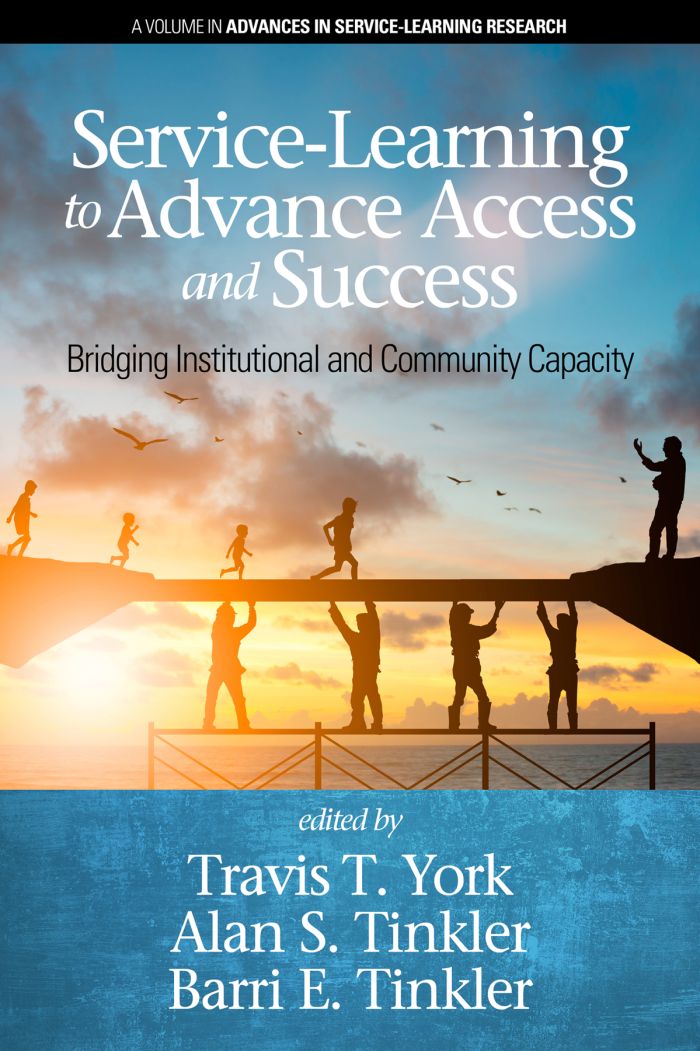
Service-Learning to Advance Access & Success
Bridging Institutional and Community Capacity

This book can be opened with

Note on our eBooks and Audiobooks: you can read our eBooks (ePUB or PDF) and listen to audiobooks on the free Emerald Books app on iOS, Android, and desktop. Or read and listen on Emerald's online reader (ePUB eBooks and audiobooks only). To purchase a digital book you will need to create an account if you don’t already have one. After purchasing you will receive instructions on how to get started.
- Description
- Contents
Throughout the 90s and early 2000s, service-learning research was intensely focused on the student outcomes. That body of research has effectively brought service-learning from the fringes into the mainstream of institutionalized pedagogies. In the past decade service-learning research has experienced an infusion of exploration in three distinct ways: first, large-scale quantitative methodologies; second, a proliferation of research that has explored how different sub-groups of students experience the pedagogy differently, thusly resulting in variation among outcomes; and third, a focus on the experiences and outcomes associated for communities and community partners engaged in service-learning.
In an effort to support these movements, this volume of the Advances in Service-Learning Research series, Service-Learning to Advance Access & Success: Bridging Institutional and Community Capacity, focuses on how service-learning can advance access and success. Not simply access and success of students, but the ways that service-learning can advance access and success for all through bridging institutional and community capacity building. The chapters in this volume serve as a testament to the ways in which service-learning research continue to be advanced by thoughtful scholar-practitioners.
The 12 chapters included in this volume are organized into three sections. The first section focuses on how institutional and community partnerships can be leveraged to build community capacity. The second section focuses on how institutions might build their own capacity to effect change for the good of society. The third and final section focuses on six studies exploring the relationship service-learning pedagogy has with access and success for students. Of the six studies, three are situated within the context of teacher-preparation programs.
Foreword.
- Introduction.
- Acknowledgments.
- Section I. Collaboration to Build Community Capacity.
- Chapter 1. An Assessment Framework for Embedding Significant and Sustainable Activity-Based, Course-Based, and Program-Based Service-Learning; Rebecca Pearson and Naomi Jeffery Peterson.
- Chapter 2. Building Community Capacity Through University-City Collaborations: A Case Study of the Austin City Hall Fellows Program; Chloe Latham Sikes, Tracie Lowe, and Suchitra Gururaj.
- Chapter 3. Building Communication Capacities Within Nonprofits Through Service-Learning; Dennis McCunney and Guiseppe Getto.
- Section II. Institutional Capacity to Achieve Change.
- Chapter 4. Transforming Institutional Capacity for Community-Based Learning: Leveraging Engaged Department Initiatives Into a Campus-Wide Community of Practice; Karyn E. Rabourn, Danielle Lake, Nicholas O. Scobey, and Gloria Mileva.
- Chapter 5. Co-Creating Service-Learning: The Importance of True Partnerships; Julianne Gassman, Emily J. Shields, Katie Kleinhesselink, and Elaine K. Ikeda.
- Chapter 6. The Community-Based Learning Coordinator Model: Investing in Infrastructure for Community Impact Through Service-Learning; Connie Snyder Mick, Annie Cahill Kelly, and Sam Centellas.
- Section III. Advancing Student Access and Success.
- Chapter 7. Addressing the Problem With Service: Community Formation, Democratization, and Community-Based Learning Pedagogy; R. Tyler Derreth.
- Chapter 8. Learning to Collaborate: Intersections of the Classroom and Community; Patricia M. Ryan, Shirley M. Matteson, and Valerie O. Paton.
- Chapter 9. Planting Seeds Through Service: A Qualitative Approach to Assessing Student Civic Learning Through Community Partnerships; Laura Martin, Lakyre'a Janae Owens, and Albert Nylander.
- Chapter 10. Advancing Democracy in Teacher Education: Service-Learning in Third Space Partnerships; Michael Kopish.
- Chapter 11. Rethinking Teacher Education: Lessons Learned From a Mandatory Community-Based Service-Learning Program; Gary Harfitt and Jessie Mei Ling Chow.
- Chapter 12. Preservice EFL Teachers' Perceptions and Their Reflected Experiences in a Service-Learning Course; Yasemin Kırkgöz.
- Chapter 13. Summary Epilogue; Alan Tinkler.
- About the Editors.
- About the Contributors.