
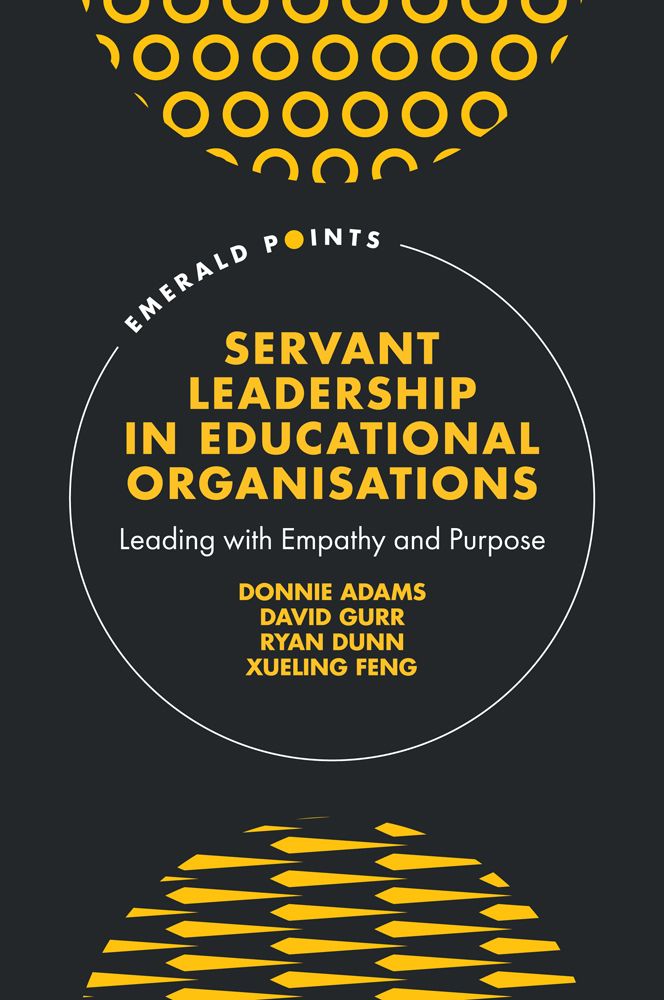

Servant Leadership in Educational Organisations
Leading with Empathy and Purpose

This book can be opened with

Note on our eBooks and Audiobooks: you can read our eBooks (ePUB or PDF) and listen to audiobooks on the free Emerald Books app on iOS, Android, and desktop. Or read and listen on Emerald's online reader (ePUB eBooks and audiobooks only). To purchase a digital book you will need to create an account if you don’t already have one. After purchasing you will receive instructions on how to get started.
- Description
- Contents
- Reviews
- About
Servant Leadership in Educational Organisations: Leading with Empathy and Purpose is a comprehensive guide to leading with empathy and purpose. It explores key leadership principles and practical strategies that empower leaders to foster collaboration and create positive change in educational settings.
At the heart of the book is a contemporary model of servant leadership, a holistic and integrative framework that connects leadership mindsets, behaviours, and organisational practices within an Equity, Diversity, Inclusion, and Belonging (EDIB) context. Providing an in-depth discussion of servant leadership tailored for educational leaders seeking to enhance their leadership skills, the authors begin with an in-depth definition and historical overview, offering a solid foundation of the origins and evolution of this leadership approach. Chapters then cover a wide range of topics essential for understanding and practicing servant leadership, including self-awareness, emotional intelligence, and the creation of a supportive work environment. Key principles such as empathy, humility, and ethical decision-making are thoroughly examined, providing readers with a framework for implementing these values in their leadership practices.
Throughout the book, real-world case studies referred to as 'Spotlights of Practice’ illustrate how servant leadership is implemented across diverse educational settings. These examples demonstrate how a servant leadership practices can lead to improved employee engagement, trust, and organisational effectiveness. The combination of theory, reflective insights, and evidence-informed practices makes this an essential read for any current and aspiring educational leaders seeking to make a positive difference in their organisations.
Chapter 1. An Introduction to Servant Leadership
- Chapter 2. The Mindset of a Servant Leader
- Chapter 3. Servant Leadership Behaviours
- Chapter 4. The Practice of Servant Leadership
- Chapter 5. Fostering Equity, Diversity, Inclusion and Belonging
- Chapter 6. Servant Leadership as Future Leadership
This book provides an innovative analysis of contemporary servant-leadership in new and significant directions. With a profound focus on educational organisations, the authors demonstrate how servant-leaders make a difference in the world of education and beyond. Well-grounded in the seminal writings of Robert K. Greenleaf, this book also provides a powerful connection between servant-leadership and diversity, equity, inclusion, and belonging. Three cheers for Donnie Adams, David Gurr, Ryan Dunn, and Xueling Feng for their creation of this remarkable work. It is a gem of a book.
Starting from an overview of academic research on servant leadership from psychology and business, Adams and colleagues masterfully demonstrate with numerous examples how servant leadership benefits educational organizations. Many case studies illustrate the way in which servant leadership in school settings help bring out the full potential of students and teachers through listening, empathy, and empowerment of all stakeholders regardless of their individual characteristics or cultural background. The book serves as a practical guide for leaders and educators seeking to develop servant leadership skills.
This important book recognises the growing importance of leadership as a relational activity, intended to support professional practice and student learning. The focus on servant leadership is timely and helpful for scholars, practitioners and policy makers.
Discover the transformative power of servant leadership in education with Servant Leadership in Educational Organisations: Leading with Empathy and Purpose. This insightful collection offers practical strategies, real-world case studies, and a holistic framework that connects leadership principles to equity, diversity, inclusion, and belonging. Designed by a team of expert editors for current and aspiring educational leaders, the book emphasises empathy, humility, and ethical decision-making to build trust and organisational effectiveness. If you’re looking to empower yourself to lead with purpose, nurture growth, and create positive change within your educational community, this book is for you.
Donnie Adams is a Lecturer in Educational Leadership at the Faculty of Education, University of Melbourne, Australia.
David Gurr is a Professor in Educational Leadership at the Faculty of Education, University of Melbourne, Australia.
Ryan Dunn is a Senior Lecturer at the Faculty of Education, University of Melbourne, Australia.
Xueling Feng is a recent Ph.D. graduate at University of Malaya, Malaysia.