
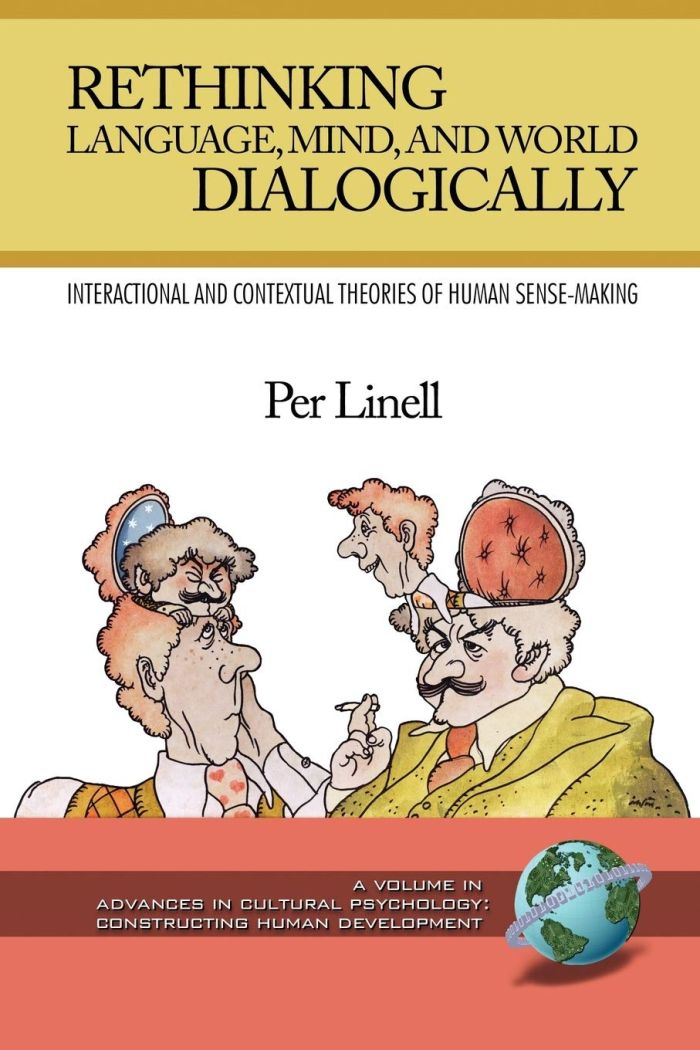
Rethinking Language, Mind, and World Dialogically

Emerald
This book can be opened with

Note on our eBooks and Audiobooks: you can read our eBooks (ePUB or PDF) and listen to audiobooks on the free Emerald Books app on iOS, Android, and desktop. Or read and listen on Emerald's online reader (ePUB eBooks and audiobooks only). To purchase a digital book you will need to create an account if you don’t already have one. After purchasing you will receive instructions on how to get started.
- Description
- Contents
- About
Rethinking Language, Mind, and World Dialogically written by Per Linell discusses Interactional and contextual theories of human sense - making.
Series Editor's Introduction: Rethinking Dialogicality Preface and Overview.
- Part I. Into the World of Dialogical Concepts.
- Chapter 1. Conceptual and Terminological Preliminaries: Dialogue, Dialogism, Dialogicality.
- Chapter 2. Dialogism and Its Axiomatic Assumptions.
- Chapter 3. Monologism.
- Chapter 4. Situations and Situation-Transcending Practices.
- Part II. Social Minds: Selves, Others and the Inter-world.
- Chapter 5. Dialogue and the Other.
- Chapter 6. The Dialogical Self.
- Chapter 7. A Relational Interworld Beyond Individual Minds.
- Part III. Sense-making: Interactions, Communicative Projects, Utterances and Texts.
- Chapter 8. Monological and Dialogical Practices.
- Chapter 9. Social Interaction and Power.
- Chapter 10. Meaning and Understanding.
- Chapter 11. Signs and Representations as Dialogical Entities.
- Chapter 12. Dynamics and Potentialities of Sense-Making: Developmental Aspects.
- Part IV. Languaging: Embodiment and Social Embedding.
- Chapter 13. Rethinking Language in Dialogical Terms.
- Chapter 14. Dialogue and Grammar: Methods for Constructing Utterances.
- Chapter 15. Dialogue and Lexicology: Meaning Potentials of Lexical Resources.
- Chapter 16. Dialogue and Artefacts.
- Chapter 17. Dialogue and the Brain.
- Part V. Dialogical Theories: Convergences and Divergences.
- Chapter 18. Dialogism and the Scientific Enterprise.
- Chapter 19. Monologism and Dialogism: Summary with Some Historical Flashbacks.
- Chapter 20. Some Misinterpretations of Dialogism.
- Chapter 21. Epilogue.
- References.
Per Linell took his degree in linguistics and is currently professor of language and culture, with a specialisation on communication and spoken interaction, at the University of Linköping, Sweden. He has been instrumental in building up an internationally renowned interdisciplinary graduate school in communication studies in Linköping. He has worked for many years on developing a dialogical alternative to mainstream theories in linguistics, psychology and social sciences. His production comprises more than 100 articles on dialogue, talk-in-interaction and institutional discourse. His more recent books include Approaching Dialogue (1998), The Written Language Bias in Linguistics (2005) and Dialogue in Focus Groups (2007, with I. Marková, M. Grossen and A. Salazar Orvig).