
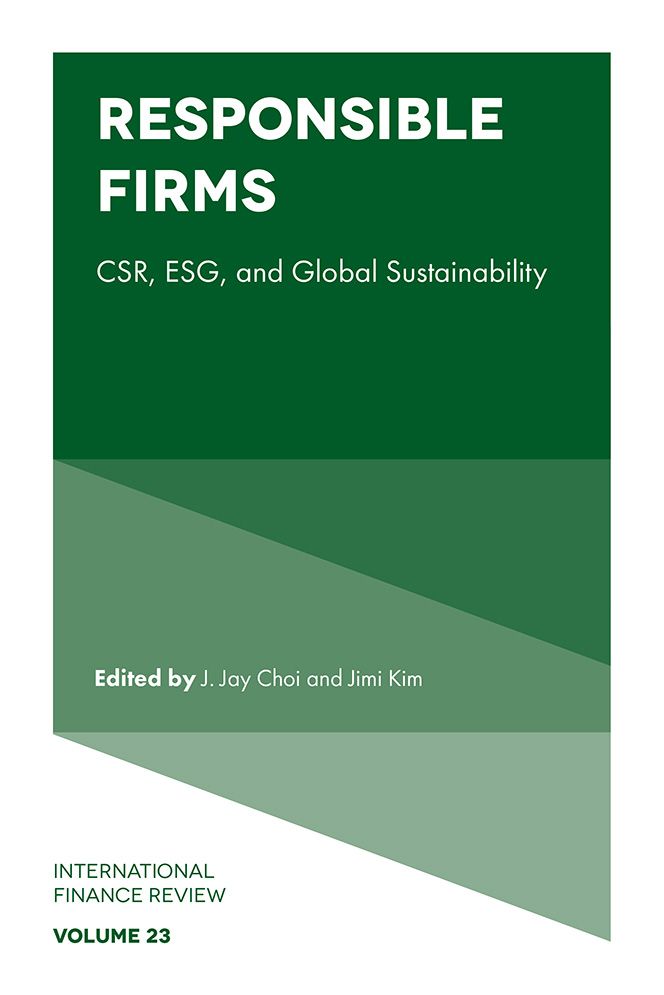

Responsible Firms
CSR, ESG, and Global Sustainability

This book can be opened with

Note on our eBooks and Audiobooks: you can read our eBooks (ePUB or PDF) and listen to audiobooks on the free Emerald Books app on iOS, Android, and desktop. Or read and listen on Emerald's online reader (ePUB eBooks and audiobooks only). To purchase a digital book you will need to create an account if you don’t already have one. After purchasing you will receive instructions on how to get started.
- Description
- Contents
- About
The purpose of corporations has long been debated, with the traditional view asserting that a firm's primary responsibility is to maximize shareholder profits. This profit-centric approach is believed to drive efficiency, innovation, and economic growth. However, an evolving perspective argues that corporations have broader responsibilities that include social and environmental considerations, suggesting that corporations should also focus on the well-being of employees, fair wages, and sustainable practices to create positive social impacts and long-term benefits.
Responsible Firms: CSR, ESG, and Global Sustainability examines global contemporary models of the "responsible firm", investigating how broader social responsibilities are, or are not, integrated and proposing new concepts and frameworks to improve.
International Finance Review publishes theme-oriented volumes on various issues in international finance, such as international business finance, international investment and capital markets, global risk management, international corporate governance and institution, currency markets, emerging market finance, international economic integration, and related issues.
PART I. AN OVERVIEW: CONCEPTS AND MEASUREMENTS
- Chapter 1. Responsible Firms and Global Sustainability: Towards an Integrated Framework; Jongmoo Jay Choi and Jimi Kim
- Chapter 2. Measuring CSR, ESG, and Sustainability; J.H. John Kim and Sebeom Oh
- PART II. CSR, ETHICS, AND SUPPLY CHAINS
- Chapter 3. Corporate Social Responsibility Strategy: The Effects of Legitimacy and Authenticity on Corporate Reputation; Robert A. Rodriques
- Chapter 4. A Comparison Of Business Ethics In China, Japan, And Korea ; Taehee Choi, Nakano Chiaki, and Zhou Zucheng
- Chapter 5. Challenges Of CSR Implementation In Supply Chains: A Thematic Review In The Emerging Market Context; Julianne Sellin
- PART III. ESG, CLIMATE RISK, AND POLITICS
- Chapter 6. Assessing Firm’s ESG Performance Using The Topsis; Palak Rathi, Ankit Nyati, Rushina Singhi, and Anubha Srivastava
- Chapter 7. Fossil-Washing? The Fossil Fuel Investment of ESG Funds; Alain Naef
- Chapter 8. Climate Risks, Sustainable Finance, and Green Growth: The Evolution of Fintech; Hai Hong Trinh, Ilham Haouas, and Tien Thi Thuy Tran
- Chapter 9. The ESG Backlash: Politics, Ideology, and The Future of Sustainable Business; Henrik Skaug Sᴂtra
- PART IV. MNE, AI, AND GLOBAL SUSTAINABILITY
- Chapter 10. Sustainability as Strategy: The Financial Performance of Un Global Compact Network Australia (UNGCNA) Member Firms On The Australian Securities Exchange (ASX); Paul X. McCarthy, Michael Parker, and Xian Gong
- Chapter 11. Business Engagement With the Sustainable Development Agenda: Evidence from Türkiye; Burcin Hatipoglu and Bengi Ertuna
- Chapter 12. The Transformative Impact of AI On CSR, ESG, And Sustainability: Critical Review and Case Studies; Bora Ozkan
- Chapter 13. How Do Consumer Goods Multinationals Engage with Corporate Sustainability? A Cross-Company Case Study Analysis; Marco Simões Coelho, Ariane Roder Figueira, and Eduardo Russo
J. Jay Choi is Laura H. Carnell Professor Emeritus of Finance and International Business at Temple University, USA. He is a founding editor of International Finance Review, and was Economist at JP Morgan Chase, and visiting faculty around the world, including Columbia, Wharton, NYU, University of Sydney, KAIST, and IUJ. Jay is internationally renowned as a scholar in international financial management, global corporate governance and finance, corporate risk and capital markets, and Asian business and multinational firms.
Jimi Kim is Senior Lecturer at the School of Management and Governance, The University of New South Wales (UNSW Sydney), Australia. Her research interests include sustainability, corporate governance, and business ethics. Jimi has been exploring what drives organizations to integrate the interests of stakeholders into strategy formulation.