
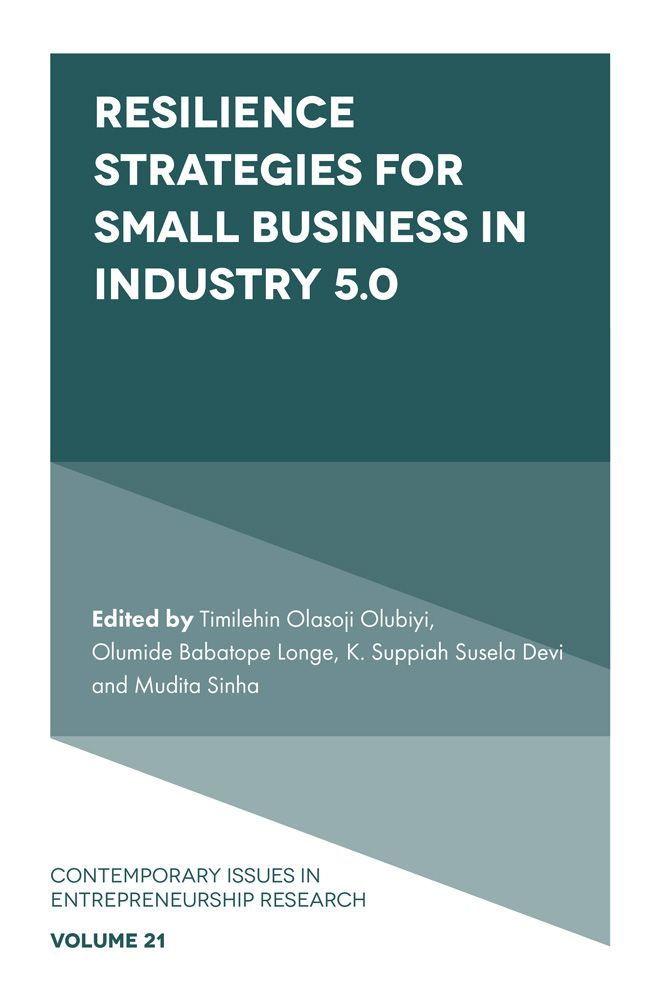

Resilience Strategies for Small Business in Industry 5.0

This book can be opened with

Note on our eBooks and Audiobooks: you can read our eBooks (ePUB or PDF) and listen to audiobooks on the free Emerald Books app on iOS, Android, and desktop. Or read and listen on Emerald's online reader (ePUB eBooks and audiobooks only). To purchase a digital book you will need to create an account if you don’t already have one. After purchasing you will receive instructions on how to get started.
- Description
- Contents
- Reviews
- About
Industry 4.0 focuses on digitization and automation, while Industry 5.0 takes it to the next level of focus, which is human working with advanced technologies, robots, and artificial intelligence. How will small businesses survive? The research curated here considers the emergence and application of Artificial Intelligence (AI) technologies in developing economies. With a balance of theoretical/methodological and empirical chapters, this book will be the first substantial study of artificial intelligence and the future of sustainable small businesses in emerging economies.
Volumes comprise of specially selected papers submitted to the ISBE annual conference in addition to invited external expert contributions. Each volume is designed around a specific theme of importance to the entrepreneurship and small business community. Articles collectively explore and develop theory and practice in the field of entrepreneurship and small business while the emphasis of the research is on quality currency and relevance.
Chapter 1. Fostering Artificial Intelligence in Small Businesses in Sub-Saharan Africa; Timilehin Olasoji Olubiyi
- Chapter 2. Sustainability Through Green Entrepreneurial Orientation (GEO); Indranil Mutsuddi and Sulagna Das
- Chapter 3. Resilience Strategies and Sustainability in Business; Godwin Ayodeji Nwogu
- Chapter 4. Quantum-Inspired Strategies and Business Resilience in Industry 5.0: A Study of Small Businesses; Saladi Jaswanth Seshasai, R. Vijay Raja, and G. Kumar
- Chapter 5. The Effect of Digital Transformation Capability on Business Model Innovation in Industry 5.0: Evidence from Vietnamese Small and Medium Enterprises; Tang My Sang
- Chapter 6. Digital Marketing Strategy for SMEs in India and South East Asian countries in Industry 5.0: A literature Review; Sabita Bhagabati
- Chapter 7. Cyberloafing and The Future of Business Productivity in Developing Economies: Insights from India; Divya, Timilehin Olasoji Olubiyi, and Mahabir Narwal
- Chapter 8. Sustainable Growth in SMES with Generative AI: Reaping Rewards, Tackling Challenges, With Human Insights; Umme Ara and Shivani Pandey
- Chapter 9. Resilience: Future Trends and Challenges in Small and Medium Enterprises; Mohit Sharma, Rishi Chaudhry, Raj Kumar, Nitika Malik, and Kuldeep Chaudhary
- Chapter 10. Impact of Information and Communication Technology on E-Business of Small and Medium Scale Enterprises in Nigeria; Mary Agamalafiya, Kelvin Inobemhe, and Tsegyu Santas
- Chapter 11. Prioritisation of Human Resource Strategies in The Digital Transformation Process of SMES; Tuğçe Şimşek and Ahmet Bahadır Şimşek
- Chapter 12. Disruptive Technology and Performance of Manufacturing SMEs as moderated by Technological Innovation in South-West Nigeria; Olamide Titilayo Ayodeji; Timilehin Olasoji Olubiyi; Titilayo Doris Ibikunle; Israel Olabode Aroge, and Abiodun Richard Obisanya
- Chapter 13. Strengthening Legal Frameworks for Small Businesses and Integrating Artificial Intelligence in Consumer Products; Rosetta Okiemute Isiavwe, Mary-Ann Onoshioke Ajayi, Folajimi Olayiwola Jejelola, and Olayiwola Owoade Oladele
- Chapter 14. E-Commerce in Industry 5.0: Insights into Consumer Purchasing Preferences and Behavior; Richard Fedorko and Štefan Kráľ
- Chapter 15. Talent Management Practices and Product Differentiation as Resilience Strategies in Africa; Solomon Olusegun Adeoye and Johnson Ashiemamho Egwakhe
Resilience Strategies for Small Business in Industry 5.0 is a timely and insightful contribution to the evolving landscape of business innovation and sustainability. This book skillfully addresses the pressing need for small enterprises to adapt, thrive, and lead in an era defined by human-centric technology and intelligent collaboration. The editorial team has demonstrated remarkable dedication and vision in curating a volume that is both academically rigorous and practically relevant. Their collective expertise, drawn from diverse professional and cultural backgrounds, has enriched the content, making it globally relevant and locally impactful. Equally commendable is the diversity of the chapter contributors, each bringing unique perspectives, experiences, and solutions that reflect the real-world challenges faced by small businesses today. Their contributions ensure that the strategies presented are not only theoretically sound but also grounded in practice. This book is more than a scholarly resource; it is a strategic guide that will empower small business owners, policymakers, and industry leaders to build resilient systems capable of withstanding and growing through the disruptions of the Industry 5.0 era. I wholeheartedly endorse Resilience Strategies for Small Business in Industry 5.0 as a valuable and necessary addition to the library of anyone invested in the future of small enterprise resilience and innovation.
As Industry 5.0 redefines the relationship between humans and machines, moving beyond automation to embrace personalization, sustainability, and collaboration, this book - "Resilience Strategies for Small Business in Industry 5.0" offers a clear, actionable roadmap for small businesses seeking not only to survive but to thrive in Industry 5.0. It is a timely and insightful contribution to the evolving discourse on the future of entrepreneurship in an age of intelligent industry transformation. The authors deftly explore how small enterprises can build adaptive capacity, leverage digital-human synergies, and integrate ethical and sustainable practices into their business models. Drawing from interdisciplinary research and practical case studies, this book equips business leaders, policymakers, and scholars with tools to navigate disruption and foster long-term resilience. I therefore endorse this book for anyone invested in the future of small business whether as a practitioner, academic, or policymaker. "Resilience Strategies for Small Business in Industry 5.0" is not just a manual for survival; it is a manifesto for inclusive and intelligent growth in the next industrial age.
Resilience Strategies for Small Business in Industry 5.0 is a timely and impactful contribution that captures the transformative pulse of today’s industrial evolution. This edited book promises a forward-thinking exploration of how small businesses can thrive amidst rapid technological shifts, human-centric innovation, and sustainability imperatives characteristic of Industry 5.0. What sets this edited book apart is its timing and the seamless integration of theory and practice, which provides not only conceptual clarity but also practical frameworks for real-world resilience. Each chapter presents a rich tapestry of research, insights, and actionable strategies, making it a cornerstone resource for small business stakeholders, academics, business leaders, innovation consultants, and policymakers alike. The contributors bring to life the realities of small enterprises navigating complexity, disruption, and opportunity. Through reflective analysis and future-oriented perspectives, this book offers more than knowledge—it delivers vision, encouragement, and a roadmap for purposeful growth. This is essential reading for those looking to strengthen the resilience of small businesses in the face of uncertainty, while harnessing the human and technological potential of Industry 5.0.
Timilehin Olasoji Olubiyi is the Dean of Management Sciences and Social Sciences West Midlands Open University in Lagos State Nigeria
Olumide Babatope Longe is the Vice Chancellor of West Midlands Open University in Lagos State Nigeria
K. Suppiah Susela Devi is a Professor of Accounting at the Department of Accounting, Sunway Business School, Malaysia
Mudita Sinha, Christ University, India