
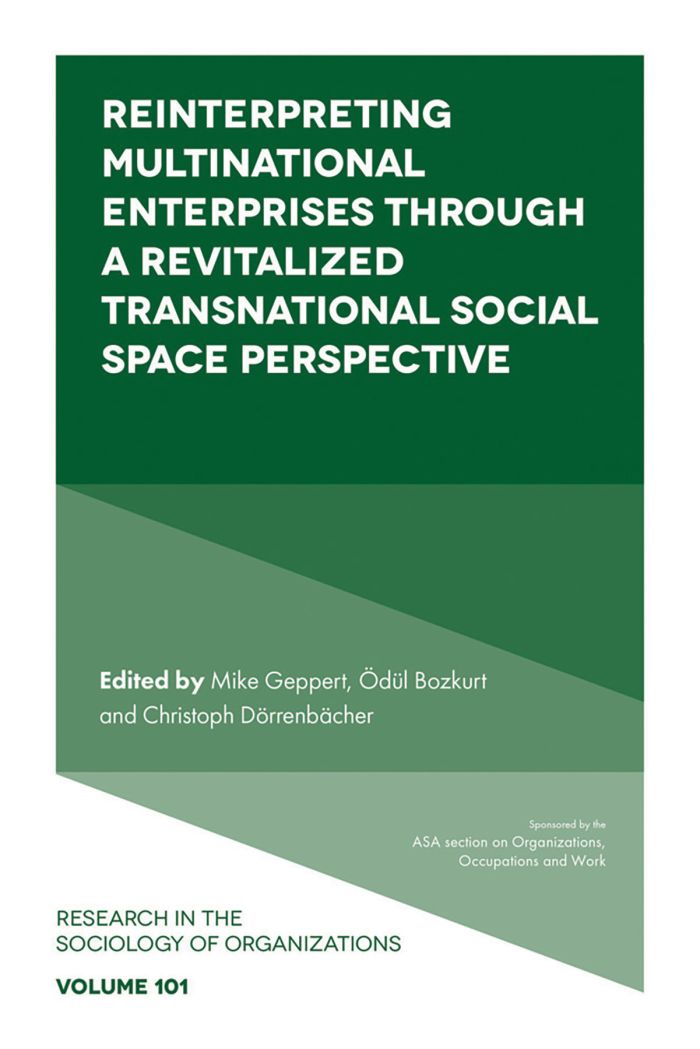
Reinterpreting Multinational Enterprises through a Revitalized Transnational Social Space Perspective

This book can be opened with

Note on our eBooks and Audiobooks: you can read our eBooks (ePUB or PDF) and listen to audiobooks on the free Emerald Books app on iOS, Android, and desktop. Or read and listen on Emerald's online reader (ePUB eBooks and audiobooks only). To purchase a digital book you will need to create an account if you don’t already have one. After purchasing you will receive instructions on how to get started.
- Description
- Contents
- Reviews
- About
The transnational social space approach has been extensively utilized in migration studies and partly also in management studies. In the latter, a key research focus is on multinational enterprises (MNEs). This Research in the Sociology of Organizations volume reinvigorates and leverages the transnational social space approach to further develop it, addressing the role of MNEs in solving Grand Challenges.
Taking an interdisciplinary approach by drawing on ideas outside of mainstream Organization Studies, such as Social Geography, Migration Studies, Political Economy, Economic Sociology, and International Business, papers take on the challenge of addressing ‘wicked problems’ like climate change, poverty, health, and inequality.
Applying the transnational social space idea as an ‘envelop framework’, the papers broaden the scope of theorizing from various theoretical angles and disciplines and enlarge the empirical scope to fields where the MNE is not automatically the central unit of study. Also, paying attention to whether and how MNEs can shape and, in some cases, distort transnational social spaces as powerful players, the papers, taken together, investigate when, why, and how MNEs can be seen as part of the problem or the solution to grand challenges.
Chapter 1. Reinterpreting Multinational Enterprises through a Revitalized Transnational Social Space Perspective: Introduction and Outlook; Mike Geppert, Ödül Bozkurt, and Christoph Dörrenbächer
- PART I
- Chapter 2. The Self-Preservation Perspective of the MNE Applied in an Emerging Transnational Social Space: A New Theoretical Lens for Analyzing Anti-Societal Firm Behavior; Stephen R. Buzdugan, David Freund, Mats Forsgren, and Ulf Holm
- Chapter 3. A Seat at the Table: A Polycentric Perspective on MNEs and Grand Challenges; Christopher A. Hartwell
- Chapter 4. International Sanctions, Transnational Social Space Dynamics and Human Resource Implications for Multinational Enterprises; Fang Lee Cooke and Geoffrey Wood
- PART II
- Chapter 5. On the Role of Issue-based Transnational Communities in MNE Organizing for Sustainability; Lutz Preuss and Ralf Barkemeyer
- Chapter 6. Global Value Chains and Transnational Social Spaces and Communities: The Emergence of a Circular Economy in the Apparel Industry; Mohammad B. Rana, Matthew M. C. Allen, and Syed Ahmed Tajuddin
- Chapter 7. Developing Transnational Social Space in an Emerging Market: How a Chinese NGO Led Apple to Clean Up Local Supply Chains; Haitao Yu, Jacky Hong, and Wenjie Liu
- PART III
- Chapter 8. Global Issues and Transnational Social Spaces: The Attention of Multinational Enterprises to Grand Challenges; Philipp Poschmann, Lisa-Maria Gerhardt, Michael Hunoldt, Jan Goldenstein, and Peter Walgenbach
- Chapter 9. Globalism and Its Discontents: A Case Study of Two Turkish MNCs between Globalism and Nationalism; Ozan Duygulu and S. Arzu Wasti
- PART IV
- Chapter 10. Transnational Communities in MNE Organizing for Sustainability: Towards a Typology; Lutz Preuss and Ralf Barkemeyer
- Chapter 11. The Failure of the International Business Discipline to Revitalize the Understanding of the Multinational Enterprise: The Example of the Global Factory Approach; Christoph Dörrenbächer and Mike Geppert
This Research in the Sociology of Organizations volume offers innovative theoretical and methodological contributions to research on MNEs. We are living in extraordinary times – marked by shifting geopolitics, rising nationalism, rapid advances in artificial intelligence, and other transformative forces – that are reshaping MNEs both internally and externally. In response, it is crucial for researchers to reconceptualize and rethink how we study MNEs as complex, dynamic organizations. This Research in the Sociology of Organizations volume contributes to that effort by introducing the transnational social space perspective, offering valuable insights into the evolving role of MNEs in addressing grand societal challenges. It also fosters critical reflection on the future of MNEs in a rapidly changing world.
At a time of growing populist nationalism and the resulting turbulence surrounding international trade and global value chains, this book is both timely and stimulating. While the 'rule-based international order' is under increasing threat and becoming weaker, this book focuses on the role of transnational social spaces within and alongside MNCs in shaping their dynamics and destiny.
The editors and contributors are leading experts in international business and management studies, offering an innovative and coherent perspective on transnational social spaces as powerhouses that influence, restrict and balance individual, collective and organizational action dynamics.
With its inspiring new perspective, this book is essential reading for students and scholars of international organizations, as well as managers and politicians involved in shaping the course of MNCs in an era of growing global disorder and challenges.
This fascinating volume provides a different way of looking at business and at transnational communities by merging the literature on multinational corporations with the literature on transnational social spaces. The papers demonstrate how useful this approach can be for addressing crucial issues like sustainability, corporate malpractice, nationalism and economic revitalization. The book allows researchers to consider ways in which MNCs can, and do, address grand challenges in a way that takes the needs of all stakeholders, local and global, into account, as well as developing new typologies and new models and maps of transnational business organization. A must read for academics interested in multinational corporations or in global social organization.
Mike Geppert is Professor of Strategic and International Management in the Faculty of Economics and Business Administration at the Friedrich Schiller University Jena, Germany.
Ödül Bozkurt is Professor of Work and Employment in the Department of Management at the University of Sussex Business School, UK.
Christoph Dörrenbächer is a Professor of Organizational Design and Behaviour in International Business in the Department of Business and Economics at the Berlin School of Economics and Law, Germany.