
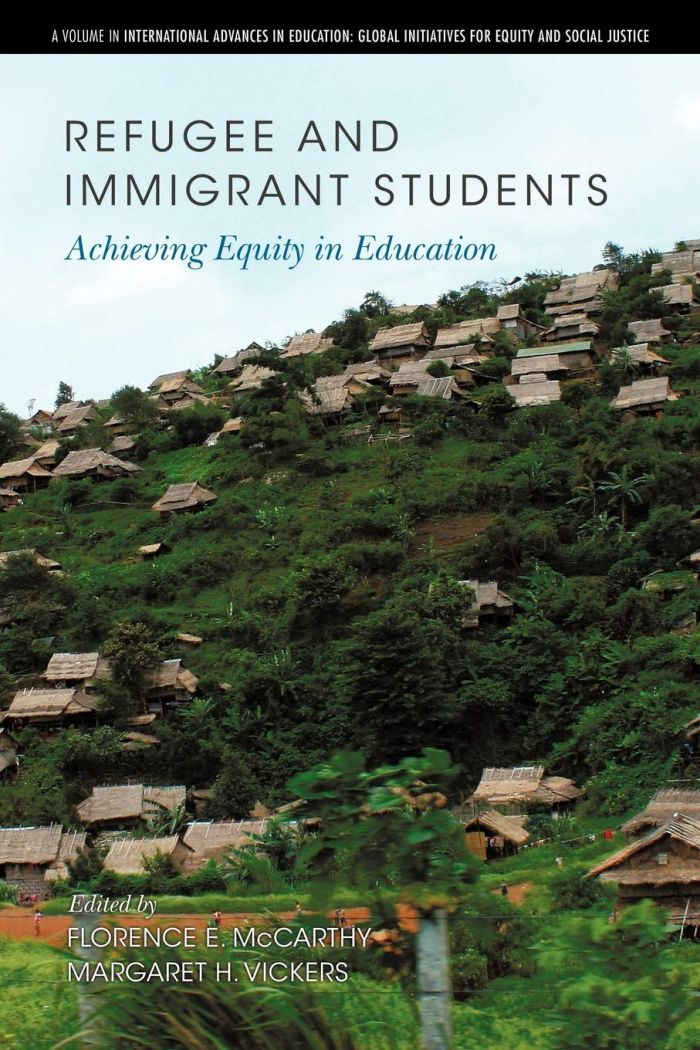
Refugee and Immigrant Students
Achieving Equity in Education

This book can be opened with

Note on our eBooks and Audiobooks: you can read our eBooks (ePUB or PDF) and listen to audiobooks on the free Emerald Books app on iOS, Android, and desktop. Or read and listen on Emerald's online reader (ePUB eBooks and audiobooks only). To purchase a digital book you will need to create an account if you don’t already have one. After purchasing you will receive instructions on how to get started.
- Description
- Contents
The focus of this book is on educational equity issues affecting immigrants and refugees around the world. Chapters highlight educational approaches that build from experiential knowledge, draw upon multiple languages, consider group identity, grapple with the complexities of inclusion, address family concerns, promote parental involvement, involve liaison with community agencies, and view cultural differences as educational strengths. While the book does not shy away from exploring the more challenging aspects of the refugee and immigrant experience, it avoids dwelling on victimology and rejects applying a deficit framework. Rather it offers hope, emphasizing the potential strengths of refugees, including their cultural capital and survival skills. The authors also make cogent suggestions for structural, pedagogical, and conceptual reform, with targets ranging from individual teachers to educational systems to social, economic, political, and cultural contexts.
Contents: Acknowledgements.
- Foreword: For My Grandparents; Carlos E. Cortés.
- Introduction: Education for Immigrants and Refugees: Creating Equitable Pathways for the Futures; Florence E. McCarthy and Margaret H. Vickers.
- Part I. Pedagogical Initiatives Addressing Issues of Educational Equity for Immigrants and Refugees.
- Chapter 1. Positioning Refugee Students as Intellectual Class Members; Karen Dooley.
- Chapter 2. Creating Shared Learning Spaces: An Intercultural, Multilingual Early Learning Program for Preschool Children from Refugee Families; Anna Kirova.
- Chapter 3. Refugees as Educators: The Potential for Positive Impact on Educational Systems; Susan Banki.
- Chapter 4. Identity and Inclusion: Education in Refugee Camps in Thailand; Su-Ann Oh.
- Part II. Refugee and Immigrant School-Community Partnerships.
- Chapter 5. Still Far to Go: Systematic Programming for Immigrant and Refugee Children and Youth; Marian J. Rossiter and Tracey M. Derwing.
- Chapter 6. Serving the Needs of Refugee Children and Families Through a Culturally Appropriate Liaison Service; J. Lynn McBrien and Jillian Ford.
- Chapter 7. Schools at the Crossroads of Competing Expectations; Linda Silka.
- Part III. Systemic Issues and Policies for Refugee and Immigrant Educational Equity.
- Chapter 8. Australia's New Arrivals Policy and the Need to Reform Refugee Education Provision; Florence E. McCarthy and Margaret H. Vickers.
- Chapter 9. Equity in Education for Migrant and Refugee Children: Issues from the United Kingdom; Jill Rutter.
- Chapter 10. Post-Primary Education Dilemmas in Protracted Refugee Situations; Timothy Brown.
- Chapter 11. Learning from the Education Programs for Sri Lankan Refugee Students in India; K. C. Saha.