
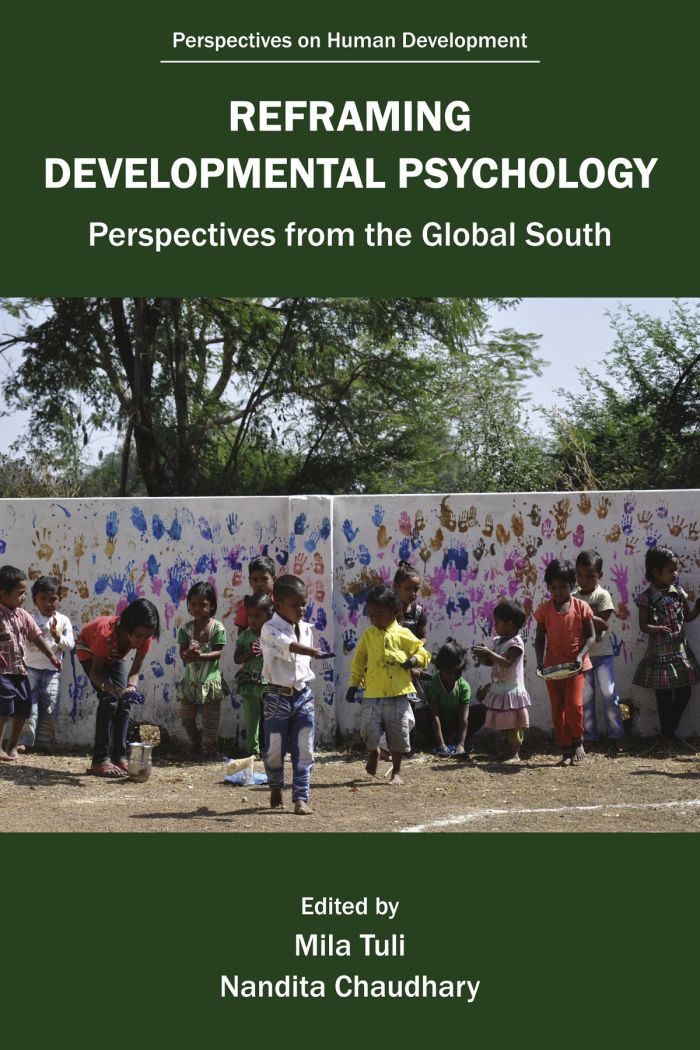

Reframing Developmental Psychology
Perspectives from the Global South

This book can be opened with

Note on our eBooks and Audiobooks: you can read our eBooks (ePUB or PDF) and listen to audiobooks on the free Emerald Books app on iOS, Android, and desktop. Or read and listen on Emerald's online reader (ePUB eBooks and audiobooks only). To purchase a digital book you will need to create an account if you don’t already have one. After purchasing you will receive instructions on how to get started.
- Description
- Contents
- About
Reframing Developmental Psychology: Perspectives from the Global South critically examines the dominant frameworks in Developmental Psychology, challenging the discipline’s reliance on mainstream theories, universalist assumptions, and culturally narrow research samples. By addressing issues such as WEIRD (Western, Educated, Industrialized, Rich, Democratic) psychology and developmentalism, the book calls for a more inclusive and culturally grounded approach to understanding human development. Contributors to this volume carefully question the assumptions that underlie conventional developmental discourse and advocate acknowledging historical contexts, cultural specificity, and diverse epistemologies, while retaining the larger objective of universal scientific study. Universalism should not imply uniformity.
Emphasizing perspectives from the Global South - understood as both a geographical and conceptual space - this book highlights the importance of integrating indigenous knowledge systems, alternative methodologies, and collaborative scholarship in the advancement of a culturally informed study of human developmental processes. It critiques the over-reliance on positivist, standardized research methods that fail to capture the complexities of meaning-making and cultural variation. Instead, it calls for a redefinition of what constitutes valid knowledge, advocating for interdisciplinary approaches that bridge psychology, anthropology, sociology, literature and philosophy. By dismantling colonial legacies and reconsidering the ethical, epistemological, and methodological foundations of the field, the book fosters a vision of Developmental Psychology that is equitable, pluralistic, and responsive to the diverse realities of human experience.
Introduction; Nandita Chaudhary and Mila Tuli
- SECTION I. Repositioning the Discourse in Developmental Psychology
- Chapter 1. A Critical Interrogation of ‘Developmentalism’ in Developmental Psychology: Paving a Way for Critical-Cultural Thinking; Parul Bansal
- Chapter 2. In Search of a New Paradigm: Why WEIRD Psychology Does Not Work in Developmental Science; Ana Luiza and Giuseppina Marsico
- Chapter 3. Developmental Science in the Global South: Shared Realities and Challenges; Esteban Durán-Delgado
- Chapter 4. Indigenous Contributions to Psychological Reflections and Practices: A Case Study in the Context of an Academic Network; Leandro Pires Gonçalves, Paula Rasia Lira, and Danilo Silva Guimarães
- Chapter 5. From Optimal to Equitable: Rethinking Developmental Models in a Diverse World; Kevin R. Carriere, Nandita Chaudhary, Leah Goldman, and Pedro Trindade
- SECTION II. Contextualizing Development: Children, Adults and the Elderly
- Chapter 6. Psychologies in Dialogue: A Personal Story; Vasudevi Reddy
- Chapter 7. Pride, Glory, Resentment and Shame: Play of Shared Sentiments in the Construction of Self and Family Worth among Children; Arpita Sahoo
- Chapter 8. Discovering the Self through Life and Art: The Little-Grand Narrative of Sonabai Rajawar; Punya Pillai
- Chapter 9. Childhood Beyond Developmental Psychology; Ravneet Kaur
- Chapter 10. Discerning the Local from the Pancultural: A Focus on Fathering and Childhood Development; Jaipaul Roopnaraine and Dickson M. M. Ong’Ayi
- Chapter 11. Growing Old, Caring and Being Cared For: Redefining the Place of the Elderly in Family Life; Mila Tuli
- SECTION III. New Frontiers in Developmental Psychology
- Chapter 12. The Birth of Research: A Difficult Delivery; Giuseppina Marsico and Jaan Valsiner
- Chapter 13. Shifting Gears ‘Methodically’: From Lab to Everyday Experiences; Deepa Chawla
- Chapter 14. Inclusive Education in India: Examining Emerging Epistemologies; Ankur Madan
- Chapter 15. Mediating Childhood Trials and Memories; Asha Singh
- Chapter 16. Recognising Developmental Diversity: The Imperative for Culturally Guided Development Policies; Bhavna Negi
Mila Tuli is full Professor at the Department of Human Development and Childhood Studies, Institute of Home Economics, University of Delhi, India.
Nandita Chaudhary is a Visiting Professor in the Department of Cultural Psychology at the Federal University of Bahia, Brazil.