
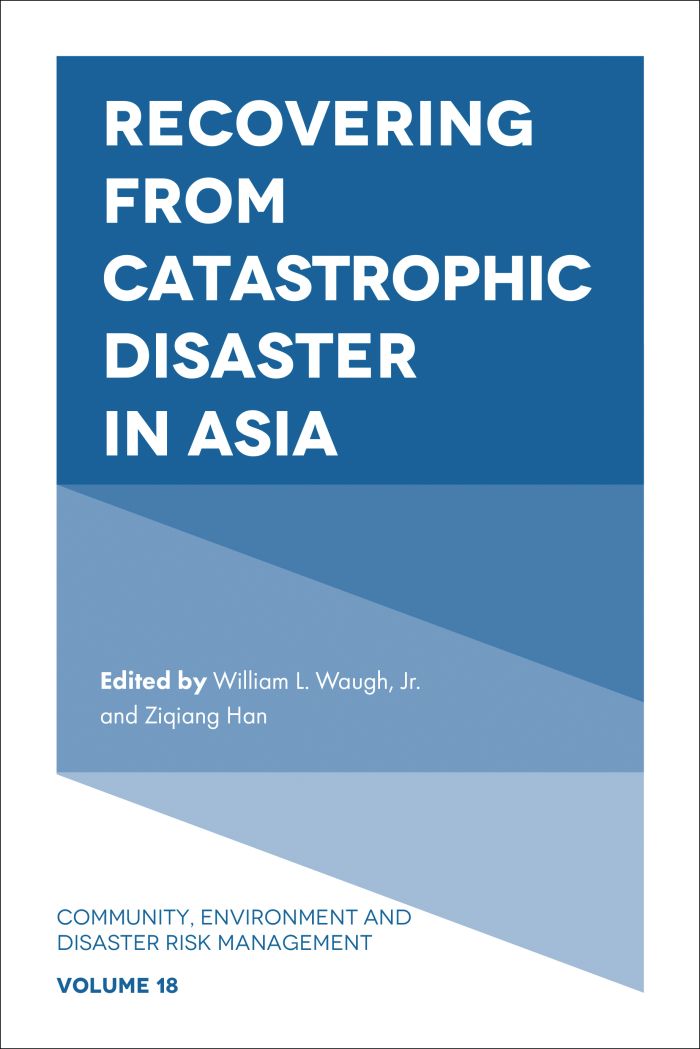
Recovering from Catastrophic Disaster in Asia

William L. Waugh Jr|Ziqiang Han
Emerald
Emerald

This book can be opened with

Glassboxx eBooks and audiobooks can be opened on phones, tablets, iOS and Android devices

Hardback
9781786352965
18 September 2017
$141.99
eBook (PDF)
9781786352958
18 September 2017
$141.99
eBook (ePub)
9781787148932
18 September 2017
$141.99

Note on our eBooks and Audiobooks: you can read our eBooks (ePUB or PDF) and listen to audiobooks on the free Emerald Books app on iOS, Android, and desktop. Or read and listen on Emerald's online reader (ePUB eBooks and audiobooks only). To purchase a digital book you will need to create an account if you don’t already have one. After purchasing you will receive instructions on how to get started.

  • Description
  • Contents
  • Reviews
  • About
Volume 18 of the Community, Environment and Disaster Risk Management series looks at how cities and countries recover from catastrophic disasters with a specific focus on Asia. Asia has experienced devastating disasters over the centuries. Proximity to the seismically active “Ring of Fire” and other plate boundaries, long Pacific and Indian Ocean coastlines, major river and tributary courses, desert and semi-desert areas, and other geographic features create a diversity of hazards and potential hazards. Chapters cover topics including International Humanitarian Assistance and Disaster Recovery, Disaster exceptionalism in India, Immigrant and refugee experiences in Canterbury and Tohoku, Citizen Participation in the Disaster Reconstruction Process after the Great East Japan Earthquake, and Social Capital and Changes in Post-Disaster Recovery Process in China after the 2008 Wenchuan Earthquake.

Chapter 1, Disaster Recovery in Asia: An Introduction; Ziqiang Han and William L. Waugh, Jr.  

  • Chapter 2, Social Capital and Changes in Post-Disaster Recovery Process: Observations from China after the 2008 Wenchuan Earthquake; Ziqiang Han 
  • Chapter 3, Recovering from Prolonged Negative Destination Images in Post-Disaster Northern Japan; David N. Nguyen and Fumihiko Imamura  
  • Chapter 4, Restoration of Communities Following the Great East Japan Disaster: the Transformation of Mutual Help Networks through the Eyes of the Victims; Morio Onda  
  • Chapter 5, Lessons from Disaster Recovery in Japan through Case Studies of Four Earthquakes; Yingying Sun
  • Chapter 6, Citizen Participation in the Disaster Reconstruction Process: Lessons from the Great East Japan Earthquake; Takashi Tsuji 
  • Chapter 7, Social Vulnerability in Disasters: Immigrant and Refugee Experiences in Canterbury and Tohoku; Shinya Uekusa 
  • Chapter 8, Disaster Exceptionalism in India: The View From Below; José Manuel Mendes 
  • Chapter 9, The 2015 Nepal Earthquake: From Rescue to Reconstruction; Chandra Lal Pandey  
  • Chapter 10, International Humanitarian Assistance and Disaster Recovery in Asia; William L. Waugh, Jr.

Sociologists and specialists in technical and policy aspects of disaster planning and response present case studies to illustrate particularly Asian approaches to recovering from catastrophe. Their topics include social capital and changes in post-disaster recovery process: observations from China after the 2008 Wenchuan earthquake, the restoration of communities following the Great East Japan Disaster: the transformation of mutual help networks through the eyes of the victims, lessons from disaster recovery in Japan through case studies of four earthquakes, disaster exceptionalism in India: the view from below, and international humanitarian assistance and disaster recovery in Asia.

- Annotation ©2017
William L. Waugh Jr. is Professor Emeritus in the Andrew Young School of Policy Studies at Georgia State University and editor-in-chief of the Journal of Emergency Management. Dr. Waugh is the author of International Terrorism (1982); Terrorism and Emergency Management (1990); and Living with Hazards, Dealing with Disasters (2000); and the coeditor of Handbook of Emergency Management (1990); Cities and Disasters (1990); Disaster Management in the U.S. and Canada (1996); and Emergency Management: Principles and Practice for Local Government, 2nd Ed. (2007); and, as well as over 200 articles, chapters, essays, and reports published in the U.S., Canada, Europe, and Asia. His current research focuses on collaboration in Disaster Management and capacity-building for community resilience. 

Dr Ziqiang Han is an Associate Professor at the Institute for Disaster Management and Reconstruction, Sichuan University-The Hong Kong Polytechnic University in China. He is also a joint researcher at the Center for Crisis Management Research, Tsinghua University. His research interests are disaster recovery and sustainable development, multi-organizational cooperation in emergency management, risk perception and decision making, institutional disaster preparedness, and disaster education. Dr.Han has published a number of papers on Natural Hazards, Risk, and Hazards & Crisis in Public Policy in the International Journal of Disaster Risk Science, China Emergency Management Journal, Journal of Risk, and the Disaster & Crisis Research.