
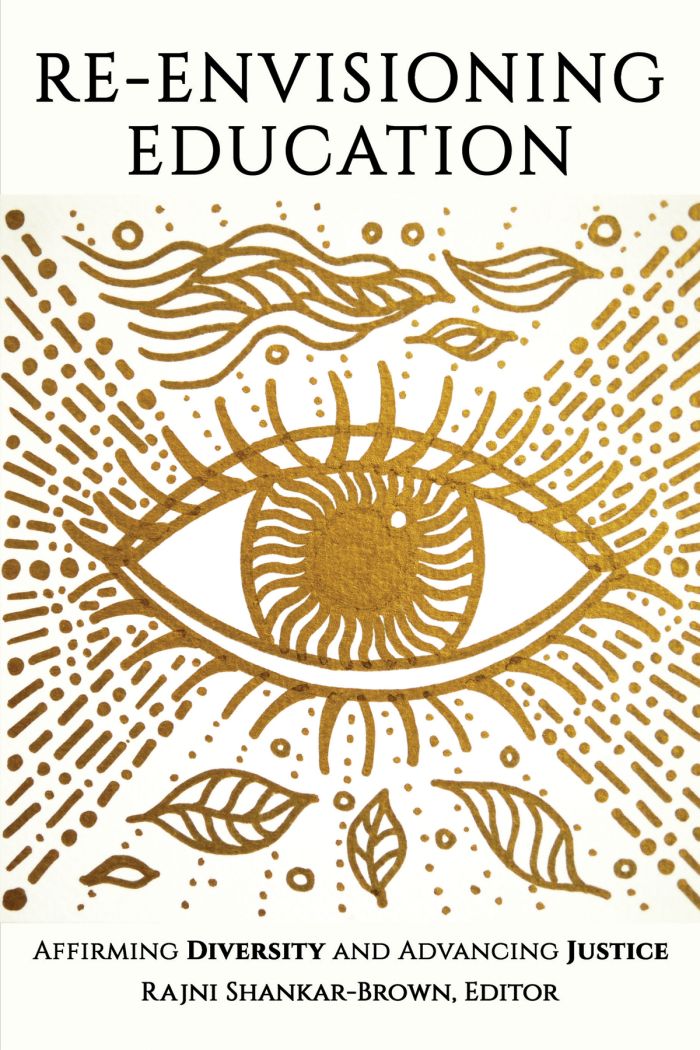

Re-Envisioning Education
Affirming Diversity and Advancing Justice

This book can be opened with

Note on our eBooks and Audiobooks: you can read our eBooks (ePUB or PDF) and listen to audiobooks on the free Emerald Books app on iOS, Android, and desktop. Or read and listen on Emerald's online reader (ePUB eBooks and audiobooks only). To purchase a digital book you will need to create an account if you don’t already have one. After purchasing you will receive instructions on how to get started.
- Description
- Contents
With increasing diversity and widening disparities in the United States and globally there are significant challenges and opportunities throughout the educational landscape. Today’s educational stakeholders, particulary public school administrators and teachers, must re- envision education and collectively build equity-centered systems, structures, and practices. Confronting systemic inequality in education can be a daunting task, but it is nonetheless imperative. Connecting theory to practice, this book aims to promote inclusive educational excellence, and will offer valuable insights and inspiration to a wide range of educational stakeholders.
Affirming diversity and advancing social justice requires dismantling oppressive customs and structures inside and outside of the classroom, fostering an equitable school culture, building inclusive learning environments, and increasing collective efficacy though best practice. Creating healthier schools and communities requires authentically investing in and supporting historically and socially marginalized students and families. Rooted in social justice and weaving together diverse voices from the field of education, this edited volume will examine equity-focused pre-K–12 pedagogical practices and showcase high-impact initiatives. Educators play a vital role in ensuring positive student outcomes and success, but often report feeling inadequately prepared for current challenges. Unfortunately, growing challenges are contributing to turnover rates and shortages as well as perpetuating social inequities among pre-K–12 students instead of dismantling them. A research study by the National Association of Secondary School Principals (NASSP) and the Learning Policy Institute (LPI) reveals that public schools with higher percentages of low-income students and students of color are more likely to experience administrative and teacher turnover, which compounds equity issues affecting already vulnerable students.
This edited volume will provide educational stakeholders (i.e., school administrators, teachers, service providers, parents/guardians, nonprofit leaders, community members) with a deeper understanding of pedagogical practices that affirm diversity and promote social justice, while offering a current view of educational inequalities juxtaposed with an urgent call to action. School districts across the United States must recognize inequalities and provide increasingly diverse students with needed support and resources, particularly as social dispairties continue to widen and adversely impact millions of students. Through a collection of diverse voices from the field of education (university educators; pre-K–12 district leaders, schools administrators and teachers; Nonprofit leaders serving children and youth) this book will illuminate current social inequalities impacting pre-K–16 students, establish the need to affirm diversity and advance social justice, share practical examples of transformative initiatives including mindful school-family- community partnerships, feature evidence-based pedagogical practices, and provide an array of helpful resources for 21st century educational stakeholders.
Acknowledgments.
- Chapter 1. Manifesting Justice: Transforming Education Toward Beloved Community; Rajni Shankar-Brown.
- Chapter 2. Facilitating Change: Families and Educational Leadership Creating Equity; Keri-Anne Croce and Johanna Mullally.
- Chapter 3. Supporting English Learners in Your School: Essential Practices for Ensuring Linguistic Equity; Ayanna Cooper and Shelley Jallow.
- Chapter 4. Growing Up Brave on the Margins: Equity-Focused Literacy Leadership in Practice Through an American Library Association Collaborative Grant Initiative; Anne Katz.
- Chapter 5. Learning Without Limits: Building the Bridge Between Students, the Community, and the World; Elizabeth Felts.
- Chapter 6. Leading Restorative Justice Efforts for Equity in Secondary Schools; Paula Smith and Alisha M. Brown.
- Chapter 7. Uprooting Injustice: School Gardens Provide Fertile Ground For Antiracist Education; Sarah E. Cramer.
- Chapter 8. Combating Racism and Educational Violence in Higher Education; Frederick V. Engram Jr.
- Chapter 9. Preparing and Mentoring New Teachers in an Increasingly Diverse World; Heather D. Young.
- Chapter 10. Painting With Words: A Writing Pedagogy That Defies Social Inequities; Julie Batten.
- Chapter 11. Improvement Science and Equity: Building Pathways Through College for Underrepresented Students; Liliana Donchik Belkin.
- About the Authors.