
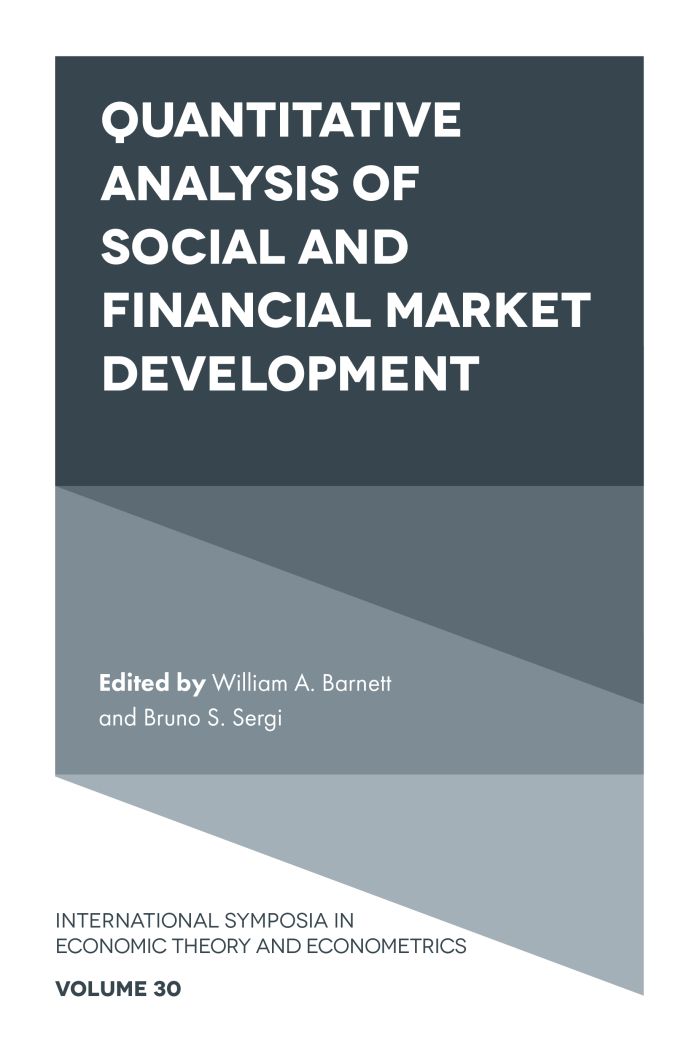

Quantitative Analysis of Social and Financial Market Development

This book can be opened with

Note on our eBooks and Audiobooks: you can read our eBooks (ePUB or PDF) and listen to audiobooks on the free Emerald Books app on iOS, Android, and desktop. Or read and listen on Emerald's online reader (ePUB eBooks and audiobooks only). To purchase a digital book you will need to create an account if you don’t already have one. After purchasing you will receive instructions on how to get started.
- Description
- Contents
- About
This 30th volume of the International Symposia in Economic Theory and Econometrics explores the latest social and financial developments across Asian markets. Chapters cover a range of topics such as the impact of COVID-19 related events in Southeast Asia along the determinants of capital structure before and during the pandemic; the influence of new distribution concepts on macro and micro economic levels; as well as the effects of long-term cross-currency basis swaps on government bonds. These peer-reviewed papers touch on a variety of timely, interdisciplinary subjects such as real earnings impact and the effects of public policy.
Together, Quantitative Analysis of Social and Financial Market Development is a crucial resource of current, cutting-edge research for any scholar of international finance and economics.
Chapter 1. Effect of Related Party Transaction and Political Connection on Real Earnings Management: Study on Manufacturing Companies Listed in Indonesia Stock Exchange; Agustin Palupi and Lusia Tania Aurelia
- Chapter 2. Exchange Rate Volatility and Tourist Arrivals from ASEAN to Malaysia; Eliza Nor, Tajul Ariffin Masron, and Hu Xiang
- Chapter 3. The Impact of Long-Term Cross-Currency Basis Swap on Japanese Government Bonds: Analysis of Different Non-traditional Monetary Policy Regimes ; Takayasu Ito
- Chapter 4. The Impact of COVID-19-Related Events on Indonesian Composite and Sectoral Index; Muhammad Hasan Ghazali and Taufik Faturohman
- Chapter 5. Customer Satisfaction of E-Wallet User: An Adoption of Information System Success Model; Fariq Rahadiyan Chalik and Taufik Faturohman
- Chapter 6. Stable Financial Performance as the Antecedent of ESG Activity and Firm Value Relationship: An Evidence from Indonesia; Yavida Nurim, Nung Harjanto, Paulina I. Prabawati, and Nur R. Wijaya
- Chapter 7. An Initial Study of Knowledge Sharing Policies in Higher Education; Lina Anatan
- Chapter 8. An Empirical Analysis of Firm-specific Determinants of Capital Structure Before and During COVID-19 Pandemic: Evidence from Listed Hotels, Restaurants, and Tourism Entities on the Indonesia Stock Exchange; Taufik Faturohman and Rashifa Qanita Noviandy
- Chapter 9. Modern Concepts of Distribution of Knowledge and Their Influence on the Process of Diffusion of Innovations on Macro and Micro Levels of Economy; Mikhailov Fedor Borisovich, Miasnikov Dmitrii Alekseevich, and Fakhrutdinov Bulat Ildarovich
- Chapter 10. Are Unhappy People More Likely to Be Religious? Evidence from Chinese Rural Elderly; Liying Xia, Jianbo Zhang, and Xuelin Ma
William A. Barnett is the Oswald Distinguished Professor of Macroeconomics at the University of Kansas, Director at the Center for Financial Stability in New York City, Founder and First President of the Society for Economic Measurement, and Editor of the Cambridge University Press journal, Macroeconomic Dynamics.
Bruno S. Sergi is an instructor at Harvard University, a faculty affiliate at the Center for International Development at Harvard, and an Associate at the Harvard Davis Center for Russian and Eurasian Studies and the Harvard Ukrainian Research Institute