
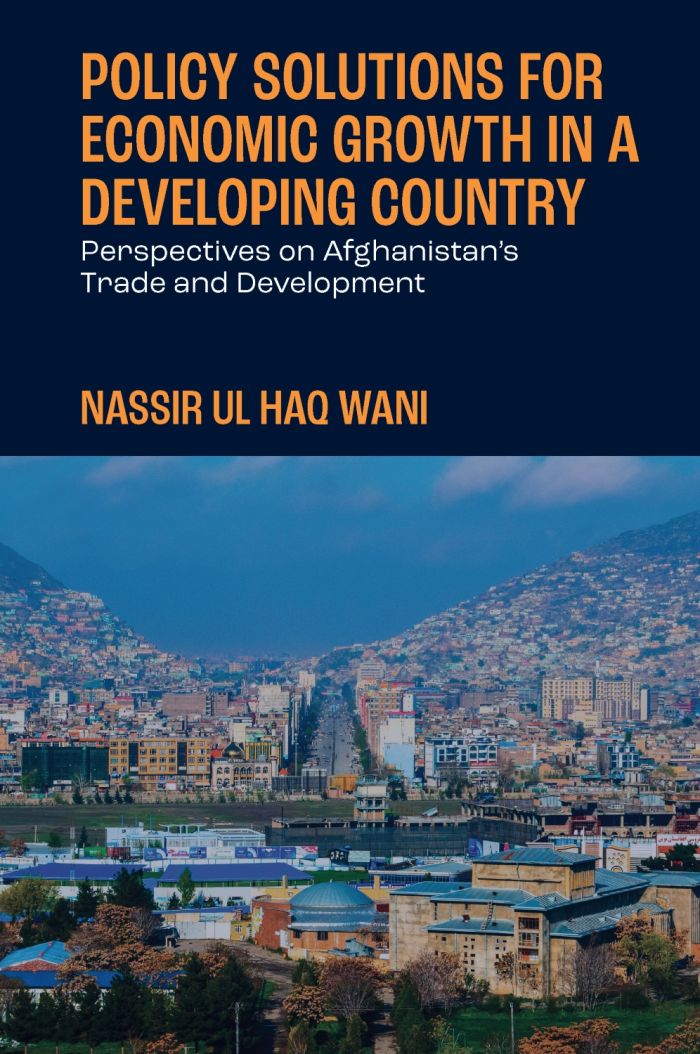

Policy Solutions for Economic Growth in a Developing Country
Perspectives on Afghanistan’s Trade and Development

This book can be opened with

Note on our eBooks and Audiobooks: you can read our eBooks (ePUB or PDF) and listen to audiobooks on the free Emerald Books app on iOS, Android, and desktop. Or read and listen on Emerald's online reader (ePUB eBooks and audiobooks only). To purchase a digital book you will need to create an account if you don’t already have one. After purchasing you will receive instructions on how to get started.
- Description
- Contents
- Reviews
- About
Following the recent change in regime, Afghanistan is at a crossroads. Key to its stability is economic growth and international trade, yet many obstacles stand in its way. In Policy Solutions for Economic Growth in a Developing Country, author Nassir Ul Haq Wani outlines these challenges and offers clear policy solutions that will put the country on a path to revive, regenerate, and revitalize its economy. Further, he contextualizes Afghanistan within the region, giving greater insight into the needs of other developing countries.
This in-depth study analyses the trading platform at national, international and regional levels for initiating a consistent and sustainable set of policies to promote exports. Alongside macroeconomic stability, this study argues that private sector development, technological progress, socio-economic balance, trade liberalization and a reinvigoration of exports can play an effective role in wealth creation for Afghanistan.
Perspectives on Afghanistan’s Trade and Development offers a rich and varied policy analysis for those who wish to design a policy to bolster exports from Afghanistan, and for academicians, researchers and students who wish to gain greater insight into this developing economy.
Part I. Introduction
- Introduction to the book
- Part II. Nexus between Trade and Development
- Chapter 1. Afghanistan’s Regional Integration with Central Asia: Identifying Trade Linkages, Economic Recital, and Future Latency
- Chapter 2. Trade Potential of Afghanistan with SAARC Region and European Union: A Gravity Model Approach
- Part III. Determinants of Trade Costs, Export Supply, Diversification, and Growth
- Chapter 3. Drivers of Export Supply in SAARC: Investigating the Cross Evidence from Afghanistan
- Chapter 4. Export Diversification in ASEAN and SAARC Regions: Exploring Trends Patterns and Determinants through Empirical Investigation
- Chapter 5. Trade Costs of Afghanistan with its Major Trading Partners: Measurement and its Determinants
- Part IV. Policy Concerns: Some Insights
- Chapter 6. Incidence of Reverse Capital Flight to Afghanistan: An Empirical Examination
- Chapter 7. Afghanistan’s Regional and Bilateral Free Trade Agreements: An Evaluation of Trade Effects, Diversion and Creation
- Chapter 8. Impact of Non-Tariff Measures on Trade Within the SAARC Region: An Empirical Investigation of Afghanistan
First of its kind, comprehensive and illuminating insight into Afghanistan with concrete recommendations on how the country can thrive and help itself reform its trade and trade relations with the world.
mmersing myself in the pages of this book, I journeyed through the world of Afghanistan's global trade, concluding with enriched insights essential for academics and policymakers.
I highly recommend this book for its in-depth exploration of Afghanistan's international trade journey, especially post-2001. It provides valuable insights for policymakers and scholars, offering innovative trade proposals and insights into Afghanistan's global trade role. Essential for understanding Afghanistan's trade potential.
This book provides a timely and profoundly insightful exploration into a fundamental question that has bedevilled economic policy planning for decades – how should developing countries achieve economic growth? Straddling the topics of international trade, globalisation, economic development, state policy planning, and private sector development, Wani diagnoses the impediments to export-oriented growth and proposes ambitious recommendations that may serve as correctives. His focus on Afghanistan provides a rich site for exploring these challenges. Using extensive quantitative analysis alongside well-established theoretical models, Wani positions Afghanistan vis-à-vis its regional neighbours as well as concerning ASEAN and SAARC nations and the European Union, thereby evincing opportunities for enhanced international trade. While optimistic, he also raises the trade-offs of different policy choices. The book draws on Wani’s decade of scholarly engagement with Afghanistan’s economy, ultimately succeeding in providing lessons on economic growth that may be applied to much of the developing world.
Nassir Ul Haq Wani is the Dean of the Department of Research and Development and a Professor at the School of Graduate Studies, Kardan University, Kabul, Afghanistan. He also serves as an Adjunct Professor at Lovely Professional University, Punjab, India; and Director of Kashmir Research Information System (KRIS), J&K, India. He is the Chief Editor of the “Kardan Journal of Economics and Management Sciences (KJEMS)”, “Afghanistan Development Review (ADR)” and the Managing Editor of “Kardan Journal of Social Sciences and Humanities (KJSSH)”.