
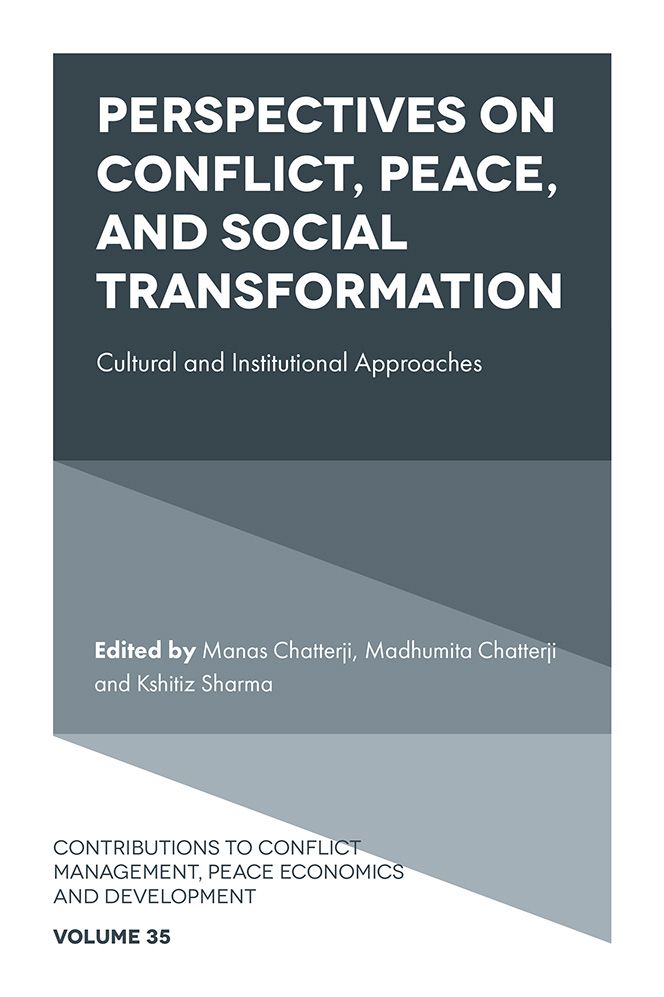
Perspectives on Conflict, Peace, and Social Transformation
Cultural and Institutional Approaches

This book can be opened with

Note on our eBooks and Audiobooks: you can read our eBooks (ePUB or PDF) and listen to audiobooks on the free Emerald Books app on iOS, Android, and desktop. Or read and listen on Emerald's online reader (ePUB eBooks and audiobooks only). To purchase a digital book you will need to create an account if you don’t already have one. After purchasing you will receive instructions on how to get started.
- Description
- Contents
- About
Perspectives on Conflict, Peace, and Social Transformation: Cultural and Institutional Approaches brings together leading scholars from across the world to explore how conflict and peace are shaped by the interplay of cultural narratives, political institutions, ethical frameworks, and economic forces. Moving beyond conventional approaches that focus solely on negotiation or political reform, the volume examines the deeper structures that generate both violence and the possibility of peace.
Across its four thematic sections, the book weaves together diverse analyses - from media influence, spiritual traditions, and artistic dialogue to governance failures, peace metrics, and climate‑related vulnerabilities. Contributors illuminate how discursive, institutional, and developmental forces co‑produce conflict dynamics, while also offering grounded pathways toward positive peace, community resilience, and structural transformation.
Rich in theory, empirical research, and interdisciplinary insight, this volume advances a holistic understanding of peace as more than the absence of violence. It presents peace as a living system rooted in cultural empathy, ethical governance, inclusive institutions, and sustainable economic environments. Scholars, policymakers, peace practitioners, and students will find in these pages a compelling call to rethink how societies build just and lasting peace.
Chapter 1. An Analysis on the Role and Impact of Media and Artificial Intelligence in Conflict Management; Pranav Varma M
- Chapter 2. Building the Bridges: Art-Based Dialogue as a Medium to Social Cohesion and Peacebuilding; Kaleli Nyaichyai
- Chapter 3. Peace and Conflict Pyramid: Indigenous Perspective; Ankur Joshi
- Chapter 4. If Not War, Then What? A Multidimensional Understanding of Security; Lester R. Kurtz, Benjamin Adjei, Md Al Ifran Hossain Mollah, and Amani L. Kurtz
- Chapter 5. Multiparty Democracy and Political Conflict in Africa: Reassessing the Relationship between Political Competition, Ethnic Mobilisation, and Democratic Governance; Lumwanga Augustine, Jive Lubbungu, and Henry Kamocha
- Chapter 6. The Role of the Parliament in Navigating Through Conflict Resolution, State-Building and Development Trajectories of Somaliland (SL); Mukhtar Hassan Maidhane
- Chapter 7. From the Theory of "Happy Globalization" to Superpower Mercantilist Policies for Global Leadership; Eric Brunat and Jacques Fontanel
- Chapter 8. Vedic Ethical Models in Circular Economy Initiatives; Kalman Kelemen
- Chapter 9. Integrating Peace as a Foundation for Sustainable Social Impact; David Hammond
- Chapter 10. Bringing Peace Closer to the People: Key Areas of Intervention in A World of Uncertainty and Complexity; Bijay Anand Misra, Kshitiz Sharma, and Madhumita Chatterji
- Chapter 11. Building Strategy for Human Inclusion; Simona Michelon
- Chapter 12. Peace Pays: Financial Market Reactions to Global Peace Index Movements; Shivaprasad G and Jyothi M
- Chapter 13. Socio-Economic Perspectives of Farmers in Rudrasagar Lake Region, Tripura: Agricultural Practices with Climate Resilient Strategies; Saptarshi Mitra, Prankrishna Dey, Pradip Debnath, and Arpita Biswas
Manas Chatterji is Professor Emeritus at Binghamton University, SUNY, USA.
Madhumita Chatterji is Director of the ABBS School of Management, India.
Kshitiz Sharma is Professor and Dean of the Faculty of Management Studies at Parul University, Goa.