
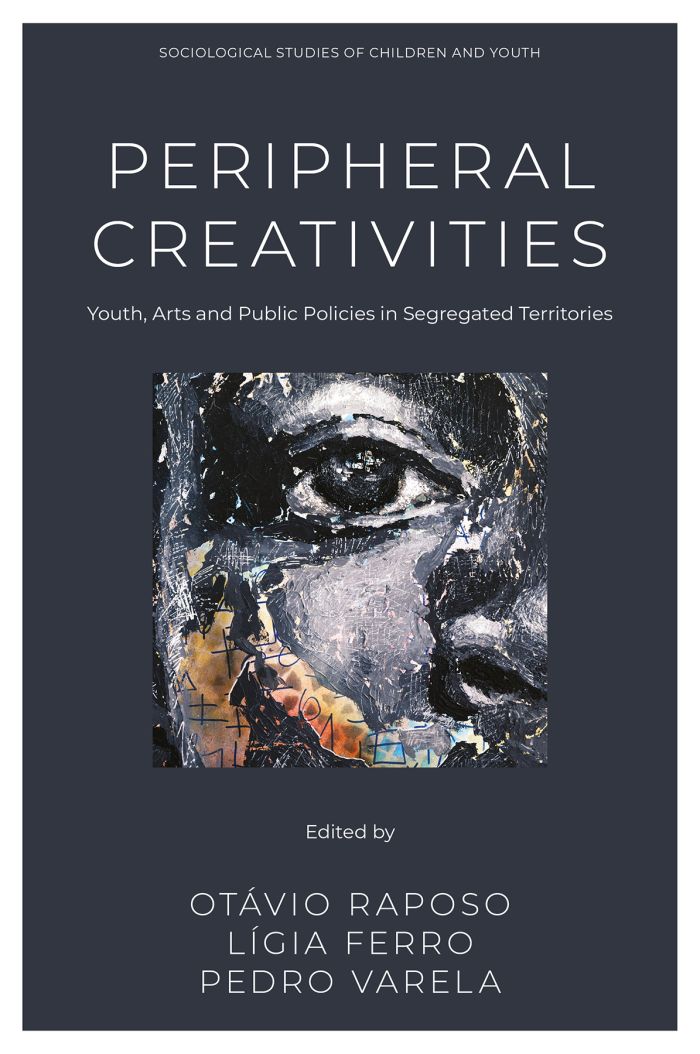
Peripheral Creativities
Youth, Arts and Public Policies in Segregated Territories

This book can be opened with

Note on our eBooks and Audiobooks: you can read our eBooks (ePUB or PDF) and listen to audiobooks on the free Emerald Books app on iOS, Android, and desktop. Or read and listen on Emerald's online reader (ePUB eBooks and audiobooks only). To purchase a digital book you will need to create an account if you don’t already have one. After purchasing you will receive instructions on how to get started.
- Description
- Contents
- About
In a context of polycrisis and lack of opportunities for youth emancipation, it is vital to understand the socio-economic conditions, life experiences, practices, and social representations of young people from disadvantaged backgrounds. Peripheral Creativities examines the intersection of urban segregation, creative practices, and public policy in understanding marginalised youth living in peripheral territories.
Bringing together contributions from sociologists, anthropologists, and other social science scholars across three continents, this edited volume addresses how creativity is mobilised by young people from urban peripheral neighbourhoods, as well as their influence on the (re)definition of public policy targeting them. Developed within the PERICREATIVITY project based in Portugal, the book combines insights from PERICREATIVITY researchers with contributions from scholars working in other parts of the world, offering diverse contexts and perspectives on peripheral youth while highlighting the growing significance of artistic practices in the construction of positive identities and in the subversion of dominant stereotypes. The volume further shows how these creative practices have also been appropriated by the state as instruments of urban governance, linked to agendas of youth participation, local development, and social inclusion.
Advancing knowledge on youth creativity in segregated territories and on public policy, the book pays particular attention to urban segregation, social marginalisation, and structural inequality.
Foreword; Maggie O’Neill
- Introduction; Otávio Raposo, Lígia Ferro, and Pedro Varela
- Pericreativities
- Chapter 1. Youth Citizenship, Artistic and Creative Practices and Technological Mediations; Ricardo Campos
- Chapter 2. Peripheral Youth, Collective Creativity, and the Making of “Sounds of a Revolution”; Alix Didier Sarrouy
- Chapter 3. Hip-Hop Culture and the Affirmation of Thug Identity: a Reading from Cape Verdean Gangsta Rap; Redy Wilson Lima
- Periurbans
- Chapter 4. Counter-imaginaries of Globalisation in Latin-American Urban Margins; Apoena Mano and Talja Blokland
- Chapter 5. The Social Value of Urban Art: Participation, Community and Territory in Latin America; Ricardo Klein
- Chapter 6. A Light in the Neighbourhood: The Revitalising Potential of a Library in a Peripheral Area of Madrid; Rebeca Muñoz García and M. Victoria Gómez García
- Chapter 7. Doubly Peripheral: Schooling Processes for Children and Young People Living in Amadora’s Segregated Contexts; Sandra Mateus and Teresa Seabra
- Chapter 8. Living Under the Same Stigma: From Living in “Shanties” to Living in the “Neighbourhood”; Rita Ávila Cachado
- Peripolitics
- Chapter 9. Youth and Arts Strategy: A Discourse Analysis of English Cultural Policy; Frances Howard
- Chapter 10. Socioeducational Policies to Young People in Peripheral Areas: International Trends and the Portuguese Case; Pedro Abrantes
- Chapter 11. Intersectionality and Cultural Policies: A Critical Reading of the Programme “Art and Urban Peripheries”; João Teixeira Lopes
- Chapter 12. From the Cultural Collective to Social Work: Ambiguities Between Work and Activism; João Rodrigo V. Martins, Livia De Tommasi, and Sílvio Rogério dos Santos
- Chapter 13. Insurgent Institutionalisation: Peripheral Youth Aesthetic Production in São Paulo; Alexandre Barbosa Pereira
Otávio Raposo is a Research Professor of Sociology and Anthropology at the Iscte-University Institute of Lisbon and Centre for Research and Studies in Sociology, Portugal.
Lígia Ferro is Professor of Sociology at the Faculty of Arts and Humanities and a researcher at the Institute of Sociology of the University of Porto, Portugal.
Pedro Varela is an anthropologist and landscape architect. He is Researcher at the Centre for Research and Studies in Sociology at Iscte-University Institute of Lisbon, Portugal.