
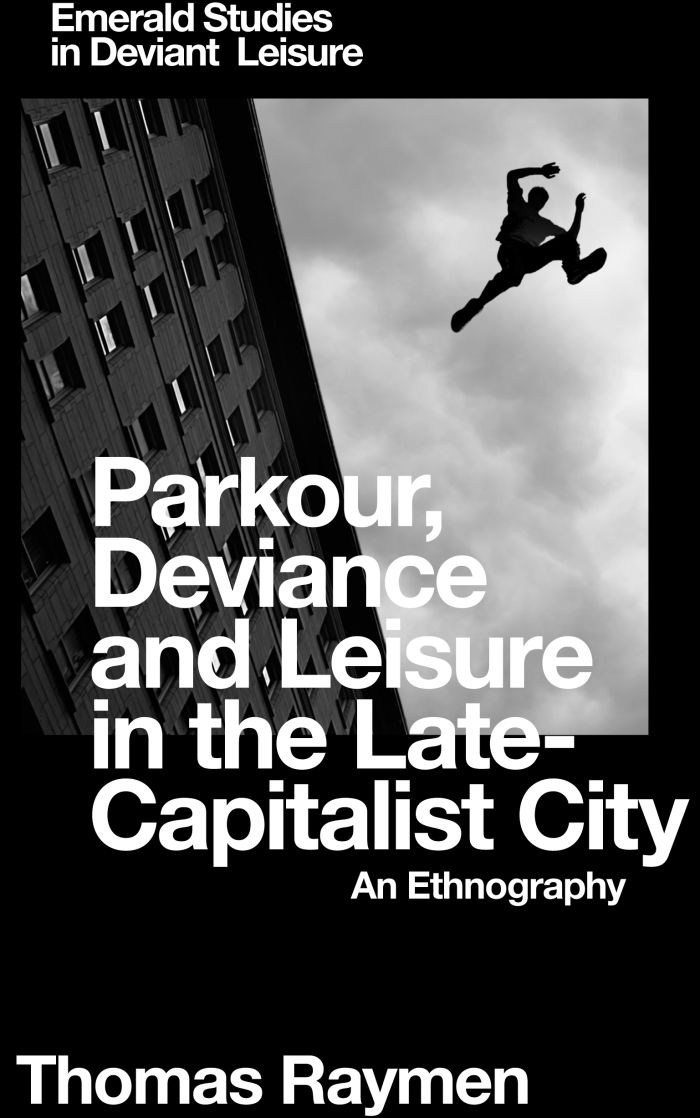

Parkour, Deviance and Leisure in the Late-Capitalist City
An Ethnography

This book can be opened with

Note on our eBooks and Audiobooks: you can read our eBooks (ePUB or PDF) and listen to audiobooks on the free Emerald Books app on iOS, Android, and desktop. Or read and listen on Emerald's online reader (ePUB eBooks and audiobooks only). To purchase a digital book you will need to create an account if you don’t already have one. After purchasing you will receive instructions on how to get started.
- Description
- Contents
- Reviews
- About
Chapter 1. The ‘Paradox’ of Parkour Chapter 2. Moving with the Times: Parkour, Leisure and Social Change Chapter 3. Ultra-Realism, Parkour and Capitalist Ideology Chapter 4. Movers and Shakers Chapter 5. Zombie Cities Chapter 6. The Parkour City Chapter 7. ‘Sorry Lads’ (But I’ve got to move you on) Chapter 8. Conclusion and Futures
Drawing on two years of participatory ethnography in the parkour scene in Newcastle, England, with members of the local parkour community and its associated professional coaching company, the author considers why parkour is excluded from urban space despite its hyper-conformity to the central values of consumer capitalism and its increasing celebration in mainstream media, advertising, and sport and lifestyle markets. He argues that this paradox is a product of late-capitalism and is a key component of capitalism's ideology and a key element in parkour's popularity, in which it appears that participants are fighting back against the system. He describes a broad theory of the changing nature of leisure and identity in late-capitalism; existing criminological and sociological theorizations of parkour and other forms of spatial transgression and their assumptions about human nature, subjectivity, and the relationship between structure and agency; the role of parkour within the pressures and realities of participants' lived experiences of consumer capitalism, particularly parkour as work and leisure; the issues of space and control and how cities attempt to create a veneer of life and the social in the dead-zone of contemporary public space, "zombifying” an urban ambience of living-dead; parkour's embodied practice and how participants move throughout urban space; and how parkour is policed and controlled by private security teams.
[The book offers] an effective corrective to both the academic and popular perceptions of parkour on one hand, and a powerful critique of contemporary late-capitalist society that goes far beyond the subject matter of parkour, on the other. The argument is well-crafted and convincing, the ethnography woven smoothly together with theory, while always keeping in mind the bigger picture, thus becoming far more than a mere ethnography of parkour. The book can be recommended as essential reading to scholars, students, and anyone interested in criminology, sociology and anthropology and for that matter contemporary consumer society – it makes for a good and important read.