
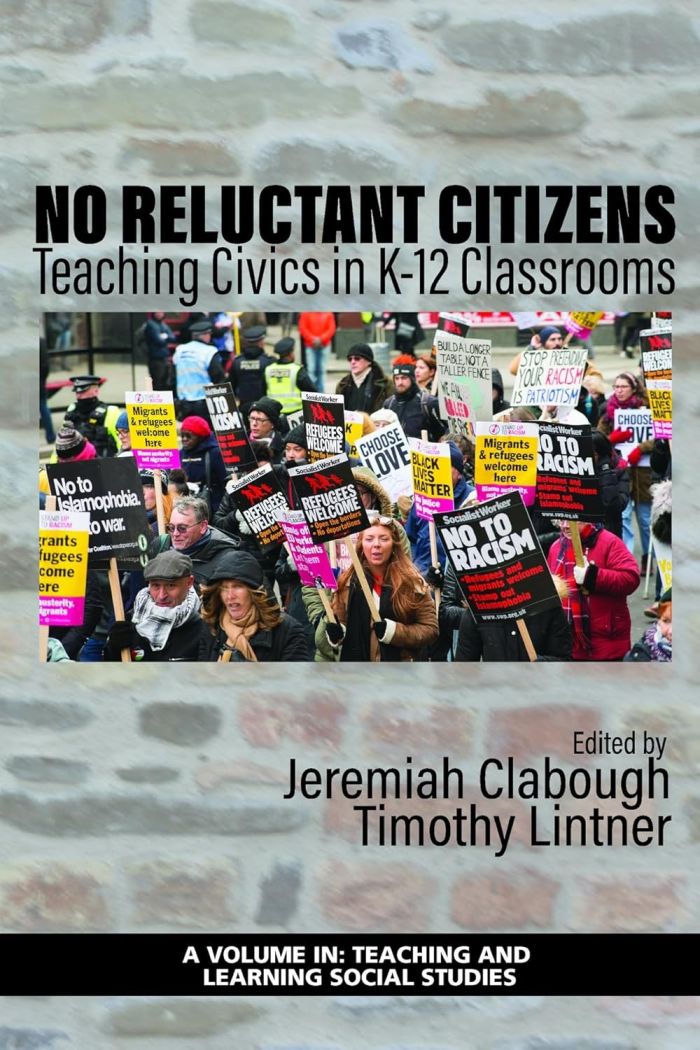
No Reluctant Citizens
Teaching Civics in K-12 Classrooms

This book can be opened with

Note on our eBooks and Audiobooks: you can read our eBooks (ePUB or PDF) and listen to audiobooks on the free Emerald Books app on iOS, Android, and desktop. Or read and listen on Emerald's online reader (ePUB eBooks and audiobooks only). To purchase a digital book you will need to create an account if you don’t already have one. After purchasing you will receive instructions on how to get started.
- Description
- Contents
American democracy is at a critical crossroads. Rancor, division, and suspicion are the unfortunate byproducts of the contentious 2016 presidential election. The election also bred a measure of civic uncertainty where citizens of all ages struggle to find and define their roles within a functioning democracy. No Reluctant Citizens: Teaching Civics in K-12 Classrooms is designed to help social studies teachers reinforce the centrality of civic education through a series of hands-on, participatory, and empowering activities. From civic literacy to human rights, from service learning to controversial issues, No Reluctant Citizens: Teaching Civics in K-12 Classrooms explores an array of topics that ultimately provides K-12 students the conceptual and practical tools to become civically engaged.
Introduction; Jeremiah Clabough.
- Chapter 1. Civic Literacy: The Building Blocks for Creating an Active and Informed Citizenry; Jeremiah Clabough.
- Chapter 2. Character Education: The Pathway to Citizenship; Thomas N. Turner.
- Chapter 3. Elementary Civics Education and Diversity (Inclusion); Janie Hubbard.
- Chapter 4. The Lemme History Detectives: Researching Rights, Race, and Activism within Local History; Jason Harshman and Lauren Darby.
- Chapter 5. Exploring Human Rights and Civic Action Through Children's Trade Books; Kristy Brugar.
- Chapter 6. Students at the Heart of Civic Learning: Best Practices in Implementing Action Civics; Brooke Blevins, Karon LaCompte, and Tyler Ellis.
- Chapter 7. Small Explosions: Igniting Controversy in the Secondary Social Studies Classroom; Timothy Lintner.
- Chapter 8. Civic Education in a Post-Truth Society: Combating Fake News and Alternative Facts; Wayne Journell.
- Chapter 9. All Politics is Local: Enhancing Media Literacy through State and Local Elections; Scott Roberts and Charles Efler.
- Chapter 10. Revolution at Sherman High School—Simulating Democracy in the Classroom; Mark Pearcy.
- Chapter 11. Integrating Service-Learning to Foster a Social Justice Approach; Greg Samuels.
- Chapter 12. Human Rights Violations Against Children: An Inquiry-Based Simulation for High School Students; Natalie Keefer.
- Chapter 13. Global Citizenship: Teaching in an Interconnected World; Ken Carano.