
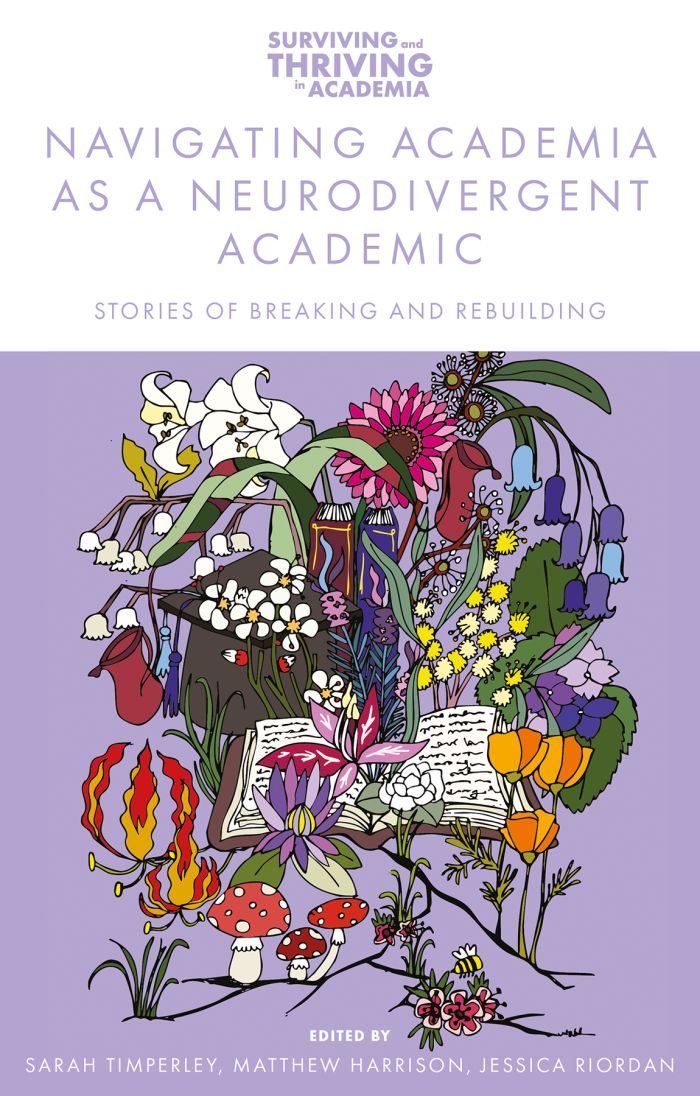
Navigating Academia as a Neurodivergent Academic
Stories of Breaking and Rebuilding

This book can be opened with

Note on our eBooks and Audiobooks: you can read our eBooks (ePUB or PDF) and listen to audiobooks on the free Emerald Books app on iOS, Android, and desktop. Or read and listen on Emerald's online reader (ePUB eBooks and audiobooks only). To purchase a digital book you will need to create an account if you don’t already have one. After purchasing you will receive instructions on how to get started.
- Description
- Contents
- Reviews
- About
Navigating Academia as a Neurodivergent Academic sheds light on the various emotional and physical tolls that navigating an unsupportive academic landscape can take on neurodivergent researchers, with calls for systemic changes to better support neurodivergent people within higher education institutions. It also celebrates finding connection and purpose within neurodivergent research communities.
Delving into experiences of a global cohort of neurodivergent scholars as they navigate professional journeys, chapters draw on personal narratives, theoretical insights, and research conducted with and by neurodivergent academics. Opening with an overview of current challenges faced by neurodivergent scholars in a time that offers both increasing mainstream acceptance and systemic pressures that disproportionally harm neurodivergent staff, the editors highlight the complexities of navigating shifting institutional attitudes and policies. Subsequent chapters identify specific challenges faced by neurodivergent academics, from PhD scholars to academics in leadership positions, alongside intersecting issues relating to gender diversity and race. Each story brings a unique perspective, showing the wide variety of neurodivergent people and the challenges that they face, with common themes of navigating spaces, systems, and social and communication norms that can create barriers to people who experience the world in different ways.
Navigating Academia as a Neurodivergent Academic highlights the need for more inclusive spaces within higher education institutions for neurodivergent individuals, with particular emphasis on neurodivergent early career academics. However, it also celebrates the successes of neurodivergent people, including the joys of finding community, the relief of finally being understood, and the positive changes neurodivergent academics are able to make when they stand together.
Chapter 1. Locating Ourselves in the Modern Academy; Sarah Timperley, Matthew Harrison, and Jessica Riordan
- Chapter 2. Between Research and Resistance: Insights from a Trans Neurodivergent PhD Student; Katie Munday
- Chapter 3. Navigating Unexpected Detours during the Transition from Student to Academic Career; Jessica Riordan
- Chapter 4. People, Politics, Power Structures, and Politeness: A Crash Course in Social Dynamics I Would Rather Have Avoided; Sarah Timperley
- Chapter 5. Imposter Syndrome as a Neurodivergent Early Career Academic; Jenny Mai Phan
- Chapter 6. Burnout in Environments Shaped by Scarcity; Kathryn E Ringland
- Chapter 7. Becoming a Sensitive Scholar: Navigating the Academic Assemblages in East Asia; Mario Liong
- Chapter 8. Commander Keen? Playing the Academic Game of Enthusiastic Innovation Constrained by Institutional Hierarchies; Matthew Harrison
- Chapter 9. It Doesn’t Get any Easier at the Top (At Least Not Yet); Sandra Thom-Jones
- Chapter 10. Where Difference Belongs: Vignettes From a Global Neurodivergent Research Community; Sarah Timperley, Michael Arhin-Acquaah, Mu-Yen Chan, Chris Edwards, Aimee Fletcher, Inga Koops, Kun-Rong Li, Salome Munyengerwi, Jess Rowlings, and Ari Star
I have read much academic writing about inclusion. This book is something else. It is raw, theoretically sharp, and genuinely moving - sometimes all three on the same page. The authors span career stages, continents, and neurotypes, yet common threads of masking, burnout, and institutional betrayal surface again and again, making the structural argument impossible to ignore. What stays with me most is the courage of contributors who refused to write the expected "over-coming" or "survival-against-the-odds" narrative and instead told the truth about where they are right now. Every academic - neurodivergent or not - should read this book.
This groundbreaking volume unites a global community of scholars—including voices from Taiwan, Zimbabwe, and Australia—to document academic trajectories ranging from doctoral study to senior leadership. It showcases a vast spectrum of neurodivergent experiences, including Autism, ADHD, Dyslexia, Tourette’s, and Sensory Processing Sensitivity, while centering the intersectional identities of trans and Global Majority researchers. Ultimately, these narratives offer an urgent manifesto for transforming the academy into a space of collective belonging by replacing ableist metrics with a genuine culture of care that celebrates neurodiversity.
An important and timely book that centres lived experience, challenges deficit narratives, and offers a deeply human account of what it means to be neurodivergent within modern academia. This work will resonate far beyond universities.
Sarah Timperley is a Research Fellow and the Project Leader for Community Education and Professional Development for the University of Melbourne Neurodiversity Project, Australia.
Matthew Harrison is a member of the University of Melbourne Faculty of Education Learning Intervention team and a project lead at the University of Melbourne Neurodiversity Project, Australia.
Jessica Riordan is a Research Fellow and the Project Leader for Staff and Student Wellbeing for the University of Melbourne Neurodiversity Project, Australia.