
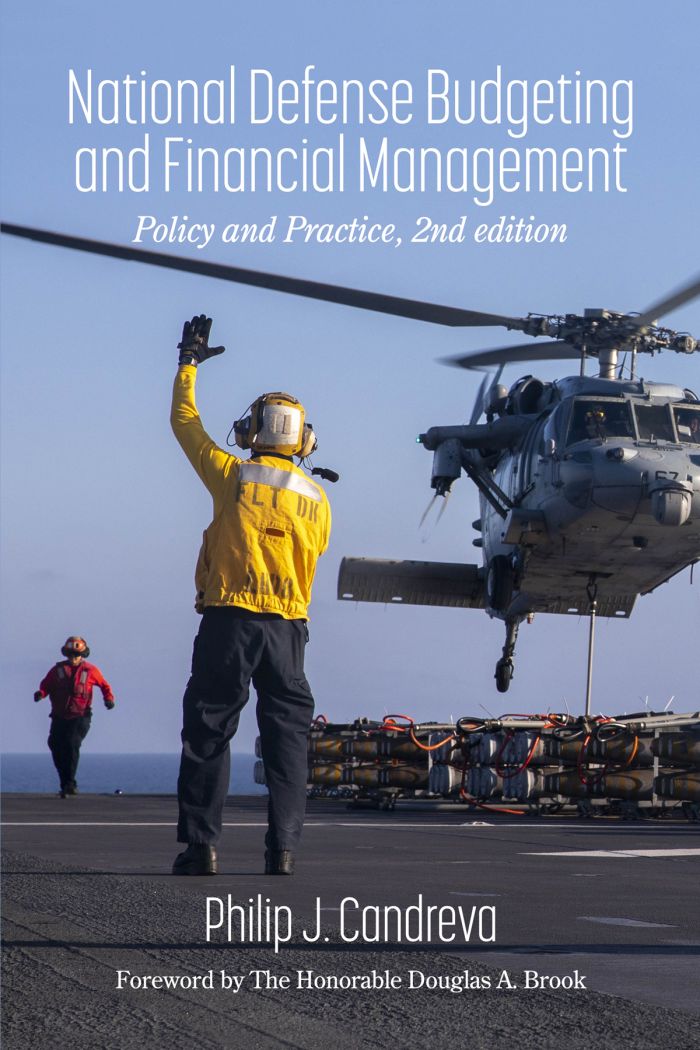
National Defense Budgeting and Financial Management
Policy and Practice

This book can be opened with

Note on our eBooks and Audiobooks: you can read our eBooks (ePUB or PDF) and listen to audiobooks on the free Emerald Books app on iOS, Android, and desktop. Or read and listen on Emerald's online reader (ePUB eBooks and audiobooks only). To purchase a digital book you will need to create an account if you don’t already have one. After purchasing you will receive instructions on how to get started.
- Description
- Contents
Budgeting for national defense is a complex endeavor, particularly for a nation like the U.S. that assumes global responsibility and strives to have the most advanced and lethal force on earth. It is necessary – and challenging – to balance the myriad requirements between current and future readiness, across warfare areas and military services, between having state of the art capability with sufficient capacity, and among people, hardware, and the activities people do with that hardware. As analytically difficult as that problem is, it is embedded in the political budgeting processes and national security must be balanced with every other function of government and there must also be cooperation across branches of government.
This text explores that complex endeavor. It takes the position that budgeting for defense is a particular instance of public budgeting which is a particular instance of public policy. Thus, this text starts with a conceptual, empirical, and process foundation before discussing the participants and processes that build the annual defense budget. It then covers the execution of that budget and the ultimate accounting.
Compared to the first edition, this text is updated with current figures and examples. There is a new chapter on determinants of military spending in society and burden sharing within alliances. The chapter on budget execution has been disaggregated and a new chapter is devoted to fiscal law. The final chapter seeks to integrate all that came before it by discussing matters that integrate the stages of budgeting and which cross branches of government. Following in the tradition of the first edition, this is intended to be both a textbook for a course in budgeting, but also a desktop reference for defense budgeting practitioners.
Foreword to the 2nd Edition; The Honorable Douglas A. Brook.
- Chapter 1. Preface; Why This Subject Is Still Important
- Chapter 2. Acknowledgments.
- Part A: Foundations For Defense Budgeting
- Chapter 3. A Theoretical And Conceptual Foundation For Defense Budgeting.
- Chapter 4. An Empirical Foundation for Defense Budgeting.
- Part B: Political And Policy Context For Defense Budgeting
- Chapter 5. Federal Budget Process.
- Chapter 6. Congress and the Defense Budget.
- Chapter 7. Determinants of Military Spending and International Burden Sharing.
- Part C: Formulating The Defense Budget
- Chapter 8. Budget Process Participants And Organization.
- Chapter 9. The Planning, Programming, Budgeting, and Execution System.
- Chapter 10. Budget Formulation and Review.
- Part D: Executing And Managing The Defense Budget
- Chapter 11. Federal Fiscal Law.
- Chapter 12. Intragovernmental Business and Working Capital Funds.
- Chapter 13. Managing Budget Execution.
- Chapter 14. Internal Controls, Accounting & Auditing.
- Chapter 15. Pulling It All Together.
- Glossary.
- List of Acronyms.
- About the Authors.