
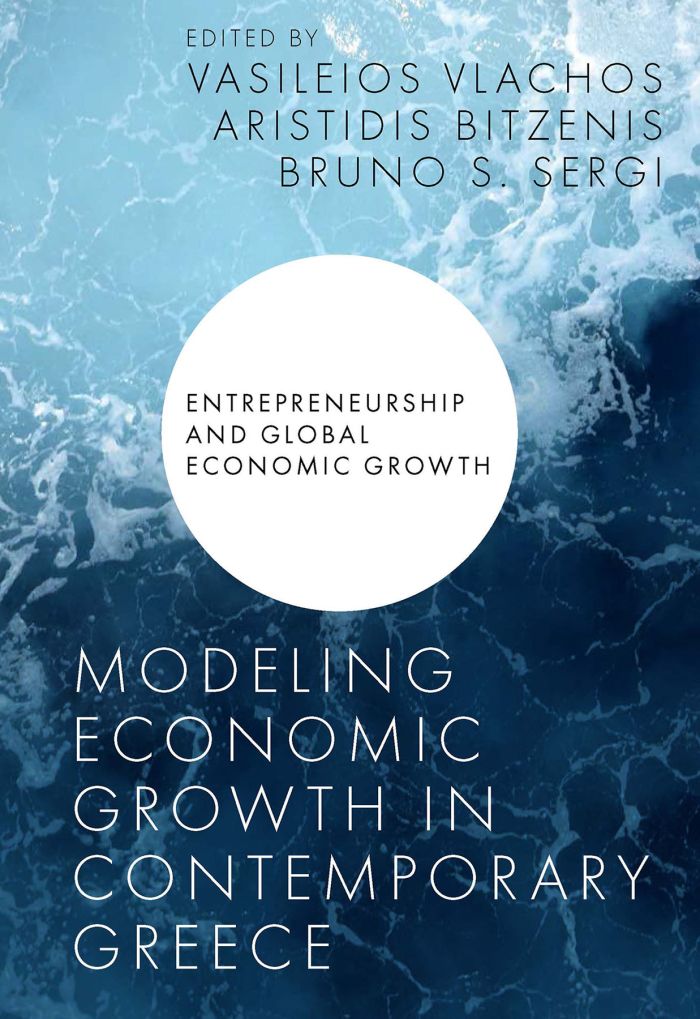

Modeling Economic Growth in Contemporary Greece

This book can be opened with

Note on our eBooks and Audiobooks: you can read our eBooks (ePUB or PDF) and listen to audiobooks on the free Emerald Books app on iOS, Android, and desktop. Or read and listen on Emerald's online reader (ePUB eBooks and audiobooks only). To purchase a digital book you will need to create an account if you don’t already have one. After purchasing you will receive instructions on how to get started.
- Description
- Contents
- About
In the aftermath of the devastating economic depression suffered for almost a decade, Modeling Economic Growth in Contemporary Greece assesses the conditions shaping the Greek economy's restart, discussing the effect of institutions on the business environment and highlighting the factors which are critical for achieving sustainable economic growth.
The intrinsic properties of the Greek economic and business environment imply that there are country-specific factors responsible for the performance of the Greek economy, which is differentiated from its European counterparts. Despite being a member of the European Union since 1981 and one of the twelve first countries who adopted the euro, Greece has not been able to converge in crucial macroeconomic indicators with the early euro area Member States. The European stimulus package to support post COVID-19 recovery appears as a unique opportunity for Greece to develop a long-term vision and materialize reforms that will unlock the economy's true potential.
This latest book in the Entrepreneurship and Global Economic Growth series is centred around the determinants of and obstacles to Greece’s sustainable economic growth, presenting the macroeconomic and external environment and the dynamics of Greek economy and focuses onto internal conditions shaped by country-specific characteristics affecting labor and product markets’ efficiency and the performance of institutions and production factors.
Foreword; Apostolos Serletis
- Chapter 1. Determinants of and Obstacles to Economic Growth in Contemporary Greece; Vasileios Vlachos, Aristidis Bitzenis, and Bruno S. Sergi
- Part 1 – Dynamics of the Greek economy
- Chapter 2. Competitive Position and Dynamics of the Greek Economy; Vasileios Vlachos and Aristidis Bitzenis
- Chapter 3. An Odyssey with a happy end? Growth challenges, successes and failures of Greece During COVID-19 Era; Konstantinos J. Hazakis
- Chapter 4. Forecasting Greek Real GDP Based on ARIMA Modeling; Chaido Dritsaki and Melina Dritsaki
- Chapter 5. Nominal or real convergence with the EMU criteria: The case of Greece; Aristidis Bitzenis and Pyrros Papadimitriou
- Part 2 – Policies, Institutions, and Markets
- Chapter 6. The Interactions between Governance Quality and Economic Development; Chara Vavoura, Dimitris Manolopoulos, and Ioannis Vavouras
- Chapter 7. Social Policy in Dribs and Drabs for the Greek Crisis; Dimitris Venieris
- Chapter 8. The Greek Labour Market during the Crisis: New Evidence on the Evolution of Wages, Employment and Unemployment; Evangelia Papapetrou and Pinelopi Tsalaporta
- Chapter 9. SME Productivity in Greece: The Role of Human Capital, ICT Adoption and Innovation; Ioannis Giotopoulos, Pelagia Kontaxaki, and Helen Louri
- Chapter 10. The impact of Competition Law on the Greek economy; Mark Clough QC and Efthymios Bourtzalas
- Part 3 – Characteristics and performance of selected industries
- Chapter 11. Greek Banking System during the Crisis and Beyond; Fotios Pasiouras and Minas-Polyvios Tsagkarakis
- Chapter 12. The Agri-Food Sector in Greece: Prospects and Possibilities; Stathis Klonaris
- Chapter 13. Energy Resources, Local Content Policies and Economic Growth: The case of Hydrocarbon Exploration in Greece; Stella Tsani
- Chapter 14. The importance of tourism for the Greek Economy: Traits and development; Iordanis Katemliadis and Andreas Papatheodorou
- Chapter 15. The Greek ICT Sector and its Contribution to Innovation and Economic Growth; Aggelos Tsakanikas, Petros Dimas, and Dimitrios Stamopoulos
- Chapter 16. Issues, Policies and Contribution of the Greek Transport Industry to Economic Growth; Tania Pantazi and Vasileios Vlachos
Vasileios Vlachos is an Assistant Professor of Macroeconomics at the International Hellenic University (Department of Economic Sciences) and an Adjunct Lecturer in Business Administration at the Hellenic Open University.
Aristidis Bitzenis is a Professor of Global Entrepreneurship; FDI at the University of Macedonia (Department of International and European Studies) and an Adjunct Lecturer in Business Administration at the Hellenic Open University.
Bruno S. Sergi, Ph.D., has been teaching at Harvard University since 2011. At Harvard, he is also an Affiliate at the Center for International Development at the Kennedy School and an Associate of the Davis Center for Russian and Eurasian Studies and the Harvard Ukrainian Research Institute.