
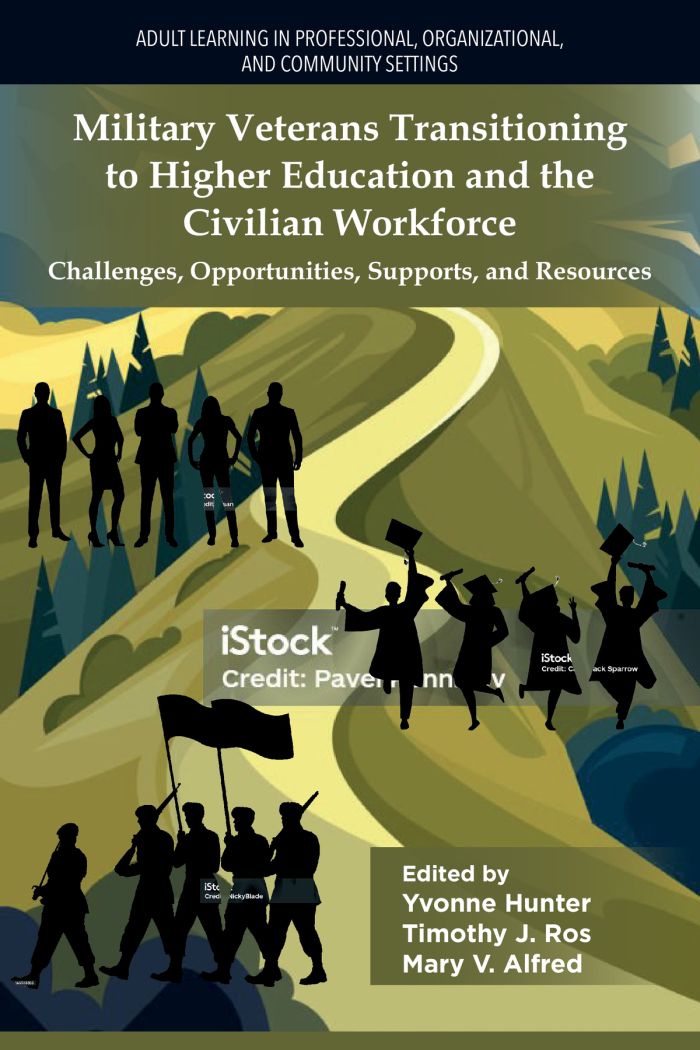
Military Veterans Transitioning to Higher Education and the Civilian Workforce
Challenges, Opportunities, Supports, and Resources

This book can be opened with

Note on our eBooks and Audiobooks: you can read our eBooks (ePUB or PDF) and listen to audiobooks on the free Emerald Books app on iOS, Android, and desktop. Or read and listen on Emerald's online reader (ePUB eBooks and audiobooks only). To purchase a digital book you will need to create an account if you don’t already have one. After purchasing you will receive instructions on how to get started.
- Description
- Contents
- About
Military Veterans Transitioning to Higher Education and the Civilian Workforce: Challenges, Opportunities, Supports, and Resources offers a thorough exploration of how veterans navigate academic and professional transitions after leaving military service. Drawing on adult education theory, human resource development, and transition frameworks, the book frames reintegration as an ongoing learning process rather than a single moment of change. It examines how military learning cultures—defined by hierarchy, structure, and collective purpose—often clash with the autonomy and self-direction expected in higher education, creating notable adjustment challenges for student veterans. Through lenses such as andragogy, transformative learning, experiential learning, and self-directed learning, the authors position veterans as non‑traditional adult learners whose experiences shape their motivation, identity, and readiness to learn.
The text also highlights institutional responsibilities, emphasizing the value of veteran‑focused orientations, peer mentorship, cultural competency training, and inclusive policies. It explores veterans’ sense of belonging, identity negotiation, and the “third space” they occupy between military and civilian life. Beyond the academic sphere, the book addresses workforce transition issues including skill translation, new authority structures, and civilian perceptions of military expertise. It underscores the need for veteran‑ready organizations and the role of human resource development professionals in supporting effective training transfer and long‑term career integration. Overall, the volume provides research‑based strategies and practical guidance for educators, employers, and policymakers committed to creating environments where veterans are not only supported but positioned to thrive.
Section 1. Teaching, Learning, and Support Services for Veterans in Higher Education
- Chapter 1. What is Adult Education?; Timothy Ros
- Chapter 2. An Analysis of Military and Higher Education Learning Environments; Susan M. Yelich Biniecki, Steven W. Schmidt, and Tyler Rund
- Chapter 3. Redefining Student Veterans as Nontraditional Adult Learners; Teresa M. Duncan
- Chapter 4. Experiences of Student Veterans in Medical Education; Pamela O’Callaghan and Chantes Still-Ciceron
- Chapter 5. Exploring Self-Directed Learning among Military Veterans Transitioning to Higher Education: Challenges, Opportunities, Supports, and Resources; Petra A. Robinson, Maja Stojanović, and Bethany A. Hager
- Section 2. Veterans in Higher Education
- Chapter 6.Best Strategies to Utilize Higher Education as a Navigational Tool for Veterans; Aynur Charkasova, Sharon V. Gardiner-Taylor, and Dauran McNeil
- Chapter 7. Teaching and Learning in Higher Education with Implications for Student Veterans; LTC Trivius G. Caldwel and Justin Nance
- Chapter 8. The Value of Positive Dialogue among Veteran Support Services in Higher Education; Kemi Elufiede
- Chapter 9. Institutional Policies, Culture, and Best Practices that Support Veterans in Higher Education; Maja Stojanović
- Chapter 10. Navigating the Third Space: Military Veterans in Higher Education; Wayne N. Taylor
- Section 3. Veterans in the Civilian Workforce
- Chapter 11. Voices of Veterans Transitioning into the Civilian Workforce; Sarah E. Minnis
- Chapter 12. Acclimating to the Shift in Transitional Authority within the Civilian Workforce; Hise O. Gibson, Liat Shapiro, and MaShon Wilson
- Chapter 13. Identifying and Adapting to the Career of Choice; Ann K. Lee, Patricia A. Bradley, and Angenetta R. Lambert
- Chapter 14. Empowering Veterans in Academia: Insights and Strategies for Enhancing Educational Experiences; Hise O. Gibson and Timothy Ros
- Section 4. Promoting a Veteran-Friendly Workforce
- Chapter 15. Student Service Members and Veterans in Higher Education: Their History, Characteristics, and Experiences; Shelley MacDermid Wadsworth, Kathrine Sullivan, Adam E. Barry, Shawn D. Whiteman, Tamika D. Gilreath, Sheryl Shipley, and Claire Rosenberger
- Chapter 16. Veteran-Friendly or Veteran-Ready? How Employment Organizations Support Veteran Success; Michael Kirchner and Angela Minichiello
- Chapter 17. Facilitating Veteran Transition in the Civilian Workforce: The Vital Role of Human Resource Development Professionals in Promoting Transfer of Training; Yvonne Hunter, Yuanlu Niu, Justin T. McDaniel, Dauran McNeil, and Dawn A. Roberts
- Chapter 18. Designing Mentoring Programs to Empower Veterans in the Civilian Workplace; Yvonne Hunter and Sarah Wilson Kroenlein
Yvonne Hunter, PhD., holds a Ph.D. in Adult Education with an emphasis in Human Resource Development, Research and Evaluation from the University of South Florida.
Timothy J. Ros, EdD.,
is an accomplished educator and leader with extensive experience in business, military operations, and higher education.
Mary V. Alfred, Ph.D. is Professor Emerita of Adult Education at Texas A&M University.