
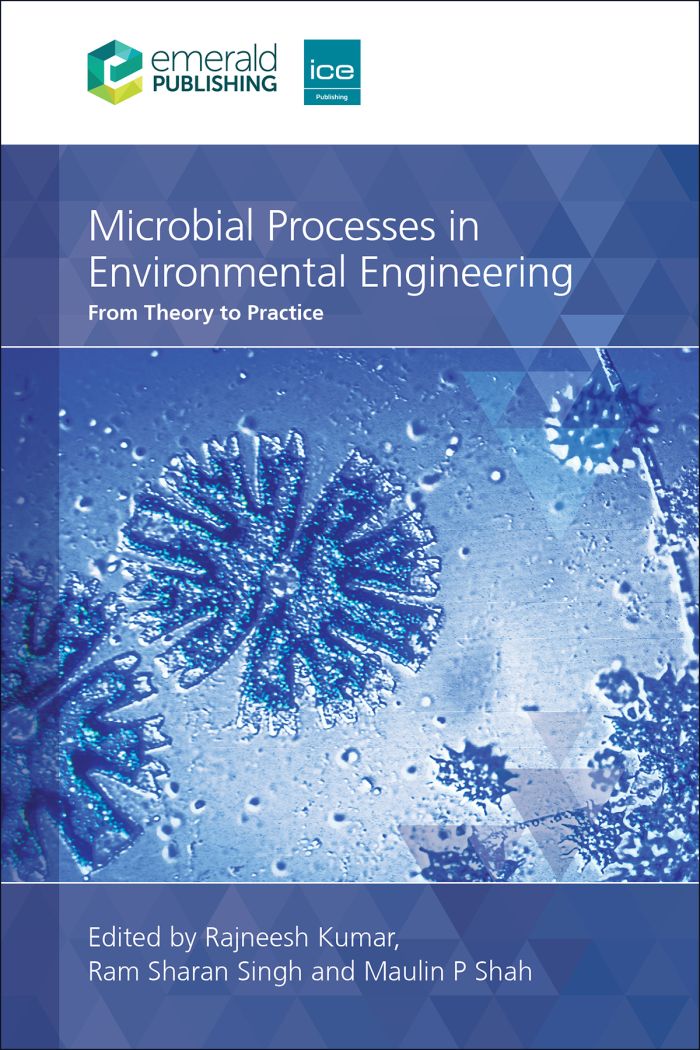
Microbial Processes in Environmental Engineering
From Theory to Practice

This book can be opened with

Note on our eBooks and Audiobooks: you can read our eBooks (ePUB or PDF) and listen to audiobooks on the free Emerald Books app on iOS, Android, and desktop. Or read and listen on Emerald's online reader (ePUB eBooks and audiobooks only). To purchase a digital book you will need to create an account if you don’t already have one. After purchasing you will receive instructions on how to get started.
- Description
- Contents
- About
Microbial Processes in Environmental Engineering explores the latest advances in microbial biotechnology and environmental engineering. Bridging the gap between theoretical concepts and practical applications, the book illustrates how microbial processes can be effectively utilised in pollution control, ecosystem restoration and resource recovery.
The chapters provide clear explanations of microbial mechanisms, biochemical pathways, and environmental factors influencing microbial activity, and cover essential topics such as microbial ecology, metabolism, biodegradation and bioremediation.
Key features include:
- applications across a range of environmental challenges, including water pollution, wastewater treatment and soil remediation
- innovative approaches to sustainable energy production, including microbial fuel cells and biogas production
- case studies in a variety of sectors providing concrete examples of successful microbial interventions
- practical techniques for bioaugmentation and biostimulation, illustrating how these technologies can enhance microbial activity for effective bioremediation
- insights into the latest advancements and future trends, including developments in pollutant degradation and resource recovery.
Microbial Processes in Environmental Engineering is an essential resource for researchers, practitioners and students in environmental engineering seeking to contribute to environmental sustainability through microbial applications.
Chapter 1. Wastewater treatment and microbial processes
- Chapter 2. Bioaugmentation and biostimulation: strategy for wastewater treatment
- Chapter 3. Bio-filtration of water pollutants
- Chapter 4. Heavy metals removal from contaminated water
- Chapter 5. Sustainable biohydrogen through microbial fuel cells: a green revolution
- Chapter 6. Nanobiomaterials for microbial fuel cells and their application in bioenergy production
- Chapter 7. Advanced microbial technologies for bioremediation of emerging contaminants
- Chapter 8. Emerging technologies in microbial environmental engineering
- Chapter 9. Microbial biosensors for environmental monitoring and sustainability
- Chapter 10. Endophytes: diversity, ecological roles and applications in pollution mitigation
- Chapter 11. Harnessing microbial potential for climate change mitigation: innovations and applications
- Chapter 12. Microbial plastic and microplastic biodegradation and remediation
- Chapter 13. Microbial processes in soil remediation
- Chapter 14. Current developments and challenges in marine microbial corrosion and biofouling
Dr. Rajneesh Kumar is a researcher at the Indian Institute of Technology, Banaras Hindu University. He specialises on wastewater treatment, where he has made significant contributions, including the utilization of plant waste as biosorbents to remove chromium from water. His PhD research focused on behaviour of aerobic sludge in wastewater treatment plants exposed to various contaminants, leading to the development of detection systems for undesired pollutants. Previously, Dr. Kumar held positions as a Research Associate III at IIT Indore, where he conducted research under the guidance of Prof. Manish Kumar Goyal on water resource management. His work has been presented at international conferences, highlighting his commitment to advancing sustainable water management practices and environmental engineering.
Dr. R. S. Singh is a distinguished professor in the Department of Chemical Engineering & Technology at IIT (BHU), Varanasi. Holding a PhD from IIT (BHU) with a focus on the degradation of volatile organic compounds (VOCs) using supported film bioreactors, he has built an illustrious career in biodegradation, bioremediation, and environmental biotechnology. His professional journey includes roles such as GET at Tata Chemicals, Lecturer at BITS Pilani and BIET Jhansi, and various academic positions at IT BHU, culminating in his current role as Professor at IIT (BHU) since 2015. With an impressive H-index of 40, over 5,000 citations, and an i10 index of 90, Dr. Singh's research contributions are highly regarded. He has 19 years of total research experience, including 13 years post-doctoral, and has mentored numerous post-doctoral fellows, PhD candidates, and M.Tech. students. His research primarily focuses on bioaugmentation, biofiltration, synthesis of biodiesel, and the application of biochar and petroleum-degrading consortia for wastewater treatment. Dr. Singh's work has significantly impacted the field of environmental engineering, providing sustainable solutions for pollution control and fostering future professionals and researchers.
Dr. Maulin P. Shah is a researcher and scientific writer in his field for over 20 years. He received a BSc degree in Microbiology from Gujarat University, Godhra (Gujarat), India. He also earned his PhD degree in Environmental Microbiology from Sardar Patel University, Vallabh Vidyanagar (Gujarat) India. His research interests include Biological Wastewater Treatment, Environmental Microbiology, Biodegradation, Bioremediation, and Phytoremediation of Environmental Pollutants from Industrial Wastewaters. He has published more than 350 research publications in national and international journals of repute on various aspects of microbial biodegradation and bioremediation of environmental pollutants.