
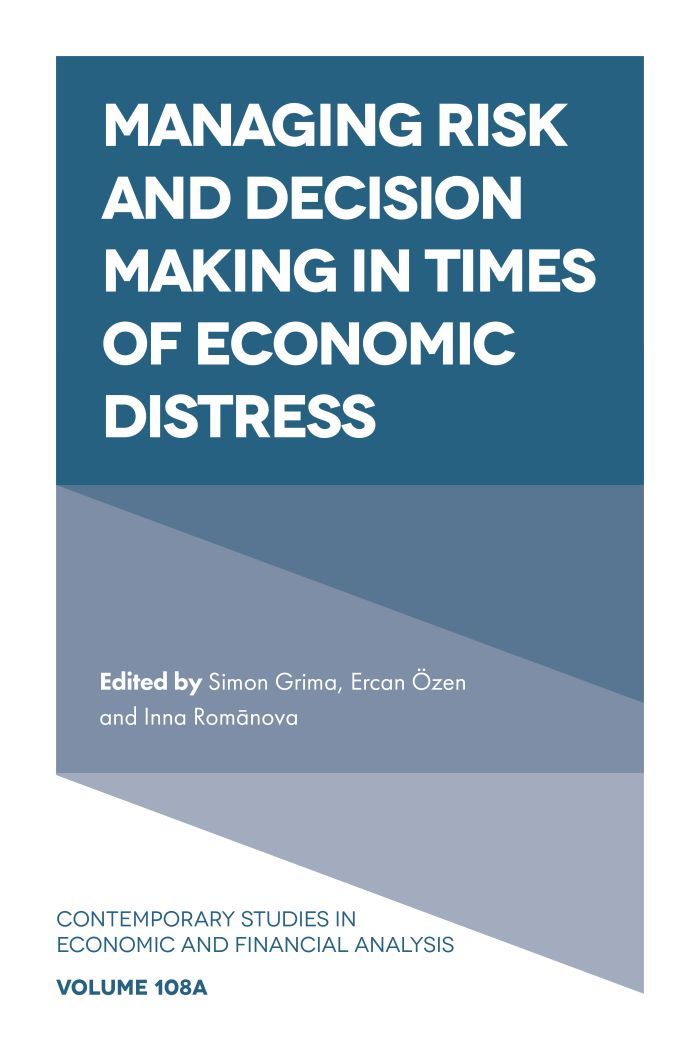

Managing Risk and Decision Making in Times of Economic Distress

This book can be opened with

Note on our eBooks and Audiobooks: you can read our eBooks (ePUB or PDF) and listen to audiobooks on the free Emerald Books app on iOS, Android, and desktop. Or read and listen on Emerald's online reader (ePUB eBooks and audiobooks only). To purchase a digital book you will need to create an account if you don’t already have one. After purchasing you will receive instructions on how to get started.
- Description
- Contents
- About
Managing Risk and Decision Making in Times of Economic Distress adds much needed scholarly analysis of the fledgling decision/control approach, arguing the merits of its empirical content to shed light on the structure of capital contracts and rationale for diversity of objectives.
Underpinning the book's central arguments are questions surrounding the identification and realisation of opportunities during periods of distress or disruption. Although such questions have been the focus of corporate finance, risk management, and financial management studies and literature, within the context of COVID-19 gaps remain unresolved.
Continuity should be a proactive living plan to return to the norm we know, and continuity planning forms an integral part of a risk management strategy. With the future set to be shaped by these many disruptions and humanity's responses to it, critical insights are more important than ever, to ensure and determine progress towards the Sustainable Development Goals and recovering from these economic and social challenges.
Contemporary Studies in Economic and Financial Analysis publishes a series of current and relevant themed volumes within the fields of economics and finance. Both disciplinary and interdisciplinary studies are welcome.
Chapter 1. Designing Curriculum about Governance and Sustainability in Higher Education: A Case Study; Clinton Cassar
- Chapter 2. Sources of Economic Policy Uncertainty in Nigeria: Implications for Africa; Peterson K. Ozili
- Chapter 3. Multi-dimensional Modelling for Mapping Project Trade-offs in Construction: A Maltese Perspective; George Dimech, Rebecca Dalli Gonzi, and Alan Wild
- Chapter 4. Supply Chain Management Reshaped with Industry 4.0: A Review; Salih Serkan Kaleli and Mehmet Baygin
- Chapter 5. Consumer Complaints And Complaint Management In The Tourism Sector; Müjde Aksoy and Özer Yilmaz
- Chapter 6. A Review of the Models used by the Universities of the Republic of Kosovo; Hamdi Hoti, Mërgim H. Hoti, Armend Salihu, and Edisona Kurhasku
- Chapter 7. Regulation and Protection of Competition in Kosova- Control of Enterprise Concentration; Gani Asllani and Simon Grima
- Chapter 8. Effects of COVID-19 Pandemic on Tourists' Travel Behaviour and Patterns; Esat Saçkes
- Chapter 9. Destination Choice Behaviour and Tourist’s Travel Behaviour and Patterns; Arzu Gürdoğan
- Chapter 10. Sustainability Accounting; Peterson K. Ozili
- Chapter 11. Sustainable Heritage Management: A Literature Review; Derya Timucin Hayat and Blend Ibrahim
- Chapter 12. Economic and Fiscal Effects of COVID-19 Pandemic: An Evaluation; Oytun Mecik, Ercan Bahtiyar, and Mustafa Karabacak
- Chapter 13. Decreasing Carbon Footprint for Sustainable Consumption; Necla Kuduz
Simon Grima is the Head of the Insurance Department, Deputy Dean of the Faculty of Economics, Management and Accountancy and an Associate Professor at the University of Malta.
Ercan Özen is Head of the Finance and Banking Department and Deputy Dean in Faculty of Applied Sciences at the University of Uşak, Turkey.
Inna Romānova is a Professor of Finance and the Vice-Dean of the Faculty of Business, Management and Economics at the University of Latvia.