
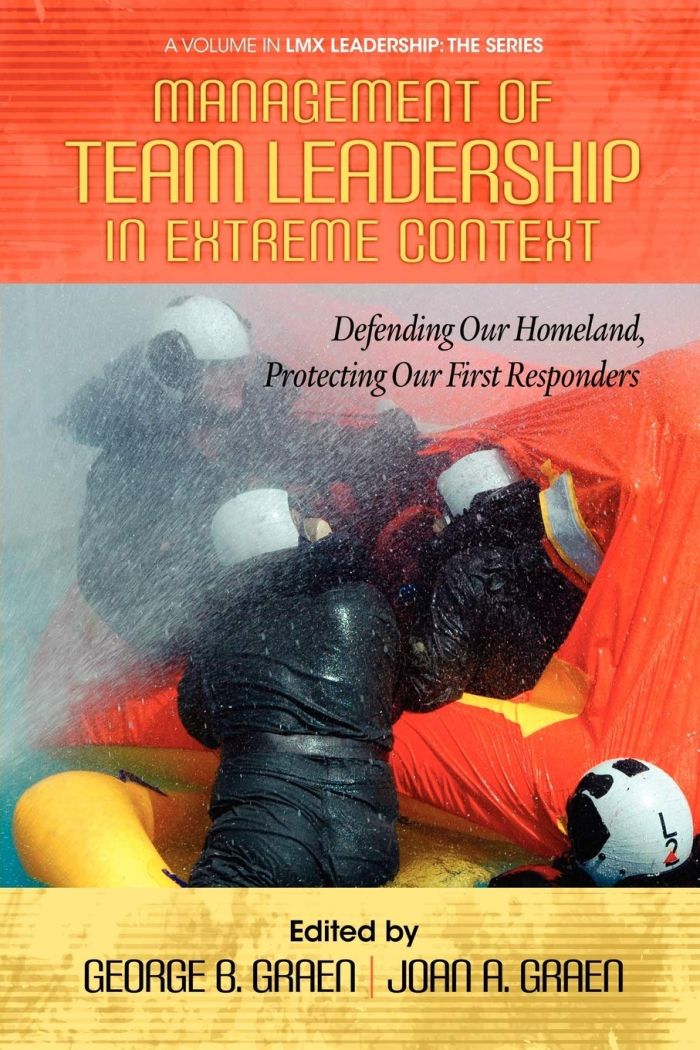

Management of Team Leadership in Extreme Context
Defending Our Homeland, Protecting Our First Responders

This book can be opened with

Note on our eBooks and Audiobooks: you can read our eBooks (ePUB or PDF) and listen to audiobooks on the free Emerald Books app on iOS, Android, and desktop. Or read and listen on Emerald's online reader (ePUB eBooks and audiobooks only). To purchase a digital book you will need to create an account if you don’t already have one. After purchasing you will receive instructions on how to get started.
- Description
- Contents
The proper balance of managerial “administrative-control” and managerial “team-leadership” depends upon the work context. After organizational procedures are designed by work-process engineers, managers and their directreports in the business units, are charged to “save our ship” (SOS) by their employers. Their ships, their business units, often were built for calm seas. Unfortunately, turbulent seas may happen unexpectedly and stress their ships and crews. Under extreme conditions, the sea may put their ships squarely in “harm’s way”. If they are not well prepared, their chances of survival are few and none. This book is about managing and being managed under conditions of “extreme contexts” where only the “special teams” survive and prosper.
Acknowledgements.
- Foreword.
- Preface.
- Chapter 2. First Responders in Action, Paul J. Breaux and Charles A. Scherbaum.
- Chapter 3. Expert Advice From Those Who Serve, George Graen.
- Chapter 4. A Breakdown in Team Leadership, Amy Fraher.
- Chapter 5. Police Officers in Danger, Mark D. Bowman.
- Chapter 6. Mateship: In Harm's Way, Kelly L. Fisher.
- Chapter 7. When Mistakes Almost Become Disasters, Benjamin E. Baran, Cliff W. Scott, and Daniel L. Bonilla.
- Chapter 8. Posttraumatic Growth, Richard G. Tedeschi.
- Chapter 9. The U.S. Air Force Approach, Robert J. Jackson, Douglas R. Lindsay, and Joseph E. Sanders.
- Chapter 11. Military Understanding of Teams, Michael Rumsey.
- Chapter 12. Transitions in Action Teams, Mary J. Waller and Sjir Uitdewilligen.
- Chapter 13. Using the Advice, George Graen.
- Appendix.