
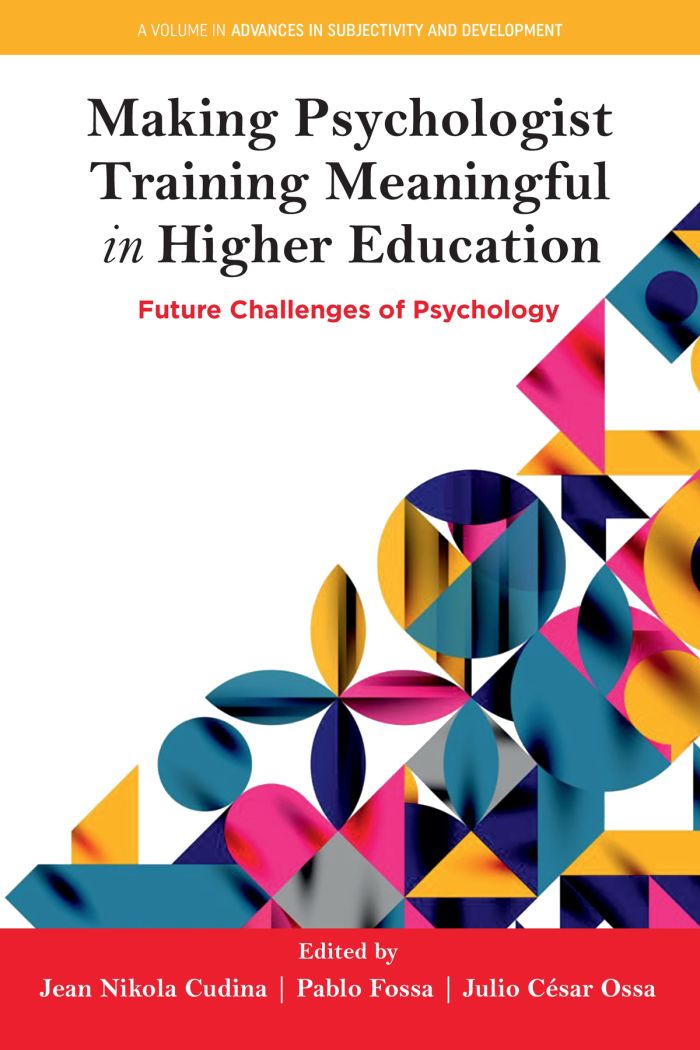
Making Psychologist Training Meaningful in Higher Education
Future Challenges of Psychology

This book can be opened with

Note on our eBooks and Audiobooks: you can read our eBooks (ePUB or PDF) and listen to audiobooks on the free Emerald Books app on iOS, Android, and desktop. Or read and listen on Emerald's online reader (ePUB eBooks and audiobooks only). To purchase a digital book you will need to create an account if you don’t already have one. After purchasing you will receive instructions on how to get started.
- Description
- Contents
- About
Making Training Meaningful in Higher Education: Future Challenges of Psychology invites us to reflect on the education and professional development of future psychologists. Their preparation demands a solid theoretical foundation, enriched by supervised practice and the strengthening of personal and professional competencies. The central purpose of this book is to share with society the psychological knowledge that students acquire and refine throughout their formative process, while highlighting emerging challenges and opportunities for the discipline in contemporary higher education.
The chapters presented within this book include proposals developed within the framework of academic activities, professional practices or research processes in which students participate with their professors. Through contributions from different countries and research teams, this book analyzes the current and future variables that the training of psychologists faces, such as the powerful technological development and its influence on the practice of the profession, distance education/learning processes, the training of therapists and clinical training in a technological society, among others. Making Psychologist Training Meaningful in Higher Education: Future Challenges of Psychology constitutes a valuable contribution for psychology teachers, clinical supervisors, educational researchers and psychology students.
Part I. Training in Psychology as a Process of Meaning Construction
- Chapter 1. Why is it Necessary to Give Meaning to the Training of Psychologists?; Jean Nikola Cudina, Julio César Ossa, and Pablo Fossa
- Chapter 2. What Does It Mean to be Trained in Psychology? A Path of Transformation and Commitment; Jean Nikola Cudina
- Chapter 3. The Culturalized Psychology Curriculum; Anup Dhar, Pradeep Chakkarath, and Luca Tateo
- Chapter 4. Professional Training as a Direction of the Life Project in Psychology Students: A Descriptive Study in Holguín; Cuba Carlos Manuel Osorio García and Zaily Leticia Velázquez Martínez
- Chapter 5. The Training Educational Process for Psychology in Brazil in the Region of Poços de Caldas, MG; Andriele Pereira, João Leite Ferreira Neto
- Part II. Training Experiences in Critical and Challenging Contexts
- Chapter 6. Digital Methodologies and Frontiers of Psychology Training: Connecting with Daily Life of Future Researchers; Camila Pérez and Ángela Rivera
- Chapter 7. Socialization of Children after Distance Learning. A Research Experience within the Training Process of a Future Psychologist; Hannah Leonie Holoubek and Amrei Zopf-Joerchel
- Chapter 8. From Trainee to Therapist: Deep Learning-Enhanced Microanalysis in Transference-Focused Psychotherapy Supervision; Daniela Saralegui, Rodrigo Vicencio Weber, Verónica Steiner, and Luis Valenciano
- Chapter 9. Training in Psychology and Gender Diversity: Lessons from Trans Research; María Del Mar Pérez-Arizabaleta and Jorge Eduardo Moncayo Quevedo
- Chapter 10. Rethinking Clinical Psychology Curricula: Student Experiences and Skills Development; Daniela Saralegui, Verónica Steiner, Luis Valenciano, Josefina Mujica, Bernardita Galleguillos, Contanza Vigil, María del Pilar Morgan, and Tatán de Laire Ibarra
- Chapter 11. Conclusions for a Meaningful Psychology: Between Culture, Ethics and Reflection; Jean Nikola Cudina, Julio César Ossa, and Pablo Fossa
Jean Nikola Cudina is an academic, psychologist, and holds an M.A. in Philosophy of Science from Leibniz University Hannover, Germany.
Pablo Fossa is Director of the Cognition & Culture Laboratory (C&C Lab) of Instituto de Bienestar Socioemocional (IBEM) at the Faculty of Psychology, Universidad del Desarrollo, Chile.
Julio César Ossa is Professor-researcher at the Universidad Cooperativa de Colombia.