
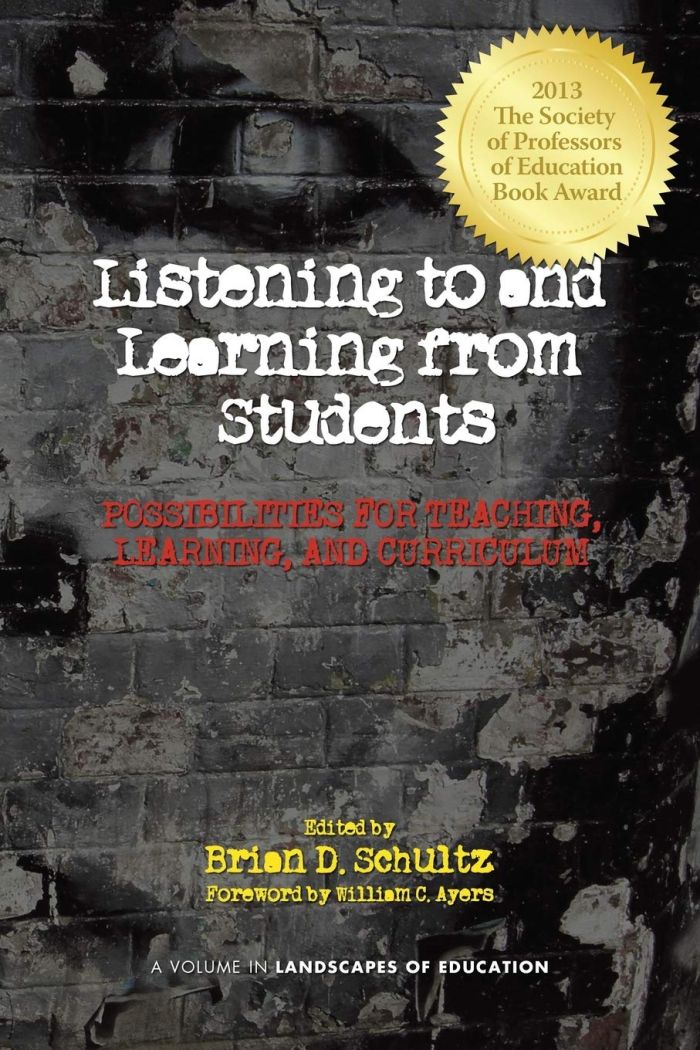
Listening to and Learning from Students
Possibilities for Teaching, Learning, and Curriculum

This book can be opened with

Note on our eBooks and Audiobooks: you can read our eBooks (ePUB or PDF) and listen to audiobooks on the free Emerald Books app on iOS, Android, and desktop. Or read and listen on Emerald's online reader (ePUB eBooks and audiobooks only). To purchase a digital book you will need to create an account if you don’t already have one. After purchasing you will receive instructions on how to get started.
- Description
- Contents
This book embraces the idea of listening to and learning from students. Although many educational theorists have long argued that incorporating children’s perspectives about teaching and curriculum has the potential for increasing students’ interest and participation in learning, their radical perspectives are still ignored or dismissed in theory and practice. Through featured essays, historical excerpts, and provocative poetry, this collection provides research literature and inquiry ideas that ought to be part of educational debates, policy discussions, and decision makings. Articulated through thoughtful prose and discerning analysis, youth, teachers, and scholars featured in this collection illuminate the power and promise of not only listening to and learning from students, but also acting upon the insights of students. This book calls for the 21st century educational workers--teachers, educators, parents, community workers, administrators, and policy makers--to perceive students as massive reservoirs of knowledge that invigorate possibilities for teaching, learning, and curriculum in the contested educational landscape.
Acknowledgements and Preface.
- Foreword: Listen and Learn; William C. Ayers.
- Chapter 1. Curricular Possibilities: Listening to; Hearing, and Learning from Students, Brian D. Schultz.
- Chapter 2. Interlude: From Pedagogy of the Oppressed; Paulo Freire.
- Chapter 3. Confronting Limit Situations in a Youth/Adult Educational Research Collaborative; Tara M. Brown and Kevin Galeas.
- Chapter 4. Interlude: from the mouths of babes; Kevin Coval.
- Chapter 5. Learning to Walk Quietly; Cathy Coulter.
- Chapter 6. Interlude: My First Voyage; L. Thomas Hopkins.
- Chapter 7. A Shorty Teaching Teachers: One Kid's Perspective About Keepin' It Real in the Classroom; Brian D. Schultz and Paris Banks.
- Chapter 8. Interlude: What Is a School? From I Learn From Children; Caroline Pratt.
- Chapter 9. Ninth-Grade Student Voices in a Social Action Project: They Went for Us, They Cared; Shira Eve Epstein.
- Chapter 10. Interlude: Hi(story) & Hope: How the Stories of Our Individual and Collective Pasts Determine What We Believe is Possible; kahlil almustafa.
- Chapter 11. They Think Kids Have Nothing to Say; Lloyd Thomas.
- Chapter 12. Listen; Miracle Graham.
- Chapter 13. Challenging Test-Prep Pedagogy: Urban High School Students Educate Pre-Service Teachers Using Liberatory Pedagogy; Louie F. Rodríguez.
- Chapter 14. Interlude: From Prospectus for a Summer Freedom School Program; Charles Cobb.
- Chapter 15. Lessons from the Journey: Exploring Citizenship through Active Civic Involvement; Jennifer Ponder, Michelle Vander Veldt, and Genell Lewis-Ferrell.
- Chapter 16. Interlude: A.D.D.; Rafael Casal.
- Chapter 17. Let My Soul Spit: Young People Write for Reflection and Inspiration; Susan Wilcox.
- Chapter 18. Interlude: Things I Wish I Told My Grandma; kahlil almustafa.
- Chapter 19. Constructing and Constricting Teachers: RateMyTeachers.com as a Knotted Space of the Educational Imaginary; Jake Burdick.
- Chapter 20. Interlude: The Moral Training from Methods of Instruction; John Dewey.
- Chapter 21. Teaching John Dewey as a Utopian Pragmatist While Learning from My Students; William H. Schubert.
- Chapter 22. Interlude: Desirable Content for a Curriculum Development Syllabus Today: The Tyler Rationale Reconsidered; Ralph W. Tyler.
- Chapter 23. Student-Led Solutions to the Dropout Crisis: A Report by Voices of Youth in Chicago Education; Voices of Youth in Chicago Education (VOYCE).
- Afterword: Prayer for the First Day of Chicago Public School; Kevin Coval.
- Permissions.
- About the Contributors.