
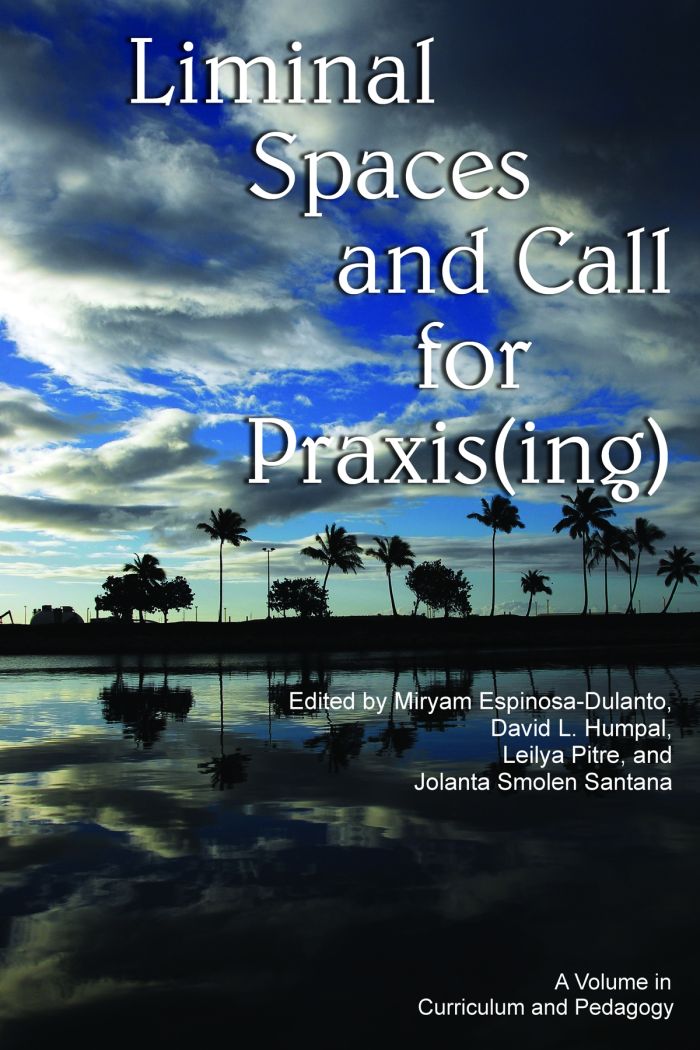
Liminal Spaces and Call for Praxis(ing)

This book can be opened with

Note on our eBooks and Audiobooks: you can read our eBooks (ePUB or PDF) and listen to audiobooks on the free Emerald Books app on iOS, Android, and desktop. Or read and listen on Emerald's online reader (ePUB eBooks and audiobooks only). To purchase a digital book you will need to create an account if you don’t already have one. After purchasing you will receive instructions on how to get started.
- Description
- Contents
Liminal Spaces and Call for Praxis(ing) follows the theme of the Curriculum & Pedagogy conference that highlighted issues of power, privilege, and supremacy across timelines and borders. This volume comprises of an interconnected mosaic of theoretical research and praxis. Facing the current and future challenges of corporatization of education, it becomes imperative to identify and deconstruct elements that provide more responsive and fertile ground for a research and praxis based mosaic of pedagogy. This volume includes works of those scholars who identified or worked with communities of color and/or who drew on the activist and intellectual traditions of peoples of color, third world feminism, indigenous liberation/sovereignty, civil rights, and anticolonial movements.
The James T. Sears Award.
- Foreword: An Interview With Dan Marshall, Dan Marshall.
- Part I. Braiding Timelines and Spaces.
- Introduction by David Humpal.
- Chapter 1. Punk Rock Pedagogy and Transcending Invisible Borders: Dismantling Power, Privilege, and White Supremacy in an Online Environment, Jennifer L. Martin.
- Chapter 2. Paulo Freire, bell hooks, and Tupac Shakur?: Examining Critical/Engaged Pedagogy Using a Hip-Hop Worldview, Kevin Joseph.
- Chapter 3. A Curricular Exploration of The Boondocks for Art Education: A Philosophical Interpretation of Black Visual Culture Through the Critical Lens of Double Consciousness, Alphonso Walter Grant.
- Chapter 4. A Search for an Alternative Curriculum and Pedagogy: The Case of the Village Institutes, Nuran Aytemur Sagiroglu.
- Chapter 5. Tattoos of a Mexican-U.S. Border Region: Liberating Hidden Curriculum as Public Pedagogy, Daniel Ricardo Aguilar, Jr.
- Part II. Power Struggles With/In Praxis Quilting.
- Introduction by Leilya Pitre.
- Chapter 6. Don't Let Your Babies Grow Up to Be Teachers: Continuing the Work of Teacher Education and Curriculum Studies in the Current Educational Climate, Jennifer Job.
- Chapter 7. The Common Core Standards Initiative: Implications for Marginalized Students' Success, Carolyn Roberts Taylor.
- Chapter 8. We Are Careful Not to Make Too Much Noise: An Infomercial Disruption, Amy Albert Bloom.
- Chapter 9. Eighth Graders' Opinions on Diversity Within the Science Classroom, Denise Gordon.
- Chapter 10. Digging, and Other Thoughtful Interventions, Brandon Sams.
- Part III. Stitching/Ming Curricular Spaces.
- Introduction by Miryam Espinosa-Dulanto and Jolanta Smolen Santana
- Chapter 11. The Complexity of Identity (Re)(De)Construction, Freyca Calderon, Karla O'Donald, and Sherrie Reynolds.
- Chapter 12. A Curricular Event-Encounter in the Borderspace(s) of the Matrixial, Barbara Bickel and Medwyn McConachy.
- Chapter 13. With/In the Garden: An In-Between Space of Togetherness and Dis/Location, Nikki Rotas.
- Chapter 14. The Curriculum That Care Forgot, Laura M. Jewett and Jolanta Smolen Santana.
- About the Editors.
- About the Contributors.