
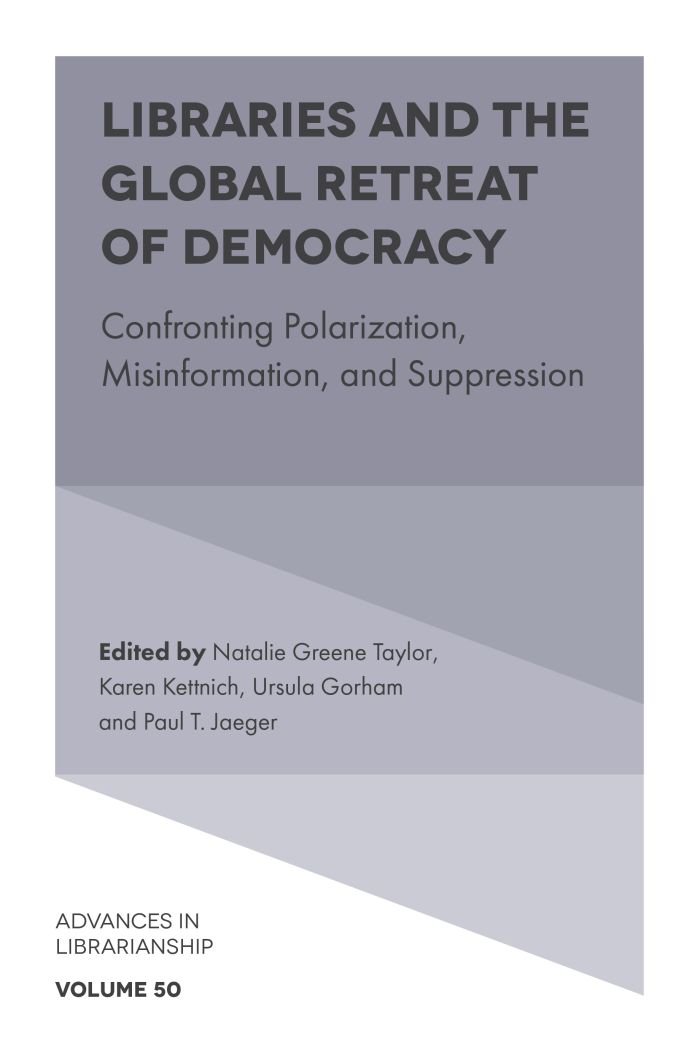

Libraries and the Global Retreat of Democracy
Confronting Polarization, Misinformation, and Suppression

This book can be opened with

Note on our eBooks and Audiobooks: you can read our eBooks (ePUB or PDF) and listen to audiobooks on the free Emerald Books app on iOS, Android, and desktop. Or read and listen on Emerald's online reader (ePUB eBooks and audiobooks only). To purchase a digital book you will need to create an account if you don’t already have one. After purchasing you will receive instructions on how to get started.
- Description
- Contents
- About
This latest volume of the Advances in Librarianship series presents original research exploring the modern state of democracies and social institutions, the contributions of libraries to the health and progress of democracies, and the political problems currently facing libraries as institutions. It details the best practices of library programs that provide political literacy education and promote civic engagement within communities. These practices include ways in which libraries can help diffuse political polarization, address significant policy issues of our day, promote political information literacy, support civic engagement, and facilitate participation in democratic processes.
Libraries and the Global Retreat of Democracy: Confronting Polarization, Misinformation, and Suppression is structured in three sections - questions of personal and state democracy, investigations of how the information infrastructure shapes these democracies, and explorations of the ways that libraries can and do contribute to democracy. Situating libraries within political conversations, highlighting their centrality to these discussions, Libraries and the Global Retreat of Democracy focuses on how libraries coordinate their work in political and information literacy and how these efforts can be improved, he recommendations and examples within which will serve as inspiration and motivation to its readers.
Section One: What is Democracy?
- Chapter 1. Actually-Existing Democracy and Libraries: A Mapping Exercise; John Buschman
- Chapter 2. A Right to be Misinformed? Considering Fake News as a Form of Information Poverty; Nicole A. Cooke
- Chapter 3. Facts (Almost) Never Change Minds: Libraries and the Management of Democracy-Supportive Public Perceptions; Bill Crowley
- Section Two: How the Information Environment Contributes to / Detracts from Democracy
- Chapter 4. Container Collapse and Misinformation: Why Digitization Creates Challenges for Democracy; Christopher Cyr
- Chapter 5. Fighting Fake News: The Cognitive Factors Impeding Political Information Literacy; Rajesh Singh and Kyle N. Brinster
- Chapter 6. Information Obstacle Course: Seeking the Right to Asylum at the US-Mexico Border; Amy Dickinson
- Section Three: Libraries as Virtual and Physical Spaces for Democracy
- Chapter 7. Beyond Fake News: Learning from Information Literacy Programs in Ukraine; Maria Haigh, Thomas Haigh, Maryna Dorosh, and Tetiana Matychak
- Chapter 8. “Politic Talks” in Academic Libraries of the South to Address a Global Democracy Recession in the United States: An Exploratory Website Analysis; Bharat Mehra and Joseph Winberry
- Chapter 9. Raking the Forests: Information Literacy, Political Polarization, Fake News, and the Educational Roles of Librarians; Paul T. Jaeger and Natalie Greene Taylor
- Chapter 10. Libraries Of, By, and For the People: Reimagining Strategies to Enhance Democratic Culture within LIS Spaces and Programming; Daniela K. DiGiacomo, Shannon M. Oltmann, and Colleen Hall
Natalie Greene Taylor is an assistant professor and Coordinator of the Master of Library and Information Science (MLIS) program at the School of Information of the University of South Florida, USA.
Karen Kettnich is Managing Editor of The Library Quarterly and lecturer in English at Clemson University, USA.
Ursula Gorham is a Senior Lecturer and the Director of the Master of Library and Information Science program in the College of Information Studies at the University of Maryland, USA.
Paul T. Jaeger is a professor of the College of Information Studies at the University of Maryland, USA.