
Leadership
Leaders, Followers, and Context

This book can be opened with

Note on our eBooks and Audiobooks: you can read our eBooks (ePUB or PDF) and listen to audiobooks on the free Emerald Books app on iOS, Android, and desktop. Or read and listen on Emerald's online reader (ePUB eBooks and audiobooks only). To purchase a digital book you will need to create an account if you don’t already have one. After purchasing you will receive instructions on how to get started.
- Description
- Contents
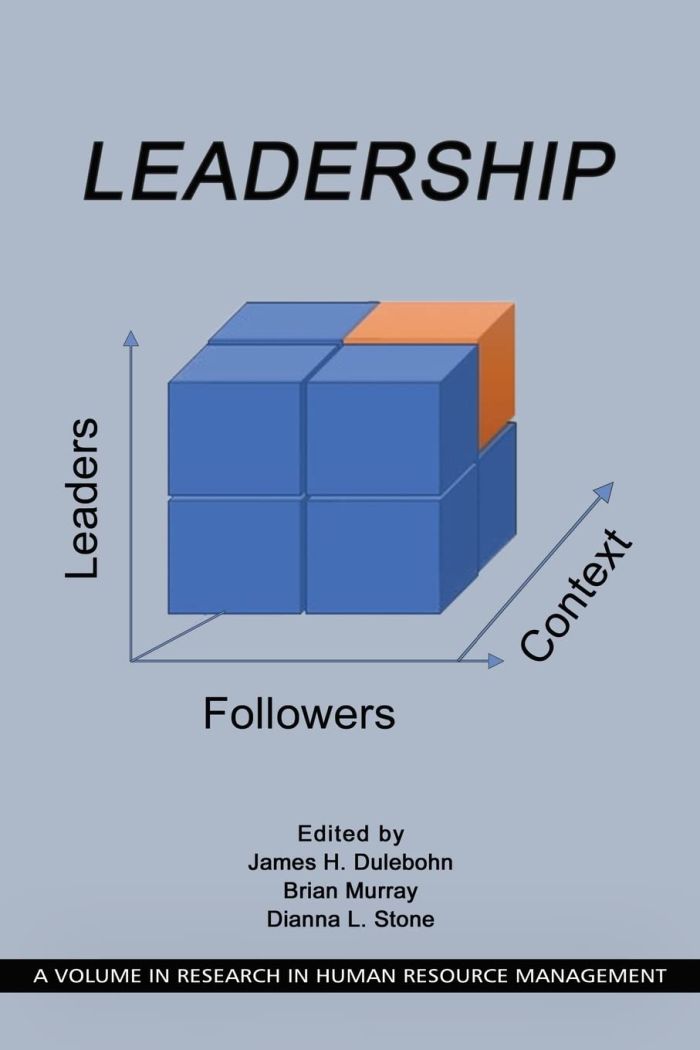
As we enter the third decade of the twenty-first century, we are seeing a renaissance of context in influencing leadership, leader-follower relations, and leader effectiveness as well as a recognition of the tripartite nature of leadership. To fully understand and appreciate leadership, one must see the multiple parts of it as well as the connections among them.
Leadership is multi-dimensional; leadership depends on leaders, followers, and context. Leadership research in the past three decades has been dominated by interest in neo-charismatic leadership styles and a focus on leadermember exchange in leader-follower relationships. Recently other approaches to leadership, such as ethical and authentic leaders, have garnered greater attention in response to the moral and ethical challenges in the workplace. Additionally, established approaches to leadership emergence and development have been challenged by their relevance to diverse work forces and issues of inclusion.
This twelve article volume includes an outstanding roster of established and emerging leadership authors who tackle questions of leadership at the intersections of leaders, followers, and context. The volume opens with two articles that set the stage for the current state of leadership research and paths for its future including a commentary by Edwin Locke and Gary Latham on current management research practices and an action-oriented review of leadership research from the start of the 21st century.
The volume is organized around three themes: leadership and diversity, leader-follower relationships, and systems of leader, follower, and context.
Articles in the volume advance diversity research with an integration of leadership and diversity theories that demonstrate the former’s need for re-examination in light of the latter, a systematic development of inclusive leadership theory, and a close examination of immigrant ethnic identity. The authors of several articles expand our understanding of leader-follower relationships in the context of teams and alliances, the contextual boundaries of authentic leadership theory, and the authentic leader’s potential impact on harassment in organizations.
The volume culminates with three demonstrations of leadership as systems of leader-follower-context interaction, including a close examination of the toxic triangle’s manifestation in university scandals, a micro-process model of power and leadership, and a configurational approach to studying leadership.
The volume is designed primarily for scholars in the fields of human resource management, organizational behavior, and leadership. It also well serves the needs of instructors and students in master's and doctoral courses in leadership or organizational behavior. Each article is grounded in managerial context that will appeal to practitioners in the field.
Chapter 1. Leadership Research at the Crossroads of Leaders, Followers, and Context; Brian Murray, James H. Dulebohn, and Dianna L. Stone.
- Chapter 2. How Can We Do Management Research That Is Valid and Useful? Edwin A. Locke and Gary P. Latham.
- Chapter 3. 21st Century Leadership Research in Elite General Management Journals: Where the First 20 Years Have Taken Us and Where We May Be Going; William H. Bommer, Emil Milevoj, and Jonathan Biggane.
- Chapter 4. It's Not Just About Representation: Integrating Diversity Into Leadership; Shannon K. Cheng, Isabel Bilotta, Brook Lu, and Eden B. King.
- Chapter 5. Inclusive Leadership: The Roots of an Emerging Theory; Trevor Cox.
- Chapter 6. Knowing Me, Knowing You: Immigrant Ethnic Identity and Leader-Member Relationships; Monica M. Sharif and Terri A. Scandura.
- Chapter 7. Using LMXAlliance to Enhance Follower and Team Performance; George B. Graen, Julio C. Canedo, Andrew F. Johnson, and Miriam Grace.
- Chapter 8. Barriers to Authentic Leader-Follower Relationships: Implications for Human Resource Management; William L. Gardner, Daniel P. Gullifor, James D. Carlson, Claudia C. Cogliser, and Margaret L. Williams.
- Chapter 9. Enough Already! The Role of Authentic Leadership in Improving the Management of Workplace Harassment in Organizations; James M. Schmidtke and Fred O. Walumbwa.
- Chapter 10. Destructive Leadership Episodes: Why Can't We Learn From Them? Laura Gail Lunsford, Art Padilla, and Paul Mulvey.
- Chapter 11. Integrating Leadership and Power: A Micro Process Model; Nicolas Bastardoz and David V. Day.
- Chapter 12. A Unifying Framework for Systems and Configurational Models of Leadership and Substitutes; J. Lee Whittington, Brian Murray, and R. Greg Bell.
- About the Authors.