
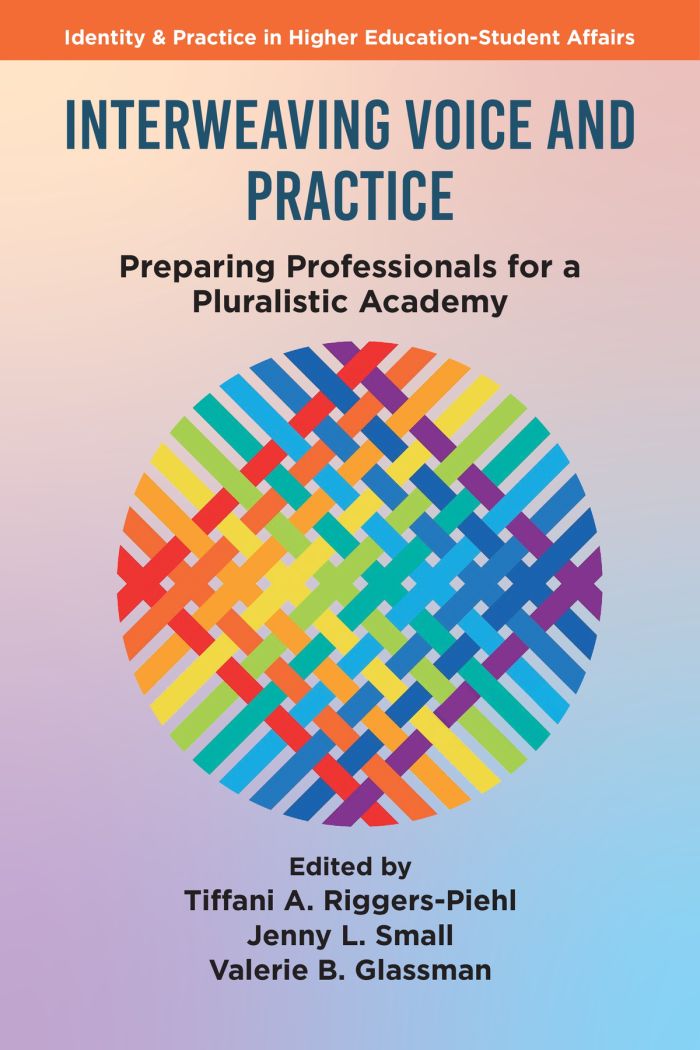
Interweaving Voice and Practice
Preparing Professionals for a Pluralistic Academy

This book can be opened with

Note on our eBooks and Audiobooks: you can read our eBooks (ePUB or PDF) and listen to audiobooks on the free Emerald Books app on iOS, Android, and desktop. Or read and listen on Emerald's online reader (ePUB eBooks and audiobooks only). To purchase a digital book you will need to create an account if you don’t already have one. After purchasing you will receive instructions on how to get started.
- Description
- Contents
- About
For decades, higher education has faced ongoing challenges in fully supporting and integrating religious, secular, and spiritual identities (RSSIs). Despite a growing need—heightened by global events such as the 9/11 attacks and continuing international religious tensions, as well as recent shifts in campus demographics—this crucial dimension of student experience remains significantly under-addressed in both professional training and institutional practice. Interweaving Voice and Practice responds to this gap by bringing together the insights of practitioners and faculty across the field, offering a rich blend of scholarly analysis and lived professional experience.
This book provides a comprehensive 360-degree view of the challenges and opportunities for supporting RSSIs on college campuses today. Chapters offer both a deep theoretical grounding and a wide range of practical applications. Section I establishes the conceptual framework, exploring critical theories, historical contexts, and the imperative for comprehensive inclusion. Section II moves to the lived experience, with narratives that honor Indigenous and Jewish spirituality, and elevate the experiences of Muslim and queer students, while also addressing the complexities of Christian identities. Finally, Section III provides a practical blueprint, offering guidance on integrating RSSIs into Higher Education and Student Affairs graduate programs, residence life, student conduct, and counseling services.
By combining personal narratives with institutional strategies, Interweaving Voice and Practice serves as a vital resource for both academics and practitioners. It is a sourcebook for HESA programs, a guide for professional development, and a call to action for transforming higher education into a more pluralistic and inclusive environment. The book not only illustrates why this work is important but also provides tangible, actionable steps for making it happen.
Section I. Theoretical and Legal Frameworks
- Chapter 1. The Cultural Reorientation; Sachi Edwards and Simran Kaur-Colbert
- Chapter 2. Theory and Application: An Analysis of Critical Religion Theories in Higher Education; Jenny L. Small
- Chapter 3. The Imperative of Incorporating Critical Frameworks for Religion in Teaching about Diversity, Equity, and Inclusion; Sachi Edwards
- Chapter 4. Black, Secular, and Free? A Sociocultural History of Race, Secularism, and the First Amendment; J.T. Snipes
- Section II. Supporting Diverse Identities
- Chapter 5. Atheists, Agnostics, and Nones, Oh My!: The Secular Umbrella on College Campuses; Gordon W. Maples
- Chapter 6. Critical Reflections on Black Christian RSSIs in Higher Education; Michele D. Smith and Tiffani A. Riggers-Piehl
- Chapter 7. Honoring Indigenous Spirituality in Higher Education; Robin Zape-tah-hol-ah Minthorn
- Chapter 8. Jewish College Students: Community and Identity in a Post-10/7 World; Ben Selznick and Rabbi Moshe Leib Gray
- Chapter 9. Elevating the Experiences of Muslim College Students; Shafiqa Ahmadi, Darnell Cole, Milie Majumder, and Mabel E. Hernandez
- Chapter 10. The Nexus of Queer and RSS Identities; Kaity Prieto
- Section III. Policy and Practice on Campus
- Chapter 11. Universal Design and Religious Practices: A New Approach to Residence Life Policies; Conor P. McLaughlin and Joshua R. Patterson
- Chapter 12. Christian Hegemony Across Religious, Spiritual, and Secular Identities (RSSIs) in Campus Student Organizations; Pietro A. Sasso
- Chapter 13. From Policy Violation to Reflective Practice: Reimagining Student Conduct as a Space for Identity, Meaning-Making, and Growth; Valerie B. Glassman
- Chapter 14. Integrating Religion, Spirituality, and Secularism in College Counseling: A Clinical Case Study of M; Bini B. Sebastian
- Chapter 15. Beyond Student Development Theory: The Value of Religious, Secular, and Spiritual Identity Inclusion Across Master’s Level HESA Curricula; Tiffani A. Riggers-Piehl
- Chapter 16. Integrating RSSI content into Higher Education Administration and Policy Doctoral Programs; Sandra Greene
Tiffani A. Riggers-Piehl is an Associate Professor of Higher Education at University of Missouri-Kansas City, USA where she coordinates the graduate programs in Higher Education Administration (MA/EdD) and is the Dean’s Fellow for Faculty Engagement.
Jenny L. Small is the Associate Director of the Jack, Joseph and Morton Mandel Center for Studies in Jewish Education at Brandeis University, USA.
Valerie B. Glassman is a nationally recognized mother-scholar-practitioner and the Senior Director for Student Affairs at the University of North Carolina School of Medicine, USA.