
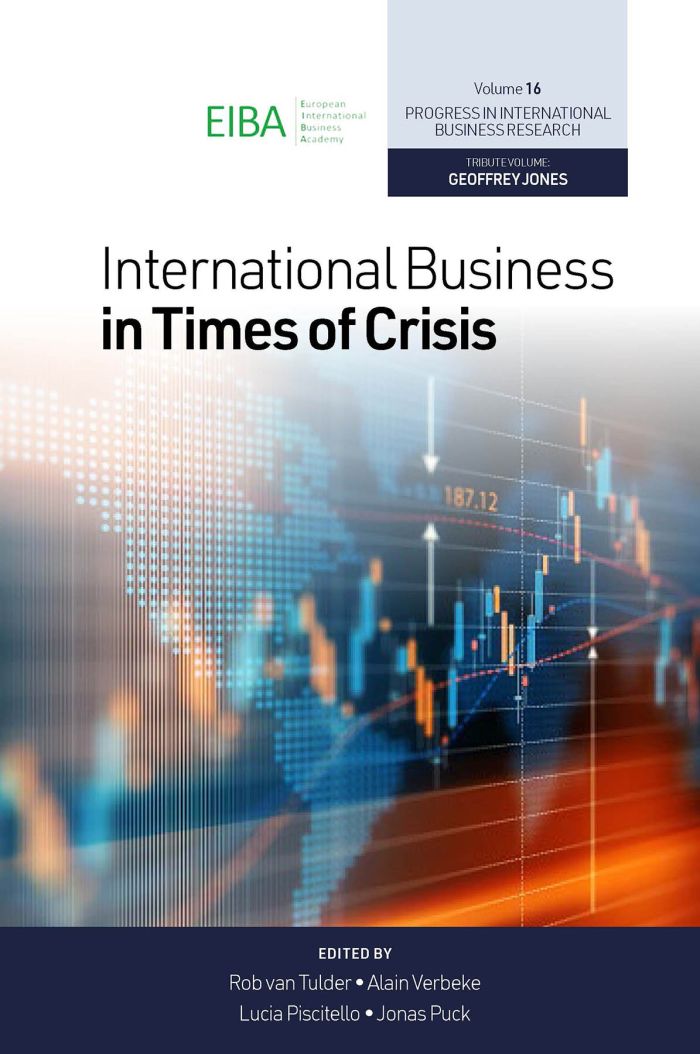

International Business in Times of Crisis

This book can be opened with

Note on our eBooks and Audiobooks: you can read our eBooks (ePUB or PDF) and listen to audiobooks on the free Emerald Books app on iOS, Android, and desktop. Or read and listen on Emerald's online reader (ePUB eBooks and audiobooks only). To purchase a digital book you will need to create an account if you don’t already have one. After purchasing you will receive instructions on how to get started.
- Description
- Contents
- About
This sixteenth volume in the PIBR series, International Business in Times of Crisis, is dedicated to Professor Geoffrey Jones from the Harvard Business School, and to the importance of historical scholarship in International Business (IB) studies.
The global Covid-19 crisis triggered a profound economic crisis, with a decline in global economic activity on a scale not seen since the Great Depression. This pandemic revealed systems failures and fragilities closely related to the organization of global economic, financial, political, and social systems. It has confronted the world with fundamental questions regarding how the global community, as well as companies in general and multinational enterprises (MNEs) in particular, should design global responses to crises. A multi-level and longitudinal approach to studying crises in IB is clearly necessary. This book classifies studies of crises relevant to IB research and will hopefully be helpful to IB scholars, as they reflect on the type of crises they want to study as part of their future research agenda.
“The main point coming out of this brief description of my own intellectual journey is to emphasize that crises have been the norm rather than the exception in the history of international business. They have taken many forms and building a typology of crises would be a helpful next step in new research.” Geoffrey Jones (in this volume)
Chapter 1. IB in Times of Crisis: What Perspective to Take?; Rob van Tulder, Alain Verbeke, Lucia Piscitello, and Jonas Puck
- Part I. The Longitudinal Perspective – The Importance of Historical IB Studies
- Chapter 2. Crises and International Business; Geoffrey Jones
- Chapter 3. Crises in International Business: A New Perspective; Mark Casson
- Chapter 4. History Matters; Mira Wilkins
- Chapter 5. Crises, Emerging Market Firms, and Global Value Chain Resilience; Pavida Pananond
- Chapter 6. Business Groups, Panics, Runs, Organ Banks and Zombie Firms; Asli M. Colpan and Randall K. Morck
- Chapter 7. Take a Look at Yourself: International Business and the De-globalization Crisis; Michael A. Witt
- Chapter 8. Extraordinary Risk Management in International Business Strategy; Teresa da Silva Lopes
- Part II. The Micro-Perspective – Self-Inflicted Crises
- Chapter 9. How Companies Respond to Self-inflicted Crises. A Comparison Between Countries, Types of Crises, and Response Strategies; Marcus Conrad and Marc Oberhauser
- Chapter 10. Learning Processes During Re-internationalization: A Case Study of Chinese SMEs; Honglan Yu, Margaret Fletcher, and Trevor Buck
- Chapter 11. Switching Governance Modes to Improve the Resilience of Global Value Chains Against External Disruptions; Wenyan Yin and Hwy-Chang Moon
- Part III. Meso-Level Perspective – Sectoral Crises
- Chapter 12. How to Be Smart: Leveraging Digital FDI to Address Risk Through Capacity and Competitiveness; Matthew Stephenson, Lorraine Eden, Michael Kende, Fukunari Kimura, Karl Sauvant, Niraja Srinivasan, Lucia Taioli, and James Zhan
- Chapter 13. COVID-19 Crisis, Digitalization and Location Decisions; Rubina Romanello, and Valerio Veglio
- Chapter 14. Serial Nonlinear Internationalization Before and During the COVID-19 Pandemic: Case Study Evidence From Estonia; Tia Vissak
- Chapter 15. Evolution of Consumption and Retail Transformation – The Emergence of a New Institutional Order for the Future of Retailing; Anna Karhu, Elina Pelto, and Lauri-Matti Palmunen
- Chapter 16. Consumer Vulnerability During COVID-19: The Impact of Fear and Age on Consumer Behaviour and Business Strategy; Helena Sá Domingues, Marcelo Augusto Linardi, Susana Costa e Silva, and Paulo Duarte
- Chapter 17. Reassessing the Impact of the 2008 Financial Crisis on Global Foreign Direct Investment: Empirical Evidence and Theoretical Implications; Guoyong Liang
- Chapter 18. Nexus of Debt Financing, Investment and Policy Intervention: Impact of COVID-19 Pandemics on CAREC Member Countries; Muhammad Ayub Mehar
- Part IV. Macro-Level Perspective – Systems Crises and Country Risks
- Chapter 19. Globalization in a COVID-19 Afflicted World; P. Trapczynski, M. G. Gorynia, J. Nowak, and R. Wolniak
- Chapter 20. Host Country Risk Dynamics and Foreign Direct Investments; Very Kunczer, Thomas Lindner, and Jonas Puck
- Chapter 21. Strategies to Face BREXIT: The Case of Polish Companies; Barbara Jankowska, Aleksandra Kania, and Katarzyna Mroczek-Dabrowska
- Chapter 22. Polish Companies and the Uncertainty Over BREXIT’s Regulatory Void: Adaptive Strategies Towards the Unknown; Katarzyna Mroczek-Dabrowska and Anna Matysek-Jędrych
- Chapter 23. The Paradox of Distance: New Zealand Businesses During COVID-19; Benjamin Fath, Antje Fiedler, Noemi Sinkovics, and Rudolf R. Sinkovics
- Part V. Exogenous Crises – Natural Distasters and Emergencies
- Chapter 24. Managers’ Identification of Natural Disaster Risks: Findings From a Survey of 18 Countries; Chang Hoon Oh and Jennifer Oetzel
- Chapter 25. A Taxonomy of Corporate Emergency Responsibility to Ensure Social Sustainability Post-Shock; Francisco Javier Forcadell and Elisa Aracil
- Chapter 26. An Enterprise Risk Model for COVID-19 Crisis Effects – The Hungarian Experience; Peter Juhasz and Ageness Szabo
- Chapter 27. Doing Business in a Distant Paradise; Adam Grzywacz, Małgorzata Kuczara, and Aleksandra Wąsowska
Rob van Tulder is a professor of International Business-Society Management at Rotterdam School of Management, Erasmus University (RSM).
Alain Verbeke is a Professor at the University of Calgary and affiliated with the University of Reading and the Vrije Universiteit Brussels.
Lucia Piscitello is Professor of International Business at Politecnico di Milano, School of Management.
Jonas Puck is Full Professor at the WU Vienna University of Economics and Business and was the founding Head of WU's Institute for International Business.