
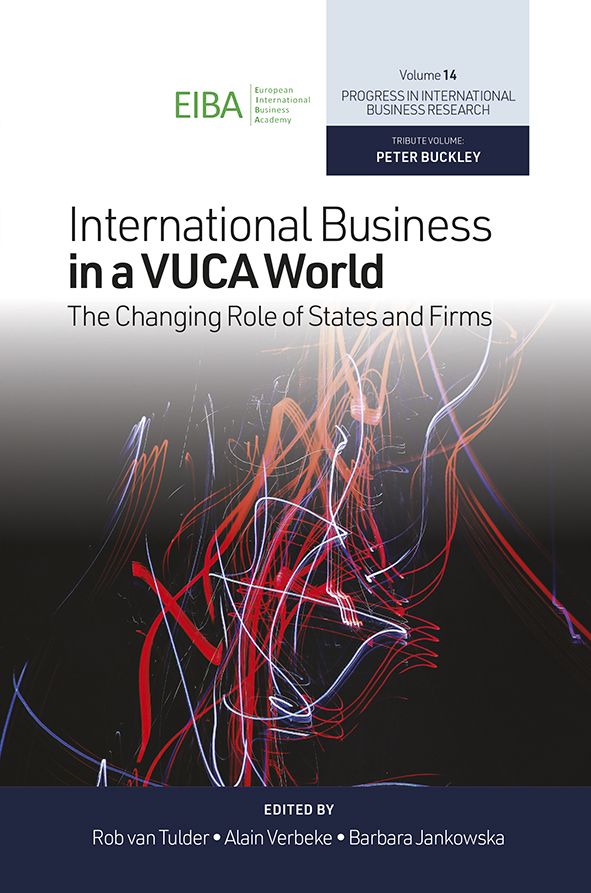

International Business in a VUCA World
The Changing Role of States and Firms

This book can be opened with

Note on our eBooks and Audiobooks: you can read our eBooks (ePUB or PDF) and listen to audiobooks on the free Emerald Books app on iOS, Android, and desktop. Or read and listen on Emerald's online reader (ePUB eBooks and audiobooks only). To purchase a digital book you will need to create an account if you don’t already have one. After purchasing you will receive instructions on how to get started.
- Description
- Contents
- Reviews
- About
This fourteenth volume in the PIBR series is dedicated to Professor Peter Buckley, OBE, whose creative contributions to IB theory and practice over many decades are unmatched. His scientific oeuvre has continued to grow, both in depth and breadth, and reflects an evolving level of scholarly resilience that has kept pace with the increasing Volatility, Uncertainty, Complexity and Ambiguity (VUCA) characteristics of the modern environment of international business.
The VUCA dimensions of the business environment that face both managers and policy makers are amplified by a wide variety of unpredictable social, economic, political and technological forces, such as: inter alia, the (post-great-recession) rise of populism; growing anti-European sentiment in the European Union; increasing protectionism; a slowdown in growth of emerging markets; the rise of the digital economy, and many more. These trends affect the competitive position of nations and firms. He present volume focuses on the threats and opportunities created by the VUCA-trends for multinational enterprises (MNEs), small and medium sized enterprises (SMEs), and international new ventures (INVs), along the following five headings:
- IB scholarship in a VUCA world.
- New Perspectives on the Interplay between Firms and the Non-Market.
- New Governance Challenges in International Business.
- New Contexts for Newly Internationalizing Firms.
- Contemporary Management Perspectives in IB Research.
Preface: Peter Buckley - A Tribute;
- Introduction: Progress in International Business Research in and Increasingly VUCA World; Rob van Tulder, Barbara Jankowska and Alain Verbeke Chapter 1. The Role of International Business Theory in an Uncertain World; Peter Buckley; Part I. International Business in a VUCA Environment; Chapter 2. The Impossibility of International Business; Mark Casson; Chapter 3. The firms of our times: risk and uncertainty; Peter W. Liesch and Lawrence S. Welch; Chapter 4. Can VUCA help us generate new theory within international business?; L. Jeremy Clegg, Hinrich Voss and Liang Chen; Part II. New Perspectives on the Interplay between Firms and the Non-Market Chapter 5. Production Switching and Vulnerability to Protectionism; Ari Van Assche and Byron Gangnes; Chapter 6. Institutional Schisms: Understanding the Role that Intergovernmental Organizations Have in Shaping Country Institutional Environments; Kristin Brandl, Luis Dau and Elizabeth Moore; Chapter 7. The Future of Transatlanticism - Effects of a Rise of US Import Tariffs on exports in the German Automotive Sector. A quantitative, data driven approach; Moritz Kath and Natalia Ribberink; Chapter 8. Passive, aggressive or creative? Adjustment strategies of companies affected by sanctions; Beata Stępień and Patrick Weber; Chapter 9. How Economic Freedom Affects Transaction Costs; Bruno Buscariolli Pereira and Jorge Manoel Teixeira Carneir; Part III. New Governance Challenges in International Business Chapter 10. Macroenvironmental dynamism and firm risk management - an exploratory investigation; Florian Klein, Jonas Puck and Martin Weiss; Chapter 11. Top Management Team Influence on Firms' Internationalization Complexity; Stefano Elia, Peder Greve, Tommaso Vallone, Daniele Marinelli and Lisa Longoni; Chapter 12. What happens after offshoring? A comprehensive framework; Marco Bettiol, Maria Chiarvesio, Eleonora Di Maria, Cristina Di Stefano and Luciano Fratocchi; Chapter 13. The role of institutional context in backshoring decisions; Lise Lillebrygfjeld Halse, Bella Belerivana Nujen and Hans Solli-Sæther; Chapter 14. Multinationals and the European poor. Reverse knowledge transfer or ad hoc solutions?; Antonella Zucchella and Serena Malvestito; Part IV. New Contexts for Newly Internationalizing Firms Chapter 15. Born globals or born regionals? A study of 32 early internationalizing SMEs; Sara Melén, Emilia Rovira Nordman and Daniel Tolstoy; Chapter 16. Facilitating International Venturing of Emerging Market Firms through Entrepreneurial Transformation: Contingent Role of Technological Environment; Chen Han and Bo Bernhard Nielsen; Chapter 17. Uncertainty and decision-making in SME internationalization: the importance of control, prediction, and knowledge; Luis Oliveira, Wensong Bai, Martin Johanson, Milena Ratajczak-Mrozek and Barbara Francioni; Chapter 18. The internationalization of early stage social enterprises; Tiina Ritvala and Rilana Riikkinen ; Part V. Contemporary Management Perspectives in IB Research Chapter 19. VUCA and the Future of the Global Mobile Telco Industry; Angels Dasi, Frank Elter, Paul Gooderham and Torben Pedersen; Chapter 20. Managing ambidexterity using networking perspective – added value or necessity? Empirical evidence from Poland; Joanna Radomska, Przemysław Wołczek and Susana Costa e Silva; Chapter 21. Exploring the context-specific talent management practices and their link to firm's absorptive capacity in emerging markets: Brazil vs Russia; Marina Latukha, Louisa Selivanovskikh and Maria Laura Maclennan; Chapter 22. Institutional effects on the ownership in cross-border acquisitions by African firms; João Neves de Carvalho Santos, Manuel Portugal Ferreira and José Carlos Rodrigues; Chapter 23. When does adaptation to foreign markets matter? An institutional approach to the internationalization of post-transition economy firms; Mariola Ciszewska-Mlinarič and Piotr Trąpczyński; Chapter 24. Outward foreign direct investment and multinationality of emerging multinationals; Mohamed Amal and Huaru Kang
This volume brings together 24 chapters by researchers from around the world, who address the challenges multinational enterprises face when expanding or repositioning themselves in the global environment in the context of volatility, uncertainty, complexity, and ambiguity (VUCA). They first discuss international business in the VUCA environment, including the role of international business theory in an uncertain world, the optimal location of plants by a global firm, risk and uncertainty in the international context, and the VUCA approach and the global factory model. The next section addresses the relationship between firms and the non-market, including trade policy uncertainties and implications for global value chains, the role of intergovernmental organizations in shaping country institutional environments, the effects of introducing a tariff on trade in the automotive sector, adaptation strategies of European Union enterprises affected by sanctions on Russia, and whether fewer trade barriers and more economic freedom lead to better functioning societies. Subsequent sections cover new governance challenges in international business, including macro-environmental dynamism and its impact on a firm's risk management, the relationship between firms' top management teams and internationalization complexity, alternatives firms can use after the initial relocation of manufacturing abroad, the role of institutional context in backshoring decisions, and multinational enterprises and poverty in Europe, as well as the context of new international business operations, including early internationalizing firms, the role of the technological environment in facilitating international venturing of emerging market firms through entrepreneurial transformation, the role of market uncertainties in the internationalization of small and medium-sized enterprises, and the internationalization of social enterprises. The final section describes the future of the global mobile telecommunications industry, managing ambidexterity using networking, talent management in Brazil and Russia, institutional effects on ownership in cross-border acquisitions by African firms, adaptation to foreign markets, and the impacts of institutional distance on the multinationality level of firms from developing countries. The book is based on the conferences of the European International Business Academy.
Rob van Tulder is a Professor of International Business at Rotterdam School of Management, Erasmus University (RSM), the Netherlands. He has published extensively on the topics of European business, multinationals, high-tech industries, corporate social responsibility, issues management, skills, network strategies, smaller industrial countries (welfare states) and European Community/Union policies.;
Alain Verbeke is a Professor of International Business Strategy and holds the McCaig Research Chair in management at the Haskayne School of Business, University of Calgary, Canada. He is a leading thinker on complex project evaluation and the strategic management of multinational networks, as well as the governance and restructuring of complex organizations.;
Barbara Jankowska is an Associate Professor and Head of the Department of International Competitiveness at Poznan University of Economics and Business. She is the author or co-author of around 140 academic publications, with her main research areas including international competitiveness of firms and industries, foreign direct investment, Industry 4.0 and business clustering.