
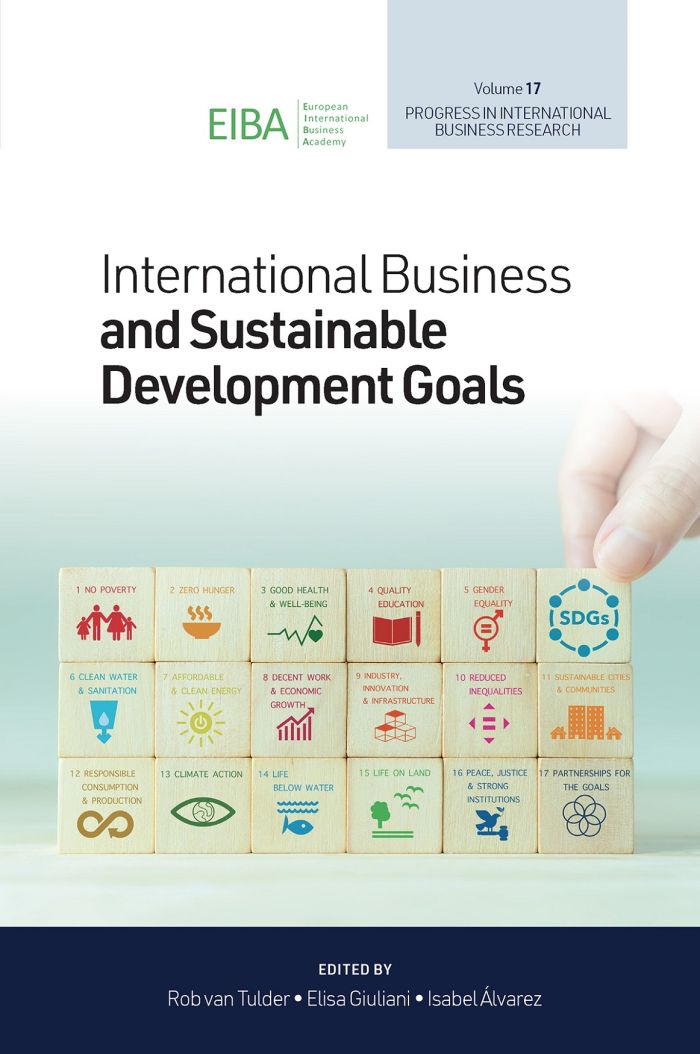

International Business and Sustainable Development Goals

This book can be opened with

Note on our eBooks and Audiobooks: you can read our eBooks (ePUB or PDF) and listen to audiobooks on the free Emerald Books app on iOS, Android, and desktop. Or read and listen on Emerald's online reader (ePUB eBooks and audiobooks only). To purchase a digital book you will need to create an account if you don’t already have one. After purchasing you will receive instructions on how to get started.
- Description
- Contents
- About
The Sustainable Development Goals (SDGs) represent the leading governance frame with which the international community tries to address complex interconnected global issues. The SDGs were adopted in 2015 by all 193 UN member states and were also quickly embraced by most Multinational Enterprises (MNEs), International NGOs and leading business schools. But progress has proved slow. In 2020, the United Nations announced a ’decade of action’ to speed-up progress in the area. To what extent and under what circumstances can MNEs help in this effort: revitalize the SDGs and rescue the beneficial effects of globalization?
Volume 17 in the series Progress in International Business Research argues that the SDGs can be considered the only relevant agenda for progress in the years to come. This makes it all the more important to critically consider the role played by MNEs, as well as explore the way IB scholarship can help MNEs to ‘walk the talk’ on the complex issues that affect the sustainable development – thereby leveraging the future shape of ‘globalization’.
The book contains contributions by established as well as young scholars and is intended to stimulate present and future research, create new forms of conceptualizations and provide first evidence of more focused empirical research on the topic of MNEs and the SDGs.
Part I: General Challenges for IB Scholarship
- Chapter 1. Introduction. IB Scholarship and the Sustainable Development Goals: Seizing Opportunities, While Tackling Challenges; Rob van Tulder, Isabel Álvarez, and Elisa Giuliani
- Chapter 2. International Business and the SDGs: Current Issues and Future Directions; Pervez Ghauri, Faith Hatani, Yingying Zhang-Zhang, Sylvia Rohlfer, and Maoliang Bu
- Chapter 3. Measuring and Managing the Impact of Business on the SDGs; Jan Anton van Zanten
- Part II: Strategic Challenges for MNEs
- Chapter 4. Walking the Talk: Making the SDGs Core Business – An Integrated Approach; Filipa Pires de Almeida, Rob van Tulder, and Suzana B. Rodrigues
- Chapter 5. Catalyzing Progress Toward the UNs’ SDGs: Building Systemic Partnerships Across Organizations Using the I-RES Methodology; Luis Dau, Larissa Pacheco, Robin White, Elizabeth Allen, and Elizabeth Moore
- Chapter 6. Addressing the Complexities in Implementing SDGs in International Business; Simone Carmine and Valentina de Marchi
- Chapter 7. SDGs and Strategic Priorities of MNEs for Sustainability Transformation– Lessons from IKEA; Bo Enquist and Samuel Petros Sebhatu
- Part III: The Nexus Challenge
- Chapter 8. Balancing Purpose and Profit in Foreign Direct Investment: How Development Finance Institutions Promote the SDGs While Being Profitable; Suhyon Oh and Michael Wendelboe Hansen
- Chapter 9. The Nexus Between Cultural and Creative Sectors and the Sustainable Development Goals: A Network Perspective; Yang Gao, Ekaterina Turkina, and Ari Van Aasche
- Chapter 10. Trade-offs in FDI Effects on SDGs in Sub-Saharan Africa Countries; Paola Garrone, Lucia Piscitello, Matilde d’Amelio, and Emanuela Colombo
- Part IV: Contextualizing the SDGs
- Chapter 11. Tax Impact of Multinationals in Central and Eastern Europe on Sustainable Development Goals; Petr Procházka
- Chapter 12. Climate Change Disclosures of Companies in Selected Developed and Emerging Countries with Impression Management Perspective; Nazlı Ece Bulgur, Emel Esen, and Selin Karaca
- Chapter 13. Multinational Corporations in Sustainable Cities: The Case of a Sustainable Headquarters Building; Tiina Ritvala, Ella Ahmas, and Rebecca Piekkari
- Chapter 14. Ports and the Sustainable Development Goals: An Ecosystems Approach; Maurice Jansen
- Chapter 15. Possibilities for Upgrading High-tech GVCs Towards Stronger SDG Performance; Antonio Biurrun and Isabel Alvarez
- Chapter 16. Tensions on the Road Towards Just Transitions in the Latin American Coffee Value Chain; Katie Louise Andrews, Noemi Sinkovics, and Rudolf R. Sinkovics
- Part V: SDG-Washing Challenges
- Chapter 17. Corporate Misbehavior in the Banking Industry: What Role Does the State Play?; Federica Nieri
- Chapter 18. Saving the Planet is Not for Everybody: A Model of CEO’s Reactions to Human Rights Defenders; Verdiana Morreale and Elisa Giuliani
Rob van Tulder, Business Society Management and Academic Director Partnerships Resource Centre (PrC), RSM Erasmus University, Netherlands.
Elisa Giuliani, Professor of Management at the University of Pisa and founder and director of the Responsible Management Research Center (REMARC).
Isabel Álvarez, Full Professor at the Economics Department, Universidad Complutense de Madrid, Spain.