
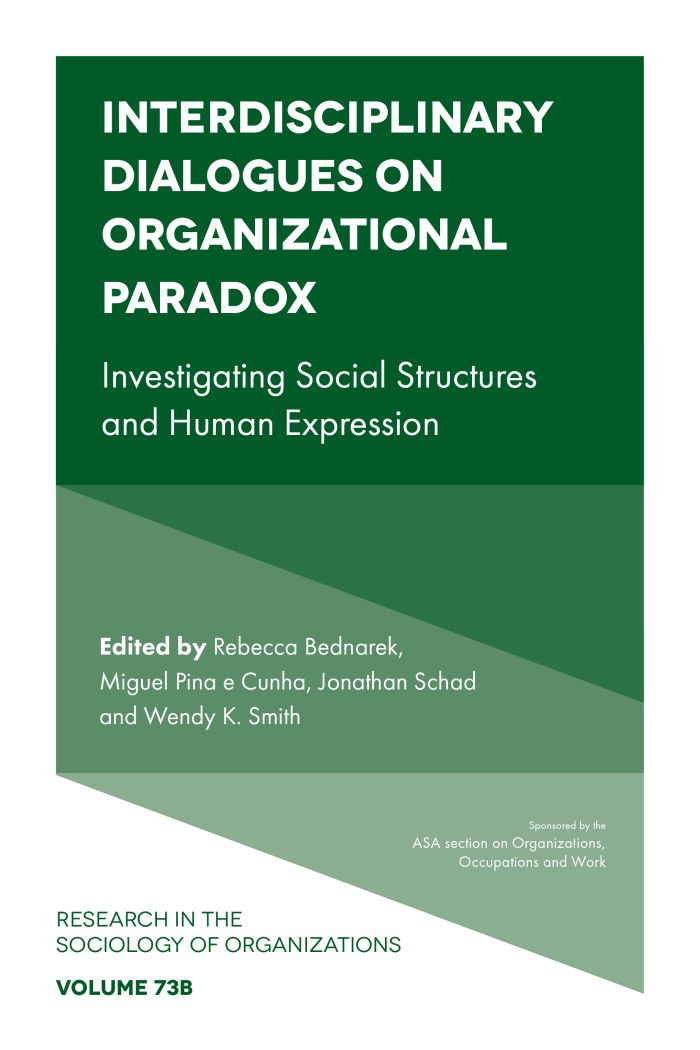
Interdisciplinary Dialogues on Organizational Paradox

Investigating Social Structures and Human Expression

Rebecca Bednarek|Miguel Pina e Cunha|Jonathan Schad|Wendy K. Smith
Emerald
Emerald

This book can be opened with

Glassboxx eBooks and audiobooks can be opened on phones, tablets, iOS and Android devices

Hardback
9781801171878
08 July 2021
$122.99
eBook (PDF)
9781801171861
08 July 2021
$122.99
eBook (ePub)
9781801171885
08 July 2021
$122.99

Note on our eBooks and Audiobooks: you can read our eBooks (ePUB or PDF) and listen to audiobooks on the free Emerald Books app on iOS, Android, and desktop. Or read and listen on Emerald's online reader (ePUB eBooks and audiobooks only). To purchase a digital book you will need to create an account if you don’t already have one. After purchasing you will receive instructions on how to get started.

  • Description
  • Contents
  • About
Interdisciplinary Dialogues on Organizational Paradox is a two-part volume exploring how paradox theory benefits from interdisciplinary theorizing and how we might go about undertaking such research.

The chapters draw from four disciplinary realms: beliefs, physicality, expression, and social structure. Unique commentaries from thought leaders expand and assess the focal pieces of each volume.

Part B: Investigating Social Structures and Human Expression continues the exploration of the why, how and where of interdisciplinary research within paradox theory by looking specifically at the realms of social structure - from logic and Luhmann, to historical analysis - and expression - from linguistics, to the maths and poetry of Spencer-Brown, to jazz. The chapters are complemented with reflective commentaries from Charles Hampden-Turner and Ann Langley. The collection ends with an examination of where the interdisciplinary foundations for organizational paradox theory arose via conversations with seminal paradox scholars.

Part B. Introduction B. Implementing Interdisciplinary Paradox Research; Rebecca Bednarek, Miguel Pina e Cunha, Jonathan Schad and Wendy K. Smith B1. Realm of Social Structures  Chapter 8. Logic(s) and paradox; Marco Berti  Chapter 9. The generative potential of Luhmann’s theorizing for paradox research: Decision paradox and deparadoxization; David Seidl, Jane Lê and Paula Jarzabkowski  Chapter 10. The historical embeddedness of organizational paradoxes: Risk-related rituals and realities in emergency management; Dean Pierides, Stewart Clegg and Miguel Pina e Cunha  Commentary 3.  Paradoxes of social structure: Commentary; Charles Hampden-Turner  B2. Realm of Expression  Chapter 11. The organizational paradox of language; Joshua Keller and Ping Tian   Chapter 12. Trying Not to Try: The Paradox of Intentionality in Jazz Improvisation and its Implications for Organizational Scholarship; Colin M. Fisher, Ozumcan Demir-Caliskan, Mel Yingying Hua and Matthew A. Cronin  Chapter 13. Spencer Brown’s paradox; Mike Zundel, Anders La Cour and Ghita Dragsdahl Lauritzen  Commentary 4. Paradox as Irony: Inspirations from Jazz, Linguistics, Mathematics, Poetry and Other Stories; Ann Langley  Conclusion   Conversations and inspirations for organizational paradox scholarship; Rebecca Bednarek, Marianne W. Lewis, and Jonathan Schad

    Rebecca Bednarek is an Associate Professor at Victoria University Wellington. She studies paradoxes and strategizing practices within science systems and financial markets and has written extensively about qualitative methods.

    Miguel Pina e Cunha is the Fundação Amélia de Mello Professor at Nova School of Business and Economics, Universidade Nova de Lisboa, Portugal. His work deals with three Ps of organizing: process, paradox, positivity.

    Jonathan Schad is Lecturer in Strategy and Organisation Theory at King’s Business School, King’s College London, UK. His research uses paradox theory to better understand the fundamental tensions contemporary organizations confront.

    Wendy K. Smith is Professor of Management at University of Delaware, USA. She studies paradoxes, exploring how leaders navigate strategic paradoxes such as tensions between exploration and exploitation or social missions and financial demands.