
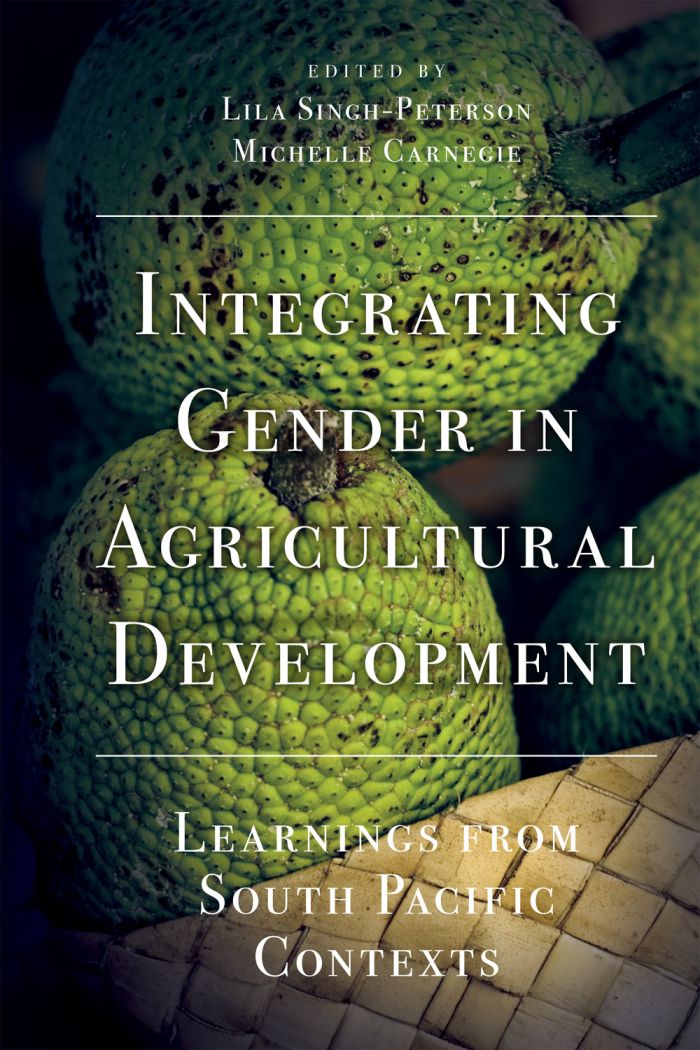

Integrating Gender in Agricultural Development
Learnings from South Pacific Contexts

This book can be opened with

Note on our eBooks and Audiobooks: you can read our eBooks (ePUB or PDF) and listen to audiobooks on the free Emerald Books app on iOS, Android, and desktop. Or read and listen on Emerald's online reader (ePUB eBooks and audiobooks only). To purchase a digital book you will need to create an account if you don’t already have one. After purchasing you will receive instructions on how to get started.
- Description
- Contents
- About
Chapter 1. Introduction; Integrating Gender in Agricultural Development Initiatives across the South Pacific: Customs, Values and Intersections; Lila Singh-Peterson and Michelle Carnegie PART ONE Chapter 2. Facing the Future: Backgrounds to Agricultural Change in the South Pacific; John Connell Chapter 3. The international 'gender agenda' in the context of the South Pacific and Agricultural Livelihoods; Michelle Carnegie and Lila Singh-Peterson PART TWO Chapter 4. Bula Coffee: Women's access to economic opportunities, the effects on women's agency and their influence on social norms in rural Fijian communities; Marilyn Vilisoni, Ajla Vilogorac and Samira Saif Chapter 5. An exploratory approach to understanding women's contributions to the aquaculture sector in Samoa: The influence of traditional systems and cultural norms; Joanne Kunatuba, Ana Laqeretabua and Ulusapeti Tiitii Chapter 6. Upward reflections on top-down gendered institutions -- a community development case study from Tonga; Lila Singh-Peterson, Tema Moala and Louna Sione Hamani Chapter 7. Agroecology and sustainable livelihoods as a framework to empower rural Ni Vanuatu women; Cherise Addinsall, Norah Rihai and Antoinette Nasse Chapter 8. Community livelihood improvement in the Papua New Guinea LNG project; R. Michael Bourke, Shirley Tombenna, Owen Hughes, Matthew'wela B. Kanua, Agnes Siune and Barbara Pamphilon Chapter 9. Research and learning from the 'inside out': processes, practices and pedagogy of a women's agricultural economic empowerment project in Papua New Guinea; Barbara Pamphilon, Veronica Bue and Fredah Wantum PART THREE Chapter 10. Reflections from the South Pacific -- Navigating intersectionality and customary contexts to progress gender equality and gender equity; Lila Singh-Peterson, Michelle Carnegie, Veronica Bue, R. Michael Burke, Joanne Kunataba, Ana Laqeretabua, Temaleti Moala, and Barbara Pamphilon and Marilyn Vilisoni Chapter 11. Conclusion; South Pacific Contexts for Gender Equality Scholarship and Practice; Lila Singh-Peterson