
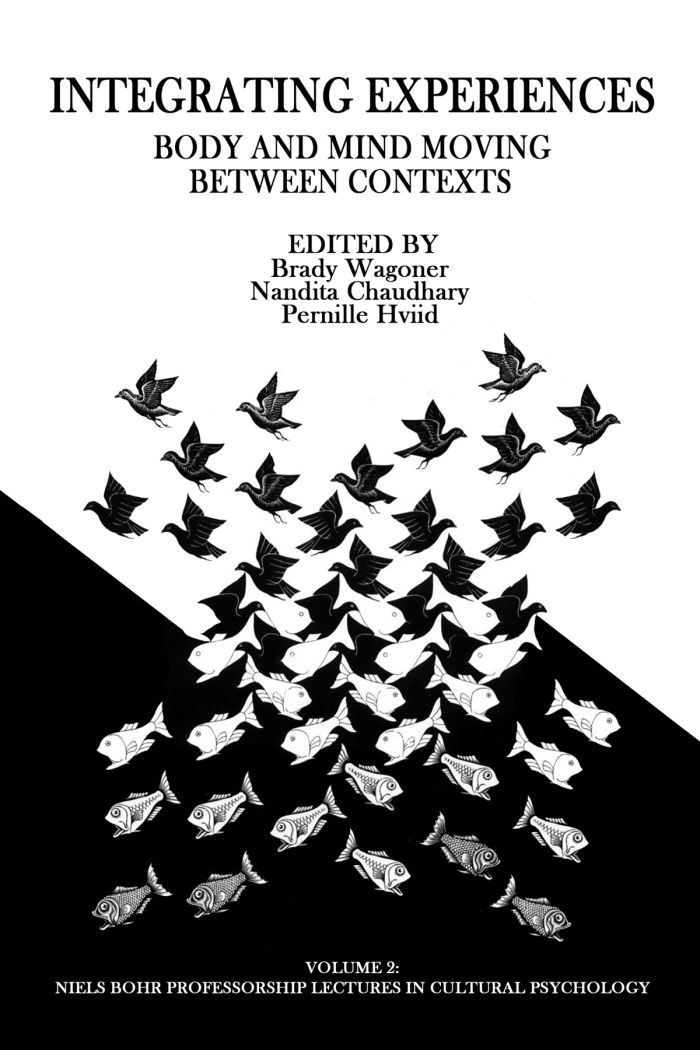
Integrating Experiences
Body and Mind Moving Between Contexts

This book can be opened with

Note on our eBooks and Audiobooks: you can read our eBooks (ePUB or PDF) and listen to audiobooks on the free Emerald Books app on iOS, Android, and desktop. Or read and listen on Emerald's online reader (ePUB eBooks and audiobooks only). To purchase a digital book you will need to create an account if you don’t already have one. After purchasing you will receive instructions on how to get started.
- Description
- Contents
Cultural Psychology studies how persons and social-cultural worlds mutually constitute one another. It is premised on the idea that culture is within us—in every moment in which we live our human lives, in the meaningful worlds we have created ourselves. In this perspective, encounters with others fundamentally transform the way we understand ourselves. With the increase of globalization and multicultural exchanges, cultural psychology becomes the psychological science for the 21st century. No longer can we ignore questions about how our cultural traditions, practices, beliefs, artifacts and other people constitute how we approach, understand, imagine and remember the world. The Niels Bohr Professorship Lectures in Cultural Psychology series aims to highlight and develop new ideas that advance our understanding of these issues.
This second volume in the series features an address by Tania Zittoun and Alex Gillespie, which is followed by commentary chapters and their response to them. In their lecture, Zittoun and Gillespie propose a model of the relation between mind and society, specifically the way in which individuals develop and gain agency through society. They theorise and demonstrate a two-way interaction: bodies moving through society accumulate differentiated experiences, which become integrated at the level of mind, enabling psychological movement between experiences, which in turn mediates how people move through society. The model is illustrated with a longitudinal analysis of diaries written by a woman leading up to and through the Second World War. Commentators further elaborate on the issues of (1) context and history, (2) experience, time and movement, and (3) methodologies for cultural psychology.
Editors' Introduction: Cultural Psychology on the Move, Brady Wagoner, Nandita Chaudhary, and Pernille Hviid.
- Part I: The Niels Bohr Professorship Lecture.
- Chapter 1. Integrating Experiences: Body and Mind Moving Between Contexts, Tania Zittoun and Alex Gillespie.
- Part II: Thinking Through Context and History.
- Chapter 2. On Context, Ivana Marková.
- Chapter 3. A Strange Homecomer: Integrating Experiences in Alfred Schütz's Socio-Phenomenological Key, David Carré.
- Chapter 4. Between History and Psychology: Steps Towards Interdisciplinarity, Jacob A. Belzen.
- Chapter 5. The Realness of History: Ambivalence, Social Norms, and the Continuous Movement of Society, Aurora Pfefferkorn and Emily Abbey.
- Part III: Experience, Time, and Movement.
- Chapter 6. Experiences Which Integrate and Which are Integrated: Proust's Art of Life and van Gennep's Rites of Passage as Scenes for Integrating Experiences à la Zittoun and Gillespie, Paul Stenner.
- Chapter 7. Experience as the Effort After Articulation, Antonia Larrain.
- Chapter 8. Time in and for Development: Mind on the Move Between Multiple and Interdependent Temporal Experiences, Mariann Märtsin .
- Chapter 9. Poetic Instants in Daily Life: Towards the Inclusion of Vertical Time in Cultural Psychology, Olga V. Lehmann.
- Chapter 10. Moving as Conducting Everyday Life: Experiencing and Imagining for Teleogenetic Collaboration, Niklas A. Chimirri.
- Part IV: Methodology in the Making.
- Chapter 11. The Diary as a Dialogical Space, Michèle Grossen.
- Chapter 12. Positioning Ourselves Within Practices and Within the Human Condition, Jack Martin.
- Chapter 13. Generalization is Possible Only From a Single Case (and From a Single Instance): The Value of a Personal Diary, Jaan Valsiner.
- Chapter 14. "I Am Not THAT KIND OF...": Personal Relating With Social Borders, Jensine Ingerslev Nedergaard, Jaan Valsiner, and Giuseppina Marsico.
- Chapter 15. Body, Mind, and Movement: Some Proposals for Constructing a Socially Inclusive Psychology Based on Developmental and Cultural Principles, Tastuya Sato, Hideaki Kasuga, Mami Kanzaki and Brady Wagoner.
- Part V: Reply.
- Chapter 16. Social and Psychological Movement: Weaving Individual Experience Into Society, Alex Gillespie and Tania Zittoun.