
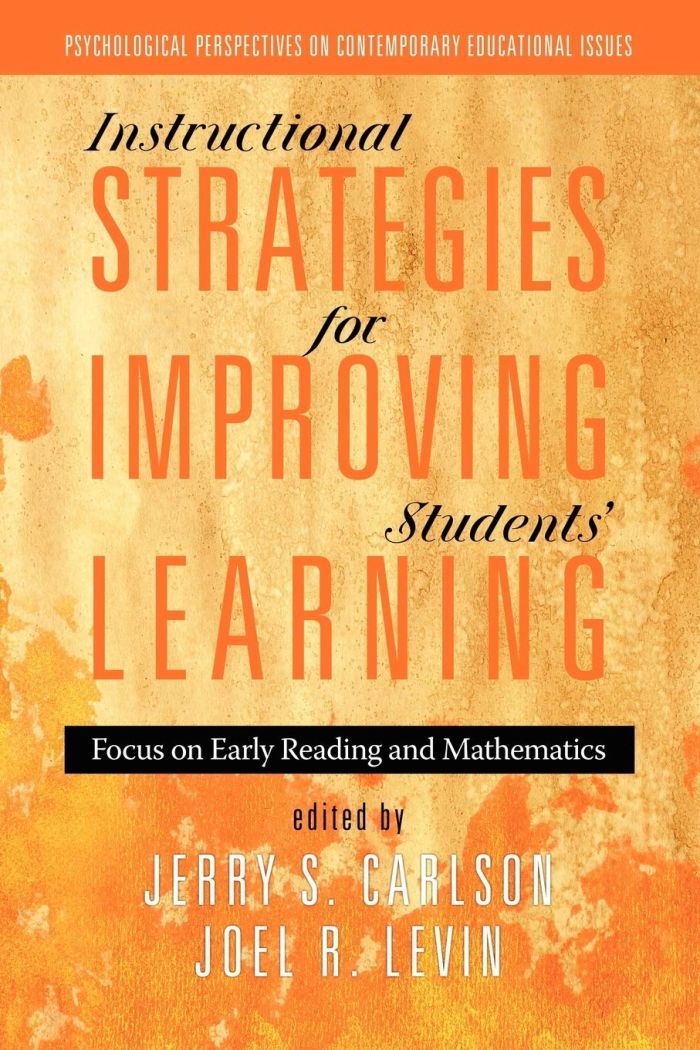
Instructional Strategies for Improving Students' Learning
Focus on Early Reading and Mathematics

This book can be opened with

Note on our eBooks and Audiobooks: you can read our eBooks (ePUB or PDF) and listen to audiobooks on the free Emerald Books app on iOS, Android, and desktop. Or read and listen on Emerald's online reader (ePUB eBooks and audiobooks only). To purchase a digital book you will need to create an account if you don’t already have one. After purchasing you will receive instructions on how to get started.
- Description
- Contents
The twin objectives of the series Psychological Perspectives on Contemporary Educational Issues are: (1) to identify issues in education that are relevant to professional educators and researchers; and (2) to address those issues from research and theory in educational psychology, psychology, and related disciplines.
The present volume, consisting of two focal chapters, commentaries, and final responses targets instructional strategies for improving students’ learning in two of the traditional “three R” areas, reading and 'rithmetic (mathematics), in the elementary school grades. The focal chapters in those two skill areas are written by leading contributors to the reading and mathematics research literatures, Cathy Collins Block for the reading section and Douglas Clements and Julie Sarama for the mathematics section. Few would dispute the essentiality of these two curricular domains in laying the foundation for the development of students’ competencies in a vast array of academic disciplines in both the in- and out-of-school years that lie ahead.
The present volume is intended for practitioners and researchers who are seeking the latest instructional research-based strategies for improving students’ early reading and mathematics performance.
Editors' Introduction.
- Section I. Reading Instructional Strategies.
- Chapter 1. Proven and Promising Reading Instruction: What We Know and What Works; Cathy Collins Block.
- Chapter 2. Proven and Promising: The Eye of the Beholder? Rollanda Estby O'Connor.
- Chapter 3. Reflections on What's Proven and Where the Promise Lies; Margaret G. McKeown.
- Chapter 4. Good Intentions and Unexpected Consequences: The Case of Reading Fluency; James F. Baumann.
- Chapter 5. Understanding Reading Research from Different Sociocultural Historical Contexts; Virginia W. Berninger.
- Chapter 6. From Proven and Promising Reading Instruction to Paving New Paths: Widening Highways, Crossing Borders, and Repairing Potholes; Cathy Collins Block.
- Section II. Mathematics Instructional Strategies.
- Chapter 7. Learning and Teaching Early and Elementary Mathematics; Douglas H. Clements and Julie Sarama.
- Chapter 8. Comments on Learning and Teaching Early and Elementary Mathematics; Arthur J. Baroody, David J. Purpura, and Erin E. Reid.
- Chapter 9. The Common Core Mathematics Standards as Supports for Learning and Teaching Early and Elementary Mathematics; Karen C. Fuson.
- Chapter 10. You Can't Play 20 Questions with Mathematics Teaching and Learning, and Win; James W. Stigler and Belinda J. Thompson.
- Chapter 11. Learning Trajectories Through a Sociocultural Lens; Anita A. Wager and Thomas P. Carpenter.
- Chapter 12. Walking the Same Broad Path (with Side Trips): Response to Comments; Julie Sarama and Douglas H. Clements.
- About the Editors.