

Institutional Interconnections and Cross-Boundary Cooperation in Inclusive Business
Case Studies from India and Africa

This book can be opened with

Note on our eBooks and Audiobooks: you can read our eBooks (ePUB or PDF) and listen to audiobooks on the free Emerald Books app on iOS, Android, and desktop. Or read and listen on Emerald's online reader (ePUB eBooks and audiobooks only). To purchase a digital book you will need to create an account if you don’t already have one. After purchasing you will receive instructions on how to get started.
- Description
- Contents
- About
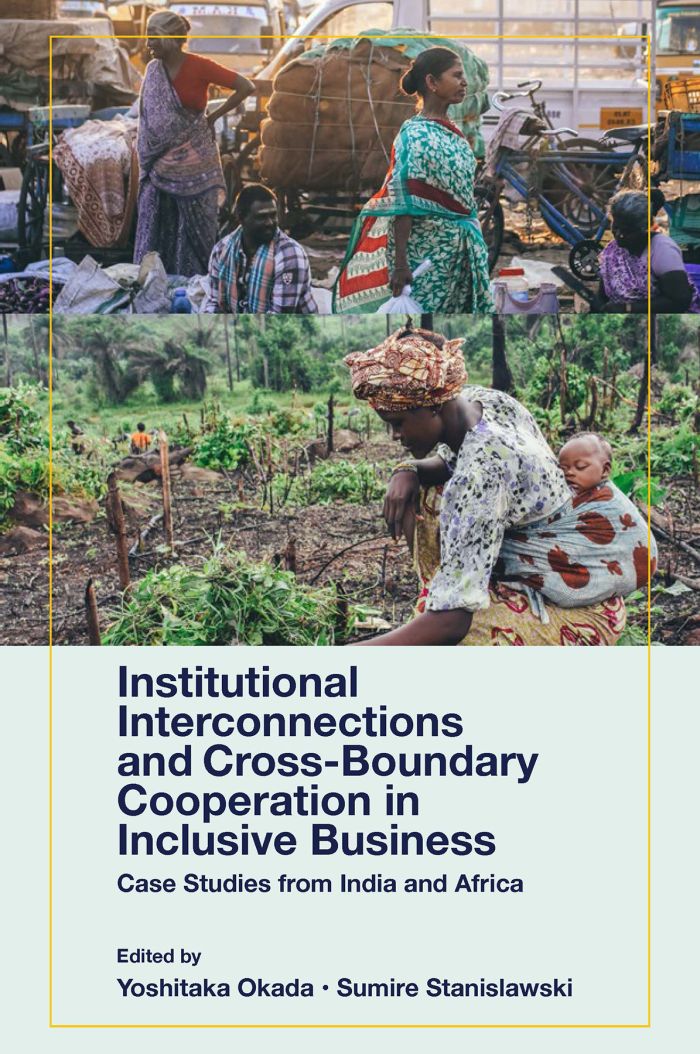
The success or failure of inclusive business often depends on institutional interconnections. By examining case studies of inclusive business projects in India and several African nations, Institutional Interconnections and Cross-Boundary Cooperation in Inclusive Business asks how these connections can be developed to help alleviate poverty through business activities in developing countries.
Conceptual orientations of what inclusion means can act to restrict the value orientation of an inclusive business project and its management practices. A significant approach of this book is an understanding that the economically disadvantaged have their own institutions to which they credibly commit, and that they are important, valuable, and dignified stakeholders or partners in an inclusive business project. By giving more weight to these institutions, it is possible to understand that some local companies may engage in inclusive practices by involving these actors as part of their regular business activities.
Using concepts of mainstream, marginalized, and hybrid inclusion, this book explores the nature and characteristics of institutional interconnections in inclusive business in a study that will appeal to researchers and practitioners of strategy, international business, and corporate social responsibility.
Chapter 1. Introduction; Yoshitaka Okada and Sumire Stanislawski
- Chapter 2. Institutional Interconnections and Cross-Boundary Cooperation in Inclusive Business: Analytical Framework; Yoshitaka Okada, Sumire Stanislawski, and Samuel Amponsah
- Chapter 3. Dynamics of a Synchronized Business Model for Inclusive Business; Yoshitaka Okada
- Chapter 4. Delegated Business Model for Stimulating Self-Initiating Behavior of the Rural Poor in Tanzania; Yoshitaka Okada
- Chapter 5. Pivoting to Adapt for Inclusive Business Sustainability in India; Sumire Stanislawski
- Chapter 6. Scaling Compassion, Blurring Boundaries: Partners and Cooperation in Aravind Eye Care System; Bhaskar Chakrabarti
- Chapter 7. Aligning Partner Interests: Challenges in Delivering Potable Water in India Through an Inclusive Business Model—Waterlife India Pvt. Ltd; Partha Sarathi Roy and Shekhar Chaudhuri
- Chapter 8. Local Agro-Processing and Inclusive Business by Ghana Nuts Company and Homefoods Processing and Cannery; Samuel Amponsah
- Chapter 9. Discussion and Conclusion; Yoshitaka Okada, Sumire Stanislawski, and Samuel Amponsah
Yoshitaka Okada is Professor of Sociology and Business at Institute for International Strategy, Tokyo International University and Professor Emeritus at Sophia University, Japan, with a Ph.D. (Economic Sociology, 1981) from the University of Wisconsin-Madison, USA.
Sumire Stanislawski is Associate Professor of Marketing at the Institute for International Strategy at Tokyo International University, Japan. Her primary research interest is in sustainability of consumption and marketing.