
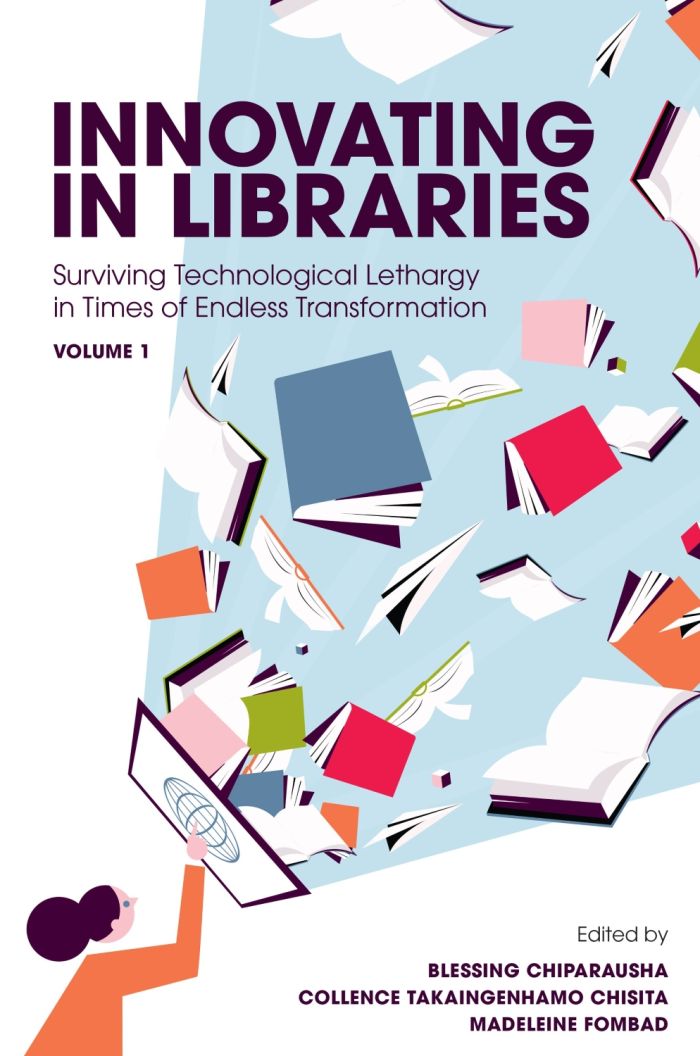
Innovating in Libraries, Volume 1
Surviving Technological Lethargy in Times of Endless Transformation

This book can be opened with

Note on our eBooks and Audiobooks: you can read our eBooks (ePUB or PDF) and listen to audiobooks on the free Emerald Books app on iOS, Android, and desktop. Or read and listen on Emerald's online reader (ePUB eBooks and audiobooks only). To purchase a digital book you will need to create an account if you don’t already have one. After purchasing you will receive instructions on how to get started.
- Description
- Contents
- Reviews
- About
The world is evolving at an unprecedented pace, driven by the transformative forces of the Integrated Industrial revolution (4th-5th Industrial Revolutions)—a new era where data, connectivity, and human-machine interaction define progress. For libraries, this revolution presents both challenges and opportunities, demanding innovation in services, technologies, and strategies.
Both Volume 1 and 2 of Innovating in Libraries explore how academic libraries can harness emerging technologies, integrate Human-Tech synergistic and reciprocal solutions, and support the Sustainable Development Goals (SDGs), with a focus on education, industry innovation, and reducing inequality. Contributions from leading experts and practitioners—many drawn from across the globe and selections from the Zimbabwe University Library Consortium’s 5th Biennial International Conference—offer global insights into spatial design for digital libraries, platform capitalism, open science, ethics, change management, and more.
With an international perspective and forward-thinking approach, Innovating in Libraries is essential for library professionals, educators, and policymakers navigating the future of information access in an era of rapid change.
Introduction; Blessing Chiparausha, Madeleine Fombad, and Collence Takaingenhamo Chisita
- Chapter 1. Disruptive Technologies and Digital Transformation in Kenya’s Academic Libraries; Tom Kwanya
- Chapter 2. Customisation and Upgrading of KOHA Integrated Library System at Kyambogo University: A Librarian's Approach; Edward Mukiibi, Mary Acanit, Lincoln Samuel Wamala, and Wangwe Isimail Gutaka
- Chapter 3. Factors Affecting the Adoption of Chatbots to Answer Users’ Queries in Academic Libraries: A Global Review of Literature; Bolaji David Oladokun and Panorea Gaitanou
- Chapter 4. Artificial Intelligence and Global Trends in Academic Libraries: Lessons and Implications for South African Universities; Grace Mutsvunguma and Madeleine Fombad
- Chapter 5. The Role of Generative Artificial Intelligence (GenAI) in Enhancing Education and Learning Outcomes; Rosemary Maturure and Braiton U. Mukhalela
- Chapter 6. Echo Chambers in the Classroom: Social Media and the Formation of Academic Echo Chambers; Alice A. Bamigbola and Christianah O. Onifade
- Chapter 7. Acceptance and Use of Artificial Intelligence Among Academic Librarians in Zambia and Zimbabwe; Blessing Chiparausha and Dalitso Mvula
- Chapter 8. Space Repurposing For Improved Learning Experiences in Zimbabwean University Libraries; Stephen Tsekea
- Chapter 9. Cultivating Sustainable Community and Research Partnerships in the Shifting Stands of Technical Progress: Strategies for Long-term Engagement and Collaboration; Adeyinka Tella and Petros Nhlavu Dlamini
- Chapter 10. Future of Libraries: Skills and Competences essential for Sustainability of Library and Information Science Profession in Nigeria; Oluwatosin Daniel Akobe, Sylvester I. Ebhonu, Amina Badaru Lukman, and Kareem Abdulraheem Onivehu
- Chapter 11. Systematic Review of Computer Vision Syndrome (CVS) in Librarians: Digital Age Occupational Health Implications; Edmont Pasipamire
- Chapter 12. Harnessing Quantum Cloud Computing for Big Data Management in Libraries: Opportunities and Threats; Bolaji David Oladokun, Rexwhite Tega Enakrire, Kingsley N. Igwe, and Yusuf Ayodeji Ajani
- Conclusion; Blessing Chiparausha, Madeleine Fombad, and Collence Takaingenhamo Chisita
The global librarianship community will benefit from the topics covered in the book. It addresses general society, covering issues linked with social dynamic, and topics studied meaningfully provide theoretical and practical elements. Touching on trending issues around the world for which solutions are required, chapters provide several methods measuring the quantitative impact along with the qualitative.
Blessing Chiparausha is the Library Director at Bindura University of Science Education, Zimbabwe.
Collence Takaingenhamo Chisita is Senior Lecturer in the Department of Information Systems at the Durban University of Technology (DUT), South Africa.
Madeleine Fombad is a Professor in the Department of Information Science at The University of South Africa (UNISA).