
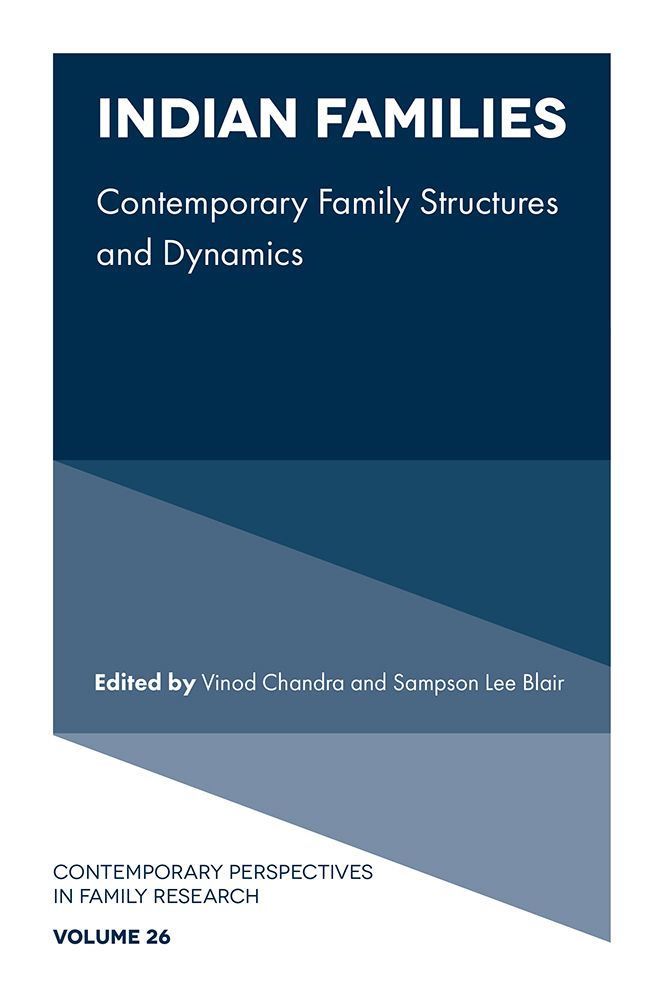

Indian Families
Contemporary Family Structures and Dynamics

This book can be opened with

Note on our eBooks and Audiobooks: you can read our eBooks (ePUB or PDF) and listen to audiobooks on the free Emerald Books app on iOS, Android, and desktop. Or read and listen on Emerald's online reader (ePUB eBooks and audiobooks only). To purchase a digital book you will need to create an account if you don’t already have one. After purchasing you will receive instructions on how to get started.
- Description
- Contents
- About
India has an intricate cultural history that extends over thousands of years. Over the past century, however, increasing modernization, along with its associated demographic shifts, has led to substantial changes in its family structures and norms. Coupled with tremendous variations across regions, ethnic groups, and religions, Indian families are complex, unique, and ever adapting.
Establishing a more thorough understanding of these changes and complexities, this volume of Contemporary Perspectives in Family Research stretches across disciplines to feature a wide array of topics, including changing forms of dating and mate selection, divorce and remarriage, cohabitation, rural-urban variations in family structures, fertility aspirations, spousal relationships and marital quality, domestic violence, filial piety, inter-generational relations, and parent-child relationships.
Demonstrating the tremendous diversity of families in India, as well as their ongoing evolution, Indian Families answers a clear call to dive deeper into the intimacy of the domestic sphere in one of the world’s largest and fastest growing societies.
Chapter 1. No Preference? An Examination of Child Sex Preferences in Rural South India; Ashley Larsen Gibby, Tiffany Fox Okeke, Nancy Luke, Melissa Alcaraz, and Mikaela Dufur
- Chapter 2. Fertility Aspirations and Family Planning Behaviour: A Qualitative Study in a Small Town of Uttar Pradesh; Shivani Katara
- Chapter 3. Exploring the Transitions in Family Structure of Vaddera Community through a Deconstructive Lens; Sonal Mobar Roy and G. V. Snigdha Raj
- Chapter 4. Changing Landscape of Indian Family; Vinod Chandra
- Chapter 5. Menstrual Hygienic Disparity in India: An Inter-State Analysis Using NFHS-5 Indicators; Megha Jacob and Japjot Kaur Saggu
- Chapter 6. Family Dynamics and Intergenerational Relation in Interdependent Society: An Indian Perspective; Sunil K. Verma, Saswati Bhattacharya, and Tushar Singh
- Chapter 7. Intermediating Individual and the Community: Indian Family in Online Matchmaking; Y. Gunjan Ramraj
- Chapter 8. Premarital Romance, Dating, and Arranged Marriages in India: The Intersection of Tradition and Globalization; Barani Kanth, Ananda Krishnan, and Debasmita Sen
- Chapter 9. My Family: Classroom Exercises on Unlearning and Learning about Families; B. Devi Prasad and Shivangi Deshwal
- Chapter 10. Towards a Sociology of "New Family" in India; Jyoti Sidana
Vinod Chandra is Principal and Professor of Sociology in the Shri Jai Narain Misra PG College, India. Dr Chandra is an established childhood and youth researcher with a long-standing specialization in the study of youth transitions, child labour, child abuse, and neglect. He has a strong interest in the study of children’s experience of education, work, labour, and leisure.
Sampson Lee Blair is a Family Sociologist and Demographer at The State University of New York, Buffalo, USA. His research interests include parent-child relationships, mate selection, marriage, and fertility.