
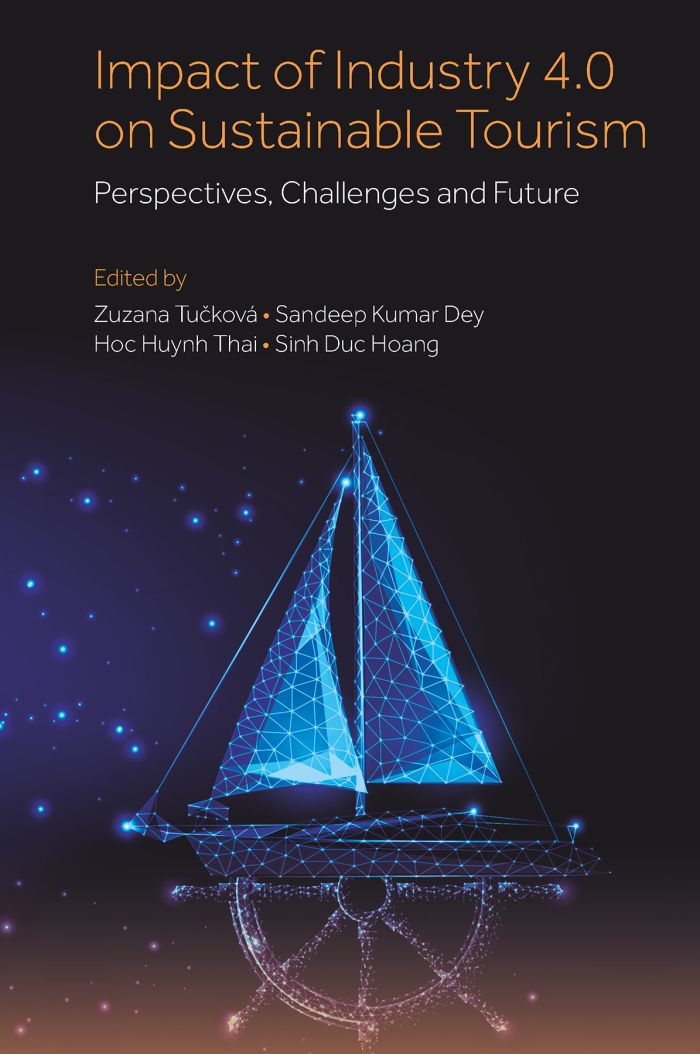

Impact of Industry 4.0 on Sustainable Tourism
Perspectives, Challenges and Future

This book can be opened with

Note on our eBooks and Audiobooks: you can read our eBooks (ePUB or PDF) and listen to audiobooks on the free Emerald Books app on iOS, Android, and desktop. Or read and listen on Emerald's online reader (ePUB eBooks and audiobooks only). To purchase a digital book you will need to create an account if you don’t already have one. After purchasing you will receive instructions on how to get started.
- Description
- Contents
- About
The tourism and hospitality industry is at the forefront of the climate crisis as a significant source of carbon emissions on a global scale. There is a need to disseminate opportunities and explore scientific avenues in emerging technologies associated with industry 4.0 , such as artificial intelligence, virtual and augmented reality, ‘extended reality’ or the use of service robots, and forecasting future trends in the tourism industry’s fight against the climate crisis.
Translating these current and future problems into pragmatic solutions, the chapter authors explore the opportunities for both academia and industry in agile and disruptive technologies. By integrating unique features of these advancements like Extended Reality (XR), Machine Intelligence (MI) and Computer Vision (CV), Impact of Industry 4.0 on Sustainable Tourism determines the trajectory of sustainable tourism development.
Of interest to both academics and practitioners, Impact of Industry 4.0 on Sustainable Tourism reveals patterns and projections to provide a discourse on the progression of disruptive and futuristic technologies in the field of sustainable tourism research and practice.
Chapter 1. Do Travel Vloggers' Credibility Influence Tourists' Visit Intention to Eco-Tourism Destination? Evidence from Bangladesh; Md. Tariqul Islam, Siti Rahayu Hussin, Wong Foong Yee, and Uma Pandey
- Chapter 2. The Effect of Tourism and Technological Contribution on Economic Growth – The Case of Vietnam and Other East Asian Members; Van Chien Nguyen
- Chapter 3. Applications of Artificial Intelligence (AI) in the Tourism Industry: A Futuristic Perspective; Deepthi. B and Vikram Bansal
- Chapter 4. Sustainable Management with Big Data: A Systematic Review on Tourism; Meral Calis Duman and Hulisi Binbasioglu
- Chapter 5. Virtual Tourism as an Alternative to Sustainable Tourism; Nguyen Thi Van Hanh and Tran Tuyen
- Chapter 6. Application of Augmented Reality (AR) and Virtual Reality (VR) in Promoting Guest Room Sales: A Critical Review; Amjad Imam Ansari and Amrik Singh
- Chapter 7. The Exploration of the Metaverse by Destination Management Organisations towards Sustainability; Marco Martins, Ricardo Guerra, Lara Santos, and Luísa Lopes
- Chapter 8. Shaping and Reshaping of Tourism; The Influence of IR 4.0 for Modifying the Tourist Behavior; Harish P and Toney K Thomas
- Chapter 9. Rise of Big Data in the Industry 4.0 Era and the Crucial Need for Data Science in Sustainable Tourism; Sahil Sharma
Zuzana Tučková is an Associate Professor at the Faculty of Management and Economics and Dean at the Faculty of Logistics and Crisis Management, Tomas Bata University in Zlin, Czech Republic.
Sandeep Kumar Dey is a Researcher at the Faculty of Management and Economics at Tomas Bata University in Zlin, Czech Republic.
Hoc Huynh Thai is a PhD scholar at Tomas Bata University in Zlin, Czech Republic and a Lecturer at the Faculty of Information Technology, School of Technology, Van Lang University, Ho Chi Minh City, Vietnam.
Sinh Duc Hoang is a PhD Graduate from the Faculty of Management and Economics, Tomas Bata University in Zlin, Czech Republic and a Lecturer at the Department of Economics – Finance, Ho Chi Minh City University of Foreign Languages - Information Technology, Vietnam.