
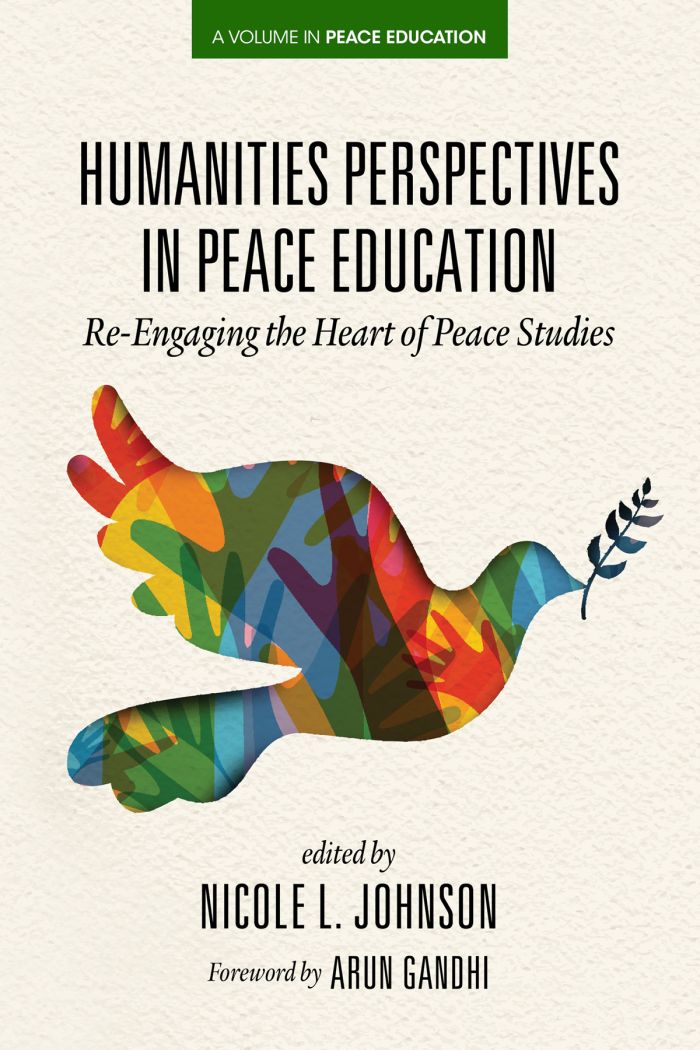
Humanities Perspectives in Peace Education
Re-Engaging the Heart of Peace Studies

This book can be opened with

Note on our eBooks and Audiobooks: you can read our eBooks (ePUB or PDF) and listen to audiobooks on the free Emerald Books app on iOS, Android, and desktop. Or read and listen on Emerald's online reader (ePUB eBooks and audiobooks only). To purchase a digital book you will need to create an account if you don’t already have one. After purchasing you will receive instructions on how to get started.
- Description
- Contents
In Humanities Perspectives in Peace Education: Re-Engaging the Heart of Peace Studies, scholar-teachers across a variety of humanities fields explore the content, methods, and pedagogies that are unique to their respective disciplines in contributing to the study of peace and justice. In recent decades, even as peace scholarship has burgeoned, many peace studies texts, including those that purport to be interdisciplinary in nature, have emphasized social science perspectives and, in some cases, have foregone exploration of the role of the humanities altogether in comprehensive peace education. While humanities scholars continue to stake out space for peace scholarship within their fields, no volume has attempted to collect the wisdom of multiple humanities disciplines in order to make the case for their critical role in authentic peace education. Humanities Perspectives in Peace Education addresses that shortcoming in the field of peace studies by exploring the ways in which the humanities are uniquely situated to contribute particular content, knowledge, skills, and values required of comprehensive peace education, scholarship, and activism. These include the development of empathy and understanding, creative vision and imagination, personal and communal transformation toward 'the good' in society (such as the pursuit of justice, nonviolence, freedom, and human thriving), and field-specific analytical lenses of their own, among other contributions.
Both teachers and students of peace will find value in this interdisciplinary humanities volume. Each chapter of Humanities Perspectives in Peace Education offers a deep-dive into a particular humanities field-including philosophy, literature, language and culture studies, rhetoric, religion, history, and music-to mine the field’s unique contributions to peace and justice studies. Scholars ask: 'What are we missing in peace education if we fail to include this academic discipline?' Chapters include suggestions for peace pedagogies within the humanities field as well as bibliographies and suggestions for further reading.
Foreword; Arun Gandhi.
- Acknowledgments.
- Introduction: Peace Education and the Humanities; Nicole L. Johnson.
- Chapter 1. Philosophy in the Pursuit of Peace; G. Scott Gravlee.
- Chapter 2. You Can't Really Change the Heart Without Telling a Story: Poetry as Peacebuilding; G. Michelle Collins-Sibley.
- Chapter 3. Promoting Peace in Cultural and Language Studies; Rebecca L. Oxford, María Matilde Olivero, and Tammy Gregersen.
- Chapter 4. Rhetoric and Peace Studies; Jamie Capuzza and Sean Patrick O'Rourke.
- Chapter 5. The Study of Religion in Comprehensive Education for Peace: On Learning to Make Room for Difference; Nicole L. Johnson.
- Chapter 6. The Past's Presents for a Just and Peaceful Future; Theresa M. Davis.
- Chapter 7. A Choir Is a Beautiful Thing: Peacebuilding and Reconciliation through the Cultivation of Beauty; Grant W. Cook, III.
- About the Contributors.