
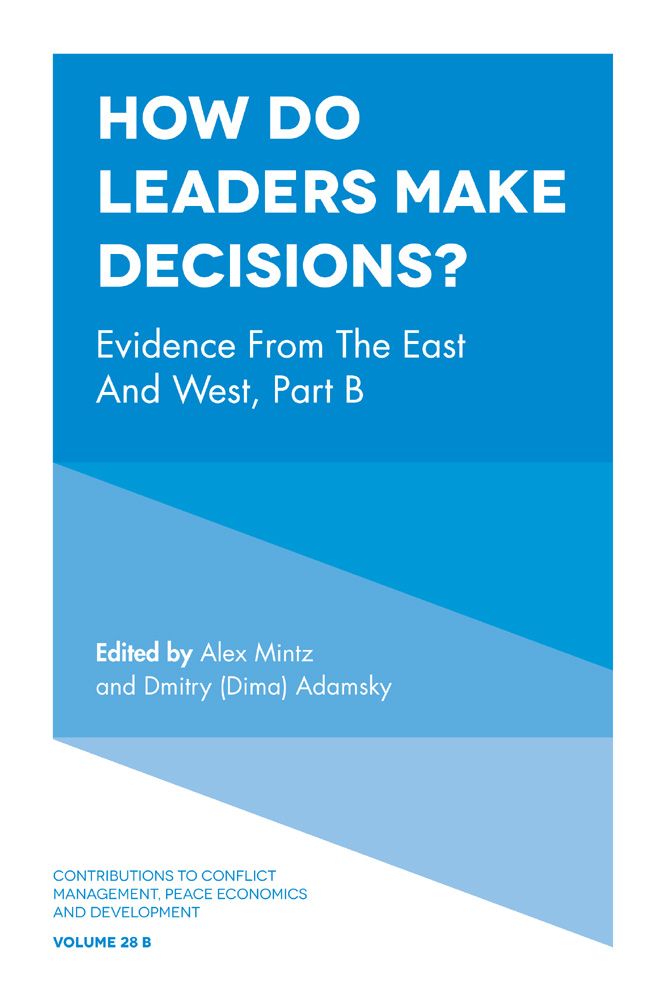


How Do Leaders Make Decisions?
Evidence from the East and West, Part B

This book can be opened with

Note on our eBooks and Audiobooks: you can read our eBooks (ePUB or PDF) and listen to audiobooks on the free Emerald Books app on iOS, Android, and desktop. Or read and listen on Emerald's online reader (ePUB eBooks and audiobooks only). To purchase a digital book you will need to create an account if you don’t already have one. After purchasing you will receive instructions on how to get started.
- Description
- Contents
- About
How Do Leaders Make Decisions?: Evidence from the East and West, Part B, the second in a two-part volume covering a total of ten world leaders, fills this gap by using the Applied Decision Analysis (ADA) method to explore how figures such as Putin, Erdogan, Khaled Mashal, Mao, and Saddam Hussein make or made major decisions of international significance. By analysing the decisions made by key political figures around the world, past and present, the chapters gathered here shed light on how they are reached and what policy implications they have for their own and other nations. The analyses are based on traditional and contemporary theories of foreign policy decision making, including, but not limited to, the rational actor model, the cybernetic theory of decision, poliheuristic theory, and various decision rules, including the elimination-by-aspect rule and the lexicographic decision rule. Cumulatively, what these chapters uncover is that foreign and national security policies can be best explained by tracing the cognitive process leaders go through in formulating and arriving at their decisions.
For its groundbreakingly rigorous methodology and its unprecedented scope, this book and its companion book are essential reading for students, scholars, and policymakers alike.Introduction How Do Leaders Make Decisions? Evidence from the East; Alex Mintz and Eldad Tal-Shir Analyses Chapter 1. The Decision Calculus of Putin; Hadar Glottman Chapter 2. The Decision Calculus of Erdogan: A Poliheuristic Perspective; Shir Simchayoff Chapter 3. The Decision Calculus of Khaled Mashal; Leehe Friedman, Yair Samban, John Tyson Chatagnier, and Alex Mintz Chapter 4. The Decision Calculus of Mao; Shimon Keselman Chapter 5. Saddam Hussein's Decision Calculus; Eli Mograbi Conclusions Conclusion; Dmitry Adamsky